Surface quality is one of the most critical characteristics in manufacturing. Whether it is a machined metal part, a molded plastic component, a medical implant, or an automotive panel, the smoothness and roughness of the surface directly influence performance, durability, aesthetics, and customer satisfaction.
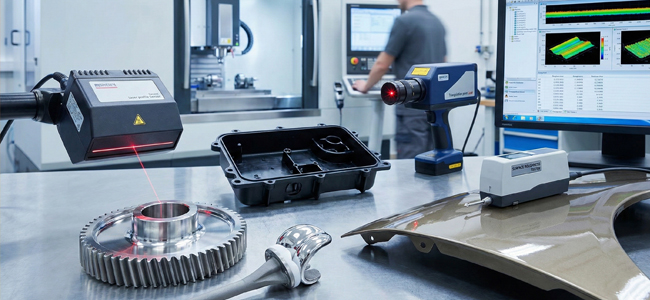
This article provides a comprehensive understanding of surface smoothness and roughness measurement, how it works, why it matters, and the technologies—especially laser profile sensors and triangulation point lasers—used in modern automated inspection systems.
What Is Surface Roughness and Surface Smoothness?
Surface roughness refers to the small-scale irregularities or deviations on a surface. These may include peaks, valleys, waviness, scratches, and micro-defects caused by machining, forming, coating, polishing, or material properties.
Surface smoothness is the opposite—how flat, even, and uniform the surface appears at the microscopic level.
The primary causes of surface irregularities:
- Machining tool wear
- Casting or molding defects
- Improper polishing or finishing
- Inconsistent coating or painting
- Wear and tear over time
- Forming and extrusion inconsistencies
Why These Parameters Matter:
- Functional surfaces may leak or fail if rough
- Optical components require extremely smooth surfaces
- Medical implants need smoothness for patient safety
- Coatings adhere better to consistent surfaces
- Consumer products demand high aesthetic quality
Common Parameters Used to Describe Surface Roughness
International surface metrology uses several parameters to describe surface texture. The most common are:
Ra (Roughness Average)
The average deviation from the mean line. Widely used in most industries.
Rz (Average Maximum Height)
Measures the height difference between the highest peak and the lowest valley across a sampling length.
Rq (Root Mean Square Roughness)
Similar to Ra but more sensitive to larger deviations.
Rt (Total Roughness Height)
The maximum peak-to-valley height across the entire surface profile.
Wa, Wq (Waviness Parameters)
Used when lower-frequency surface variations (like slopes or waves) need monitoring.
Traditional vs. Modern Methods of Surface Roughness Measurement
Traditional Contact Methods: Stylus Profilometers
A physical stylus drags across the surface to measure height variations.
Pros:
- Very accurate
- Widely used in metrology labs
Cons:
- Slow
- Not suitable for moving surfaces
- Cannot be used on soft or delicate surfaces
- Contact can damage the product
- Not ideal for inline automation
Modern Non-Contact Methods for Industrial Automation
Industries today require contactless, fast, and repeatable measurements. This has led to the rise of optical and laser-based methods:
(1) Laser Profile Sensors (2D/3D Profiling)
Laser profile sensors project a laser line onto the surface. A camera captures the deformation of that line to reconstruct a 2D or 3D height map.
Capabilities:
- High-resolution 3D surface profiling
- Measurement of Ra, Rq, Rz, and more
- Detection of dents, bumps, waviness, micro-defects
- Visualization of surface topography
(2) Typical applications:
- Machined parts
- Automotive panels
- Medical devices
- Precision components
- Extruded and rolled products
(2) 3D Cameras / Structured Light Sensors
These use patterned light (grid or stripe) and capture depth via triangulation or time-of-flight.
Best for:
- Large-area scans
- Medium precision applications
- Surface height maps, not just roughness
(3) Triangulation Point Laser Sensors (Cost-Effective, Point-Based
Point laser triangulation sensors project a single spot on the surface. Based on the angle of reflected light, the sensor calculates the height of that point with high precision.
To measure a surface:
- Inspect one point
- Move or index to another
- Build a multi-point roughness profile
This is ideal when:
- The surface is wide or long
- Full 3D coverage is too expensive
- Only specific critical zones need measurement
- Budget or space limitations apply
Industries using point-laser roughness measurement:
- Large metal sheets and plates
- Aluminum profiles
- Steel coils
- Cabinets, panels, doors
- Long automotive components
- Aerospace parts
How Triangulation and Laser Profiling Work
The Principle of Triangulation
Triangulation is based on geometry.
A laser projects light on the surface → A sensor receives the reflected light → The angle of reflection gives the height.
More angle shift → Higher deviation → Rougher surface
Laser profile sensors simply extend this principle from a single point to a full line, creating a complete 2D/3D map.
Measuring Surface Smoothness in Manufacturing Lines
Automated inspection systems perform roughness measurement in real time:
Step 1: Part Positioning
- On a conveyor (inline)
- On a fixture (stationary)
- On a robotic motion system
Step 2: Laser Emission & Image Capture
- Profile sensor emits a laser line
- Triangulation sensor emits a point
- Camera captures height variations
Step 3: Surface Data Processing
Intelgic’s Live Vision AI software computes:
- Roughness values
- Height deviations
- Peaks and valleys
- Waviness
- Statistical summaries
Step 4: Thresholding & Decisions
If any measurement exceeds limits:
- The system marks the defective zone
- Triggers a Pass/Fail output
- Sends alerts to operators or PLC
Step 5: Reporting & Traceability
- Full surface maps (for 3D sensors)
- Point-wise height measurement logs
- CSV/PDF reports
- Batch-level analytics
Why Large Surfaces Need a Different Approach
3D cameras and laser profile sensors are powerful but can be:
Challenges with Large Surface Measurement
- Expensive for wide areas
- Sensitive to vibration
- Challenging to mount and align
- Heavy on computation
- Limited in field-of-view per frame
Common Large Surface Applications
- Steel billets
- Aluminum extrusions
- Pipes, slabs
- Doors, cabinets, panels
A full 3D inspection system may not be practical for these applications. Point-based triangulation gives a cost-effective alternative while still providing actionable quality data.
Choosing Between a 3D Profile Sensor and a Triangulation Point Sensor
| Feature | 3D Profile Sensor | Triangulation Point Sensor |
|---|---|---|
| Coverage | Full area | Selected points |
| Cost | High | Low |
| Precision | Very high | High |
| Setup complexity | Higher | Simple |
| Ideal for | Small/medium parts | Large surfaces |
| Data density | Dense | Sparse but sufficient |
| Best use-case | Detailed surface topography | Quick roughness checks |
Importance of Surface Smoothness in Different Industries
Automotive
Surface waviness affects NVH (Noise, Vibration, Harshness), sealing, and appearance.
Metal & Steel
Rough surfaces can cause friction, wear, and coating failures.
Medical Devices
Implants require exceptionally smooth surfaces for biocompatibility.
Aerospace
Surface defects can lead to aerodynamic drag and safety issues.
Consumer Goods & Furniture
Surface texture influences aesthetics and customer perception.
Future of Surface Roughness Measurement
Advancements in:
AI-based surface classification
High-speed laser triangulation
Compact 3D laser sensors
Cloud-based quality analytics
Multi-line triangulation arrays
...are enabling even more powerful and affordable surface inspection systems.
Soon, factories will be able to measure smoothness at every stage of production, automatically adjusting processes to maintain perfection.
Surface smoothness and roughness measurement is essential for ensuring product quality, performance and customer trust. Modern laser-based technologies—especially laser profile sensors and triangulation point lasers—have made it possible to automate this process with high accuracy, speed and repeatability.
By choosing the right measurement method for your product size, line speed, and tolerance requirements, manufacturers can achieve:
- Reduced defects
- Better process control
- Lower scrap rate
- Consistent product quality
- Higher customer satisfaction
Intelgic provides a complete ecosystem of surface inspection systems, tailored to both critical 3D needs and scalable triangulation-based methods, ensuring that every surface meets the standards your customers expect.