High-Accuracy, Automated Flatness Measurement for Industrial Manufacturing
Surface flatness is one of the most critical geometric quality parameters in modern manufacturing. Even minute deviations in flatness can lead to assembly issues, sealing failures, uneven load distribution, premature wear, and functional breakdowns—especially in automotive, aerospace, metal fabrication, electronics, and precision engineering industries.
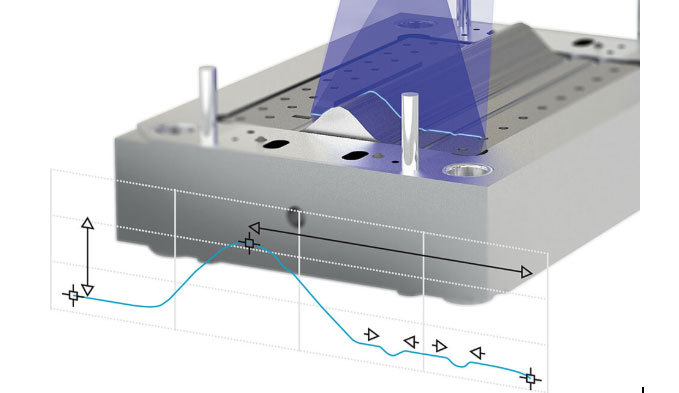
3D laser profile cameras have emerged as a powerful, non-contact technology for accurate, repeatable, and automated surface flatness testing, both inline and offline. When integrated into an automated system, they enable 100% inspection at production speed with micron-level precision.
What Is Surface Flatness?
Surface flatness refers to how closely a surface conforms to an ideal geometric plane. Unlike thickness or height at a single point, flatness evaluates the entire surface area.
Flatness Definition (Practical View)
- The maximum deviation between the highest and lowest points on a surface
- Measured relative to a mathematically fitted reference plane
- Independent of part orientation or alignment
Flatness is typically specified on engineering drawings with tight tolerances, often in the range of microns.
Why Use 3D Laser Profile Cameras for Flatness Testing?
Traditional methods—dial gauges, granite tables, CMMs—are accurate but:
- Slow
- Contact-based
- Unsuitable for inline inspection
- Limited for large or moving parts
A 3D laser profile camera overcomes these limitations by capturing true height (Z) data across the surface.
Key Advantages
- Non-contact measurement
- High Z-resolution (micron or sub-micron level)
- Full surface coverage, not point sampling
- Fast scanning, suitable for production lines
- Works on various materials
How a 3D Laser Profile Camera Measures Flatness
A laser profile camera works on the principle of laser triangulation:
- A laser line is projected onto the surface
- The reflected laser is captured by a high-resolution sensor
- Height (Z) values are calculated for each point along the line
- As the part or sensor moves, thousands of profiles are captured
- Profiles are stitched together to form a dense 3D point cloud
From this point cloud, the surface flatness is computed.
Flatness Measurement Workflow
1. Data Acquisition
Continuous laser profiles captured across the surface
Encoder or motion-synchronized scanning ensures accurate spatial mapping
2. Point Cloud Generation
Individual profiles are merged into a 3D surface model
Noise filtering and smoothing algorithms are applied
3. Reference Plane Fitting
A mathematical plane is computed using:
- Best-fit plane (least squares)
- Datum-based plane (as per drawing requirement)
4. Flatness Calculation
Distance of every point from the reference plane is calculated
Maximum peak-to-valley deviation defines flatness
5. Tolerance Evaluation
Flatness value compared against allowed tolerance
Automated pass/fail decision generated
Types of Flatness Analysis Supported
Modern laser profiling systems can perform multiple flatness evaluations:
Global flatness – entire surface
Zonal flatness – defined inspection regions
Localized warpage detection
Edge lift or corner curl analysis
Trend analysis over batches
This flexibility is critical when different zones have different functional requirements.
Inline vs Offline Flatness Inspection
Inline Flatness Testing
- Installed directly on production lines
- Continuous scanning as parts move on conveyors
- Real-time feedback to PLC
- Ideal for high-volume manufacturing
Near-Line / Offline Testing
- Standalone inspection stations
- Higher-resolution scans
- Used for process validation and root cause analysis
Both configurations use the same core laser profiling technology.
Industrial Applications of Flatness Testing
Surface flatness inspection using 3D laser profile cameras is widely used for:
Automotive Components
Engine blocks, housings, brake discs
Aerospace Parts
Structural components, wing surfaces
Electronics
Heat sinks, enclosures, PCBs
Metal Fabrication
Sheet metal panels, stampings
Precision Engineering
Machined plates, fixtures
EV Components
Battery trays, enclosures
Even minor flatness deviations in these components can result in leakage, NVH issues, uneven torque distribution, or thermal inefficiency.
Role of Automation in Flatness Inspection
Accurate flatness measurement is not only about the sensor—it depends heavily on system-level design. This is where Intelgic delivers a significant advantage.
Intelgic's End-to-End Flatness Automation Includes:
3D laser profile camera selection based on tolerance
Precision motion systems (linear or gantry-based)
Custom mechanical fixtures for repeatable positioning
Encoder-synchronized scanning
Advanced flatness and surface algorithms
PLC, robot, and MES integration
Recipe-based inspection for multiple part variants
The result is a production-ready flatness inspection system, not just a measurement setup.
Benefits Over Traditional Methods
| Traditional Methods | 3D Laser Profile Inspection |
|---|---|
| Contact-based | Non-contact |
| Slow & manual | Fully automated |
| Point-based | Full surface evaluation |
| Offline only | Inline or offline |
| Limited traceability | Complete digital records |
Data, Traceability & Quality Control
Each inspected part can generate:
Measurement Data
- Flatness value
- Deviation heatmaps
- Pass/fail status
- Timestamped inspection records
Data Applications
- Statistical process control (SPC)
- Early detection of warpage trends
- Closed-loop process optimization
- Digital quality documentation
Surface flatness is a foundational quality attribute that directly impacts performance, reliability, and assembly success.
By using 3D laser profile cameras within a fully automated inspection system, manufacturers can achieve:
Micron-level flatness accuracy
100% inspection coverage
High-speed inline operation
Complete digital traceability
With end-to-end solutions covering hardware, software, mechanics, and automation, Intelgic transforms flatness testing from a bottleneck into a real-time quality assurance process—built for modern manufacturing.