Surface quality plays a crucial role in the performance, durability, and appearance of manufactured products.
Many industries require products to be free from defects such as scratches, dents, cracks, contamination, and surface irregularities.
Manual inspection of surfaces is often inconsistent and unreliable, especially when defects are very small or production lines operate at high speeds.
To overcome these challenges, manufacturers increasingly rely on machine vision systems powered by industrial cameras and artificial intelligence (AI).
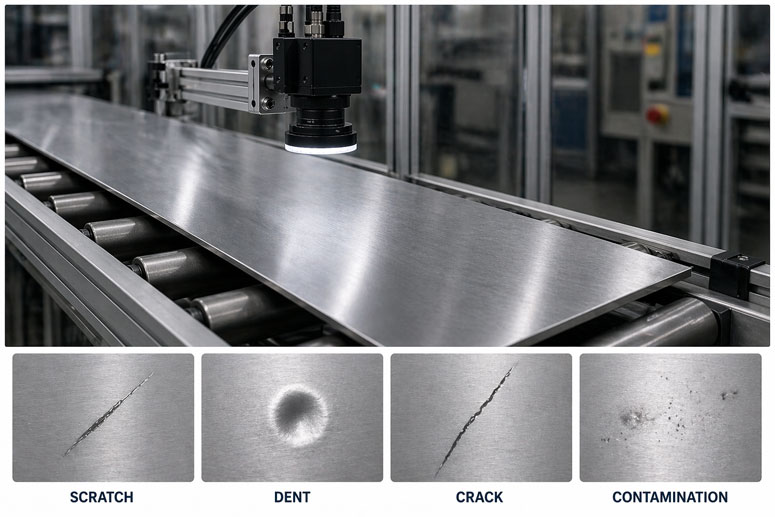
Automated surface defect detection systems enable manufacturers to inspect products continuously and identify defects in real time, ensuring consistent product quality while maintaining production efficiency.
What is Surface Defect Detection?
Surface defect detection is the process of identifying irregularities or imperfections on the surface of a product.
Machine vision systems analyze images of the product surface to detect defects that may affect:
- Product functionality
- Structural integrity
- Product appearance
- Manufacturing quality
These systems are capable of detecting defects that are too small or subtle for the human eye to detect reliably.
Common Types of Surface Defects
Different manufacturing processes produce different types of surface defects.
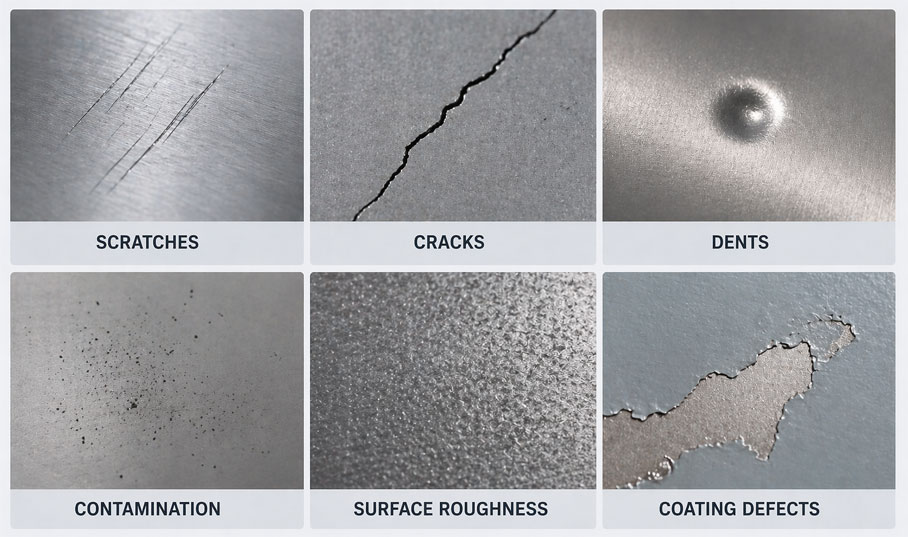
Scratches
Thin lines or marks on the surface caused by handling or friction.
Cracks
Structural breaks in the material.
Dents
Small depressions caused by mechanical impact.
Contamination
Dust, oil, or foreign particles on the surface.
Surface Roughness
Irregular surface texture that affects product quality.
Coating Defects
Uneven or missing coating on painted or treated surfaces.
How Machine Vision Detects Surface Defects
Machine vision systems detect surface defects using cameras, lighting, and image processing software.
Step 1 — Image Acquisition
Industrial cameras capture high-resolution images of the product surface.
Step 2 — Lighting Optimization
Specialized lighting techniques highlight surface features and defects.
Step 3 — Image Processing
Software processes captured images to identify patterns and irregularities.
Step 4 — AI-Based Analysis
AI models analyze the images to detect defects accurately.
Step 5 — Defect Classification
Detected defects are categorized by type and severity.
Step 6 — Pass/Fail Decision
Products that fail inspection are automatically rejected or flagged.
Lighting Techniques for Surface Inspection
Lighting is one of the most critical aspects of surface defect detection.
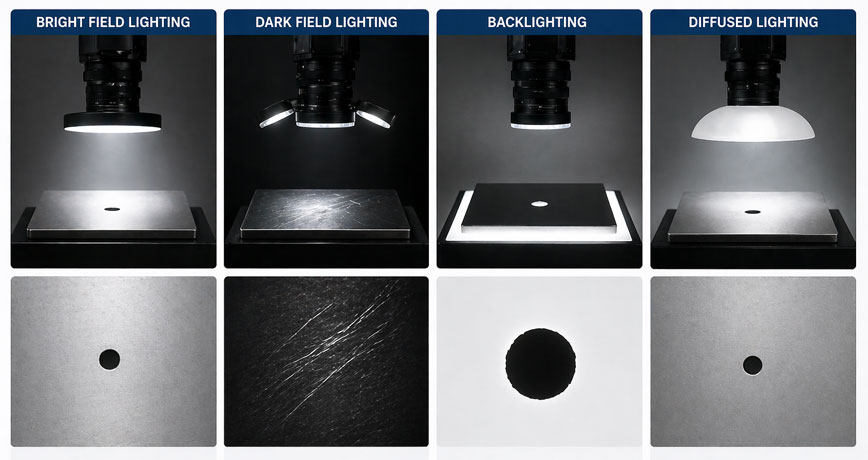
Bright Field Lighting
Used for general surface inspection.
Dark Field Lighting
Low-angle lighting highlights scratches and surface irregularities.
Backlighting
Useful for detecting shape defects and holes.
Diffused Lighting
Reduces reflections on shiny surfaces.
Selecting the correct lighting geometry helps maximize defect visibility.
Role of AI in Surface Defect Detection
AI and deep learning technologies have significantly improved surface inspection systems.
AI-based systems can:
- detect complex and irregular defects
- learn from large datasets of defect images
- adapt to product variations
- reduce false defect detection
Deep learning models are particularly useful for detecting defects that vary in shape, size, and appearance.
Benefits of Automated Surface Inspection
High Inspection Accuracy
Machine vision systems detect defects that are difficult for humans to see.
High-Speed Inspection
Inspection can occur at production line speeds.
100% Inspection Coverage
Every product can be inspected automatically.
Reduced Labor Costs
Automation reduces reliance on manual inspection.
Consistent Quality Control
Inspection results remain consistent across production shifts.
Industrial Applications
Surface defect detection systems are used across many manufacturing industries.
Automotive Manufacturing
Inspection of metal panels, engine components, and body parts.
Textile Industry
Detection of defects in fabrics and garments.
Electronics Manufacturing
Inspection of PCB surfaces and electronic components.
Glass Manufacturing
Detection of scratches and cracks on glass surfaces.
Plastic Manufacturing
Inspection of molded plastic components.
Integration with Smart Manufacturing
Machine vision inspection systems can integrate with factory automation systems including:
PLC controllers
robotic sorting systems
manufacturing execution systems (MES)
production monitoring dashboards
This integration enables real-time quality monitoring and automated defect handling.
Intelgic's Surface Inspection Solutions
Intelgic develops AI-powered machine vision systems designed to detect surface defects in complex manufacturing environments.
These systems enable manufacturers to detect even microscopic surface defects while maintaining production efficiency.
Future of Surface Defect Detection
Advances in machine vision and AI are enabling more powerful inspection technologies.
Future developments include:
- ultra-high-resolution imaging systems
- AI models capable of detecting extremely small defects
- 3D surface inspection technologies
- integration with smart factory platforms
These innovations will enable fully automated surface inspection systems in modern manufacturing environments.
Automated surface defect detection using machine vision systems enables manufacturers to achieve fast, accurate, and reliable inspection of product surfaces.
By combining industrial cameras, advanced lighting techniques, AI-based analysis, and automated inspection systems, manufacturers can detect defects early, improve product quality, and reduce manufacturing costs.
As manufacturing continues to adopt Industry 4.0 technologies, machine vision surface inspection systems will play a critical role in modern quality control.