Precision measurement plays a crucial role in manufacturing industries such as automotive, aerospace, electronics, and metal fabrication. For decades, Coordinate Measuring Machines (CMMs) have been widely used for dimensional inspection of manufactured parts.
While CMM machines provide very high accuracy, they are often slow, expensive, and difficult to integrate into production lines. As manufacturing moves toward automation and real-time quality control, many manufacturers are adopting 3D laser profile sensors as an alternative for measurement inspection.
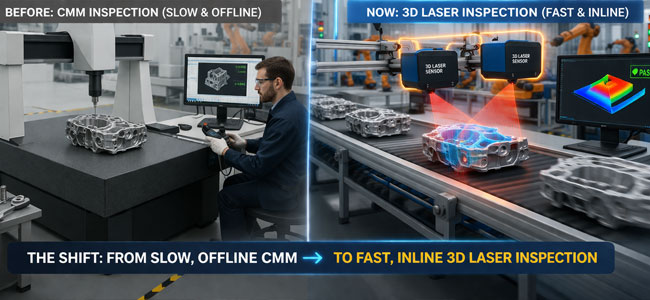
3D laser profile sensors enable high-speed, non-contact measurement directly on production lines, allowing manufacturers to inspect parts in real time without interrupting the manufacturing process.
What is a CMM Machine?
A Coordinate Measuring Machine (CMM) is a precision measurement device used to measure the physical geometry of objects.
CMM machines typically use a contact probe that touches different points on the object to measure dimensions such as:
- Length
- Width
- Height
- Hole positions
- Geometric tolerances
CMMs are extremely accurate and are commonly used in quality laboratories and metrology departments. However, they have several limitations when used in high-speed production environments.
Limitations of CMM Machines
Although CMM machines offer excellent accuracy, they present several challenges in modern manufacturing.
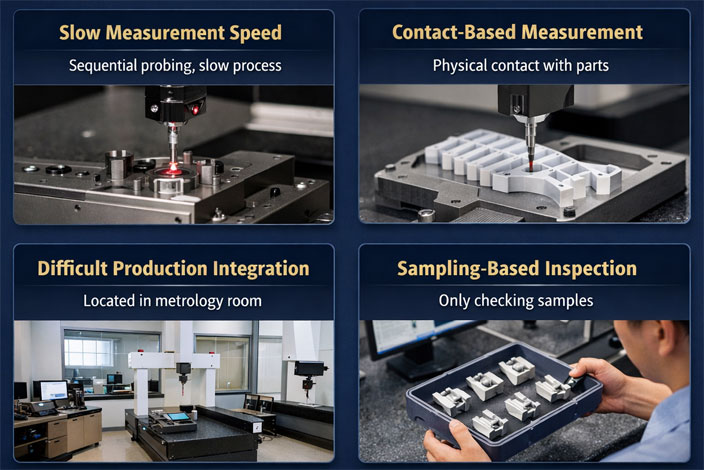
Slow Measurement Speed
CMM machines measure points sequentially using a probe, which makes the inspection process relatively slow.
Contact-Based Measurement
The probe physically touches the object surface, which may not be suitable for delicate or soft materials.
Difficult Production Integration
CMM machines are typically installed in temperature-controlled metrology rooms, making them difficult to integrate into production lines.
Sampling-Based Inspection
Because of slow inspection speeds, manufacturers often inspect only a sample of parts instead of every part.
These limitations make it difficult to perform real-time inspection during manufacturing.
What Are 3D Laser Profile Sensors?
3D laser profile sensors are non-contact measurement devices that use laser triangulation technology to measure the shape and dimensions of objects.
The sensor projects a laser line onto the object surface, and a camera captures the reflection of the laser line.
By analyzing how the laser line deforms when it hits the object, the system calculates the exact surface profile of the object.
When the object moves under the sensor, the system captures multiple profiles and generates a complete 3D model of the object surface.
Advantages of 3D Laser Profile Sensors
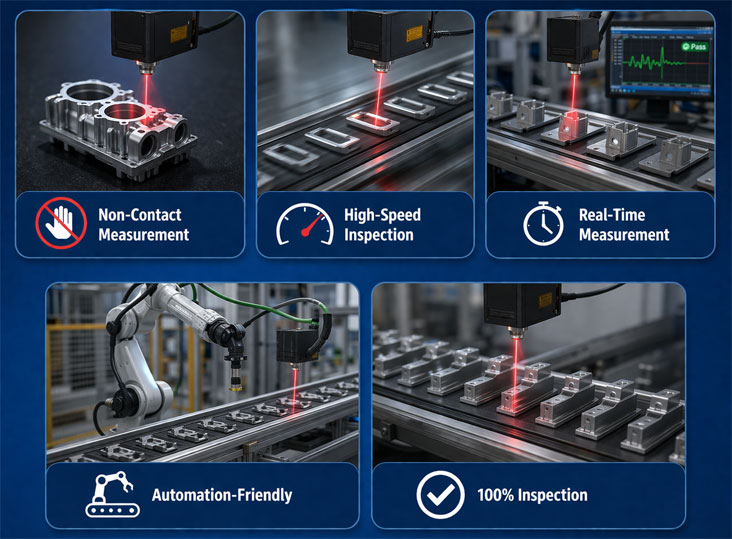
Non-Contact Measurement
Laser sensors measure objects without touching them, preventing damage to delicate parts.
High-Speed Inspection
Sensors can capture thousands of profiles per second, making them suitable for production lines.
Real-Time Measurement
Parts can be inspected directly on the manufacturing line.
Automation-Friendly
Laser sensors can be easily integrated with robotic systems and conveyors.
100% Inspection
Unlike CMM machines, laser sensors allow manufacturers to inspect every part produced.
Measurement Capabilities of Laser Profile Sensors
3D laser profile sensors can measure a wide range of dimensional features.
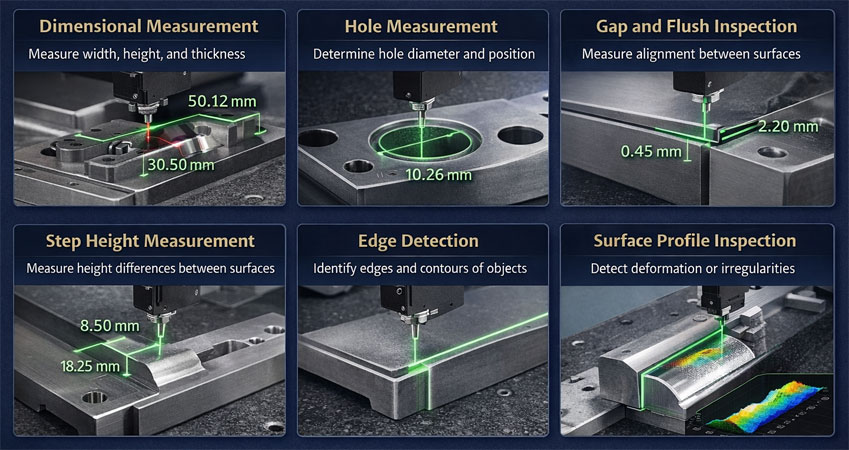
Dimensional Measurement
Measure width, height, and thickness of parts.
Hole Measurement
Determine hole diameter and position.
Gap and Flush Inspection
Measure alignment between surfaces.
Step Height Measurement
Measure height differences between surfaces.
Edge Detection
Identify edges and contours of objects.
Surface Profile Inspection
Detect deformation or irregularities.
CMM vs 3D Laser Profile Sensors
| Feature |
CMM Machine
|
3D Laser Profile Sensor
|
|---|---|---|
| Measurement Method | Contact probing | Non-contact laser |
| Inspection Speed | Slow | Very fast |
| Production Line Integration | Difficult | Easy |
| Inspection Coverage | Sampling | 100% inspection |
| Automation Compatibility | Limited | Highly compatible |
| Environment | Controlled lab | Factory floor |
While CMM machines are still valuable for high-precision laboratory measurements, laser profile sensors are more suitable for real-time production inspection.
Industrial Applications
Laser profile sensors are used in many manufacturing industries.
Automotive Manufacturing
- Measurement of stamped metal parts
- Gap and flush inspection
- Gear profile inspection
Metal Fabrication
- Sheet metal flatness inspection
- Weld inspection
- Dimensional measurement of fabricated parts
Electronics Manufacturing
- PCB component height measurement
- Connector alignment inspection
Packaging Industry
- Bottle cap height inspection
- Container shape verification
Construction Materials
- Tile flatness inspection
- Dimensional inspection of building materials
Combining Laser Sensors with AI and Machine Vision
Modern inspection systems often combine laser profile sensors with machine vision cameras and AI algorithms.
In such systems:
Laser sensors measure dimensional features
Cameras inspect surface defects
AI algorithms analyze both datasets
This combination provides a complete inspection system capable of detecting both dimensional and surface defects.
Companies like Intelgic develop integrated systems combining laser sensors, cameras, AI software, and industrial automation for complex manufacturing inspection tasks.
The Future of Measurement Inspection
As manufacturing moves toward smart factories and Industry 4.0, measurement inspection technologies are evolving rapidly.
Key trends include:
High-speed inline measurement systems
AI-assisted dimensional inspection
Integration with robotic automation
Real-time production analytics
These innovations will allow manufacturers to achieve fully automated dimensional inspection directly on production lines.
3D laser profile sensors are transforming measurement inspection in manufacturing by providing fast, accurate, and non-contact dimensional measurement.
While CMM machines remain valuable for laboratory metrology, laser profile sensors offer a powerful solution for real-time production inspection and automated quality control.
By integrating laser sensors with machine vision and AI technologies, manufacturers can build advanced inspection systems capable of ensuring high product quality in modern automated factories.