Automated, High-Accuracy Inspection of OCTG Threads with Intelgic’s Vision Systems
Oilfield tubulars—such as casing, tubing, and drill pipes—operate under extreme mechanical stress, pressure, and corrosive environments. The threaded connections of these tubulars are among the most critical features, as even minor defects can lead to connection failure, leakage, or costly downtime in the field. Traditional inspection methods, often manual or contact-based, are time-consuming, operator-dependent, and difficult to scale for high-throughput production.
At Intelgic, we deploy an AI-driven machine vision system using line scan cameras and a controlled rotating mechanism to perform automated, non-contact inspection of oilfield tubular threads. This approach ensures complete surface coverage, high dimensional fidelity, and reliable defect detection across both outer thread surfaces and partially visible inner thread regions.
Challenges in Oilfield Tubular Thread Inspection
Oilfield tubular threads present a unique inspection challenge due to:
- Cylindrical and helical geometry
- Long inspection lengths and fine thread features
- Reflective, dark, or oily metal surfaces
- Tight tolerance requirements
- High safety and reliability expectations
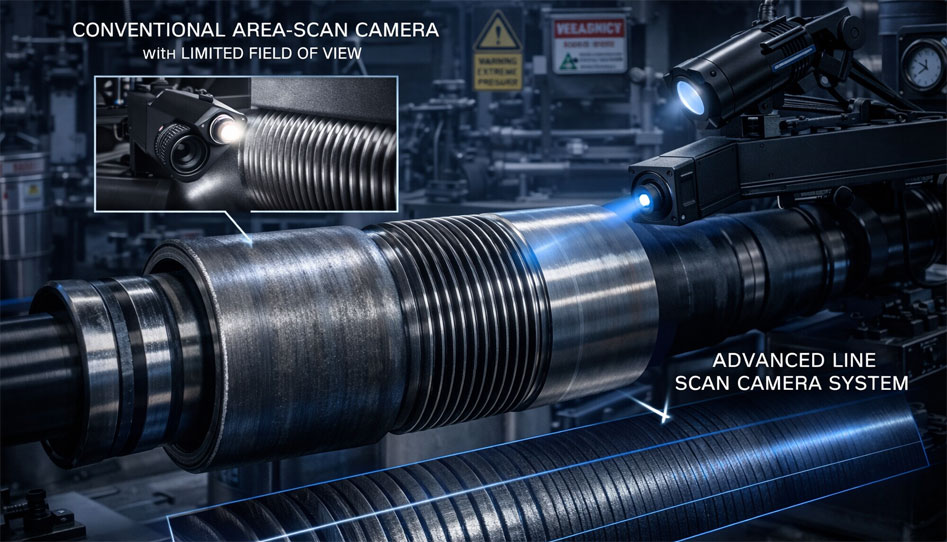
A conventional area-scan camera captures only a limited field of view, making it impractical to image the entire threaded surface uniformly. Intelgic’s solution addresses these challenges using continuous line scan imaging synchronized with rotational motion.
Line Scan Camera–Based Inspection Concept
A line scan camera captures a single line of pixels at extremely high speed. When the tubular is rotated with precision, each captured line corresponds to a narrow circumferential slice of the thread surface. Over one full rotation (or multiple rotations), these lines are stitched together to form a flattened, high-resolution image of the complete threaded surface.
Key Advantages of Line Scan Imaging
Uniform resolution across long and continuous surfaces
No perspective distortion common in area-scan imaging
Extremely high detail, ideal for fine thread features
Consistent lighting and repeatable imaging conditions
Rotating Mechanism and Motion Synchronization
The tubular is mounted on a precision-controlled rotating mechanism driven by a motor and encoder. The encoder feedback is tightly synchronized with the line scan camera acquisition, ensuring:
Accurate pixel-to-angle mapping
Zero overlap or missing surface regions
Stable image geometry regardless of tubular diameter
This synchronized motion allows Intelgic's system to convert the helical thread geometry into a true unwrapped 2D surface image, ready for inspection and AI analysis.
Outer and Inner Thread Imaging Using Tilted Camera Geometry
In addition to outer thread inspection, Intelgic employs a tilted camera geometry to image critical inner thread regions near the pipe mouth.
By carefully selecting:
- Camera tilt angle
- Working distance
- Lens and depth of field
- Lighting orientation
The system can capture:
- Crest and root regions of inner threads
- Entry chamfers and lead-in surfaces
- Early-stage damage inside the threaded connection
This hybrid geometry significantly improves inspection coverage without requiring complex internal probes or contact gauges.
AI-Based Defect Detection and Learning Strategy
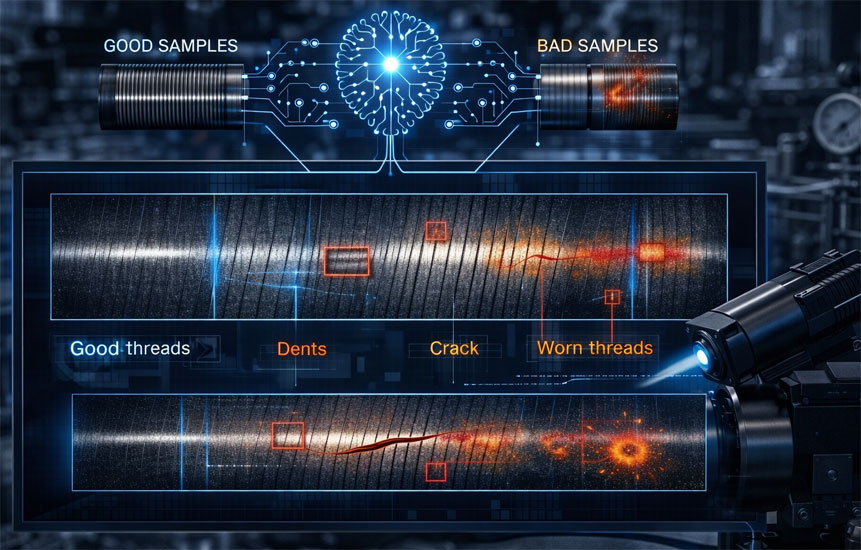
Once high-quality line scan images are generated, AI models are trained to recognize thread surface quality and defects.
Defects Commonly Detected
- Thread damage and deformation
- Nicks, dents, and scratches
- Incomplete or worn threads
- Surface cracks or pits
- Manufacturing inconsistencies and tool marks
AI Training Methodology
- Good surface images are used to define the acceptable thread condition
- Bad or defective images (real or simulated) are included to improve robustness
- AI learns subtle texture variations, machining marks, and surface discontinuities
This mixed training approach dramatically increases inspection accuracy and reduces false positives.
End-to-End Inspection Workflow
Tubular is loaded onto the rotating inspection station
Line scan camera begins continuous imaging
Rotating mechanism synchronizes motion with image capture
Full outer thread surface is unwrapped into a single image
Tilted camera captures inner thread regions
AI analyzes images for defects and surface anomalies
System generates pass/fail results and detailed defect maps
Inspection results can be displayed visually and stored for traceability and quality reporting.
Automation and Production-Line Integration
Intelgic’s tubular thread inspection system is designed for industrial automation environments and can be integrated with:
Automated material handling systems
PLCs and encoders
MES and quality databases
Cloud-based dashboards for inspection history
The system supports near-line or fully in-line inspection, making it suitable for both manufacturing plants and finishing facilities.
Benefits for Oil & Gas Manufacturers
100% inspection of threaded surfaces
Non-contact and non-destructive testing
High repeatability with minimal operator dependency
Reduced risk of field failures
Faster inspection cycles compared to manual methods
Oilfield tubular thread inspection demands precision, consistency, and reliability. By combining line scan cameras, precision rotating mechanisms, tilted camera geometry, and AI-based defect detection, Intelgic delivers a robust solution capable of inspecting both outer and critical inner thread surfaces with exceptional accurac
This advanced vision-based approach transforms tubular inspection from a manual, error-prone process into a fully automated, data-driven quality assurance system, helping oil and gas manufacturers meet the highest safety and performance standards.