Line Scan vs Area Scan Cameras in Machine Vision
Published on: Mar 31, 2026

Written by:Content team, Intelgic
Machine vision systems rely heavily on industrial cameras to capture images for inspection, measurement, and automation. Two of the most commonly used camera technologies in machine vision are line scan cameras and area scan cameras.
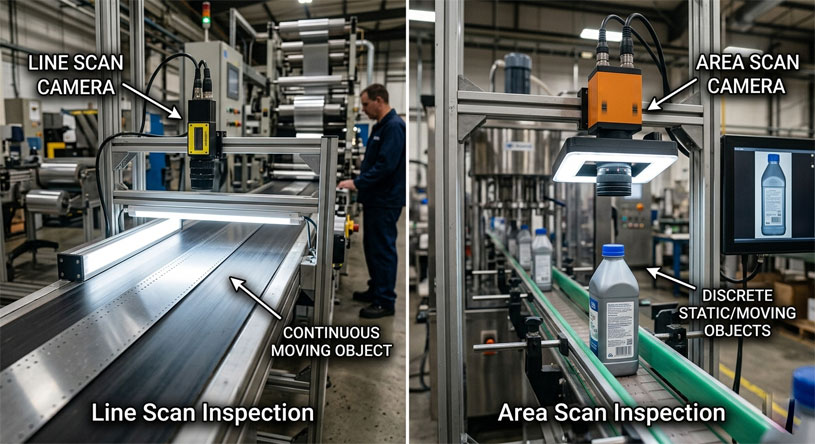
Choosing the right type of camera is crucial because it directly affects image quality, inspection speed, system complexity, and defect detection capability.
In this guide, we explain the differences between line scan and area scan cameras, how they work, and when to use each technology in manufacturing inspection systems.
What is an Area Scan Camera?
An area scan camera captures a complete image frame in a single exposure, similar to how a traditional digital camera works. The camera sensor consists of a two-dimensional grid of pixels, which allows it to capture an entire image at once.
How Area Scan Cameras Work
- 1 The camera captures a full image frame.
- 2 The image is processed by machine vision software.
- 3 The system analyzes the image to detect defects or measure features.
Area scan cameras are ideal for inspecting individual parts or objects that are stationary or moving slowly.
Common Applications of Area Scan Cameras
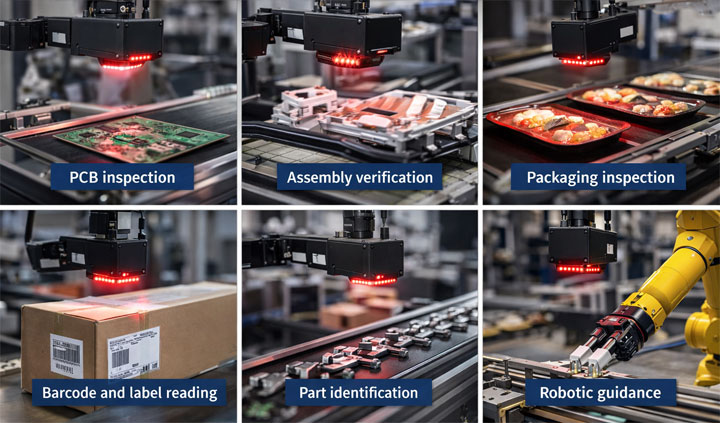
Because they capture the entire image at once, area scan cameras are excellent for inspecting discrete objects or components.
What is a Line Scan Camera?
A line scan camera captures images one line of pixels at a time instead of capturing the entire image frame. The camera sensor consists of a single row of pixels. As the object moves past the camera, the system captures multiple lines and stitches them together to create a complete image.
How Line Scan Cameras Work
- 1 The object moves under the camera on a conveyor.
- 2 The camera continuously captures pixel lines.
- 3 Software combines these lines into a full image.
This technique allows extremely high-resolution imaging of large or continuous materials.
Common Applications of Line Scan Cameras
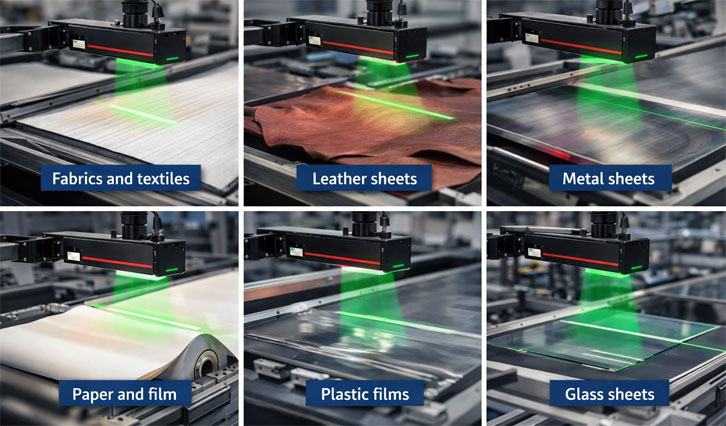
They are also used in high-speed production lines where large surfaces must be inspected continuously.
Key Differences Between Line Scan and Area Scan Cameras
| Feature |
Line Scan Camera
|
Area Scan Camera
|
|---|---|---|
| Image Capture | Captures one line at a time | Captures full image frame |
| Sensor Type | 1D sensor (single pixel row) | 2D sensor (pixel matrix) |
| Best For | Continuous materials | Individual objects |
| Resolution | Extremely high resolution possible | Limited by sensor size |
| Speed | Very high for moving materials | Moderate |
| System Complexity | Requires motion synchronization | Simpler setup |
Advantages of Area Scan Cameras and Line Scan Cameras
Area Scan Advantages
-
Simple System Setup Easier to install and configure.
-
Suitable for Static Objects Ideal for inspecting parts on a stationary inspection station.
-
Flexible Applications Used in a wide variety of machine vision tasks.
-
Lower System Complexity Does not require precise motion synchronization.
Line Scan Advantages
-
Extremely High Resolution Can capture extremely detailed images.
-
Ideal for Continuous Materials Perfect for inspecting long surfaces such as sheets or rolls.
-
Uniform Image Quality Consistent image quality across the entire inspected surface.
-
High-Speed Inspection Capable of inspecting materials moving at very high speeds.
When to Use Each Technology
When to Use Line Scan Cameras
Line scan cameras are preferred when:
Examples include:
When to Use Area Scan Cameras
Area scan cameras are preferred when:
Examples include:
Combining Line Scan and Area Scan Systems
In many advanced inspection systems, manufacturers combine both technologies to create comprehensive inspection coverage.
Inspect large surfaces and continuous materials for overall quality assessment.
Inspect specific features, discrete components, and detailed measurements.
Hybrid Approach: This combination provides comprehensive inspection coverage for complex manufacturing environments.
Role of AI in Modern Vision Cameras
Modern machine vision systems increasingly integrate AI and deep learning algorithms. Both line scan and area scan cameras can be integrated with AI-based inspection software.
Detect Complex Defects
Identify Subtle Anomalies
Improve Accuracy Over Time
Adapt to Variations
Intelgic’s Machine Vision Solutions
Intelgic develops custom machine vision systems using both line scan and area scan camera technologies.
Intelgic solutions integrate:
- • Industrial cameras and optics
- • Advanced lighting systems
- • AI-based inspection software
- • Automated motion systems
- • GPU-powered processing platforms
These systems are used for applications such as:
Line scan and area scan cameras are both essential technologies in machine vision systems. While area scan cameras are ideal for inspecting individual parts, line scan cameras are best suited for inspecting continuous materials and high-speed production lines.
Choosing the right camera depends on the product type, inspection requirements, production speed, and resolution needs.
By selecting the appropriate camera technology and integrating it with AI-powered inspection software, manufacturers can build highly efficient and accurate automated inspection systems.