In industries such as wood panels, sheet metal fabrication, plastic panel manufacturing, composites, and engineered surfaces, dimensional accuracy is critical. Even small deviations in surface flatness, hole geometry, or depth can lead to downstream assembly failures, cosmetic rejections, or functional issues.
A Laser 3D Profiler provides a non-contact, highly accurate, and production-ready method to inspect these parameters by generating a true 3D representation of the product surface. Intelgic’s 3D profile cameras are specifically designed to create dense, high-resolution point clouds that allow precise dimensional inspection directly on the production floor.
What Is a Laser 3D Profiler?
A laser 3D profiler projects a laser line onto the surface of a moving or stationary product. As the surface height changes, the reflected laser line shifts, and an internal sensor captures this deformation.
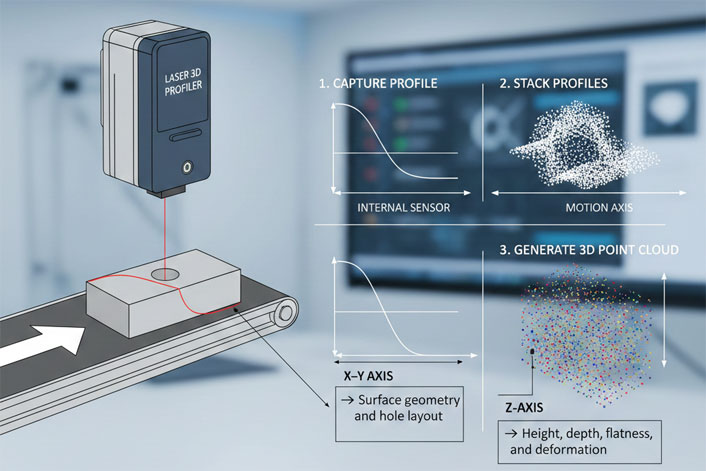
By continuously capturing profiles and stacking them along the motion axis, the system generates a 3D point cloud, where each point contains precise X, Y, and Z coordinates.
- X–Y → Surface geometry and hole layout
- Z-axis → Height, depth, flatness, and deformation
Intelgic’s 3D Profiling Approach
Intelgic offers industrial-grade 3D profile cameras combined with intelligent inspection algorithms that operate directly on raw point cloud data.
Micron-level Z-axis resolution
Dense and uniform point cloud generation
High-speed profile acquisition for inline or offline inspection
Advanced algorithms for dimensional analysis
Surface Flatness Inspection Using Point Cloud Analysis
How Flatness Is Measured
- A reference plane is mathematically fitted to the surface data
- The Z-value of every point is compared against this reference plane
- Deviations are calculated across the entire surface
Flatness Results
- Maximum peak-to-valley variation
- Warpage or bending detection
- Localized bumps or depressions
- Pass/Fail decision based on tolerance limits
Why 3D Profiling Is Superior
- Measures the entire surface, not just a few points
- Detects subtle warping invisible to 2D cameras
- No physical contact, no deformation of soft materials
Hole Detection and Hole Counting
Hole Identification from Point Cloud
In a 3D point cloud:
- Holes appear as sudden negative Z-axis discontinuities
- The algorithm segments regions where depth crosses a defined threshold
- Each segmented cavity is classified as a hole
Hole Counting Logic
Each valid hole region is counted once with false features rejected using:
- Minimum/maximum area filters
- Depth validation
- Shape consistency rules
This ensures reliable hole counting even when holes are closely spaced or partially obscured by dust or surface texture.
Accurate Measurement of Hole Diameter
Diameter Measurement Using Point Cloud Geometry
Unlike 2D vision systems that estimate diameter from edge pixels, Intelgic’s system measures true 3D geometry:
- Extract the 3D boundary points of the hole opening
- Fit a best-fit circle or cylinder in 3D space
- Calculate the diameter based on actual spatial coordinates
Advantages
- Accurate even if the hole edge is chamfered
- Works on reflective or textured surfaces
- Immune to lighting variations
This makes it ideal for functional hole inspection where precision is critical
Hole Depth Measurement (Z-Axis Inspection)
Depth Measurement Process
Hole depth is directly derived from Z-axis values:
- Identify the reference top surface plane
- Measure the lowest Z-value inside each hole
- Calculate depth as the vertical distance between the surface plane and hole bottom
What Can Be Verified
- Correct drilling or punching depth
- Through-hole vs blind-hole confirmation
- Consistency across multiple holes
- Minimum and maximum depth tolerance checks
All measurements are absolute, not relative, ensuring high repeatability.
Algorithmic Tolerance Verification
Intelgic’s inspection algorithms operate directly on the point cloud to ensure:
- Z-axis deviations are within specified tolerances
- Hole diameter meets engineering drawings
- Hole depth conforms to process requirements
- Missing or extra holes are instantly detected
Each inspection can generate:
- Numerical measurement reports
- 3D deviation maps
- Pass/Fail decisions per feature or per part
Typical Applications
Wooden Panels
Flatness and hole inspection
Sheet Metal
Punching and drilling verification
Plastic/Composites
Panel dimensional inspection
Furniture
Modular panel manufacturing
Automotive
Flat component inspection
Appliances
Surface quality control
Inline and Offline Deployment
Inline inspection
Profiler scans parts as they move on conveyors
Stationary inspection
Part stops, scanner traverses using linear motion
Robotic integration
Profiler mounted on X-Y-Z stages for complex layouts
The same point cloud approach works across all configurations.
Why Laser 3D Profilers Are Ideal for Flat-Surfaced Products
- True 3D measurement, not visual estimation
- High precision across large surface areas
- Robust against color, texture, and lighting changes
- Single scan provides flatness, hole count, diameter, and depth
Laser 3D profilers have become an essential technology for high-precision surface and hole inspection. By generating accurate point clouds and applying intelligent algorithms, Intelgic’s 3D profile cameras enable manufacturers to verify surface flatness, hole presence, hole diameter, and hole depth with confidence.
The result is higher quality assurance, reduced rework, and complete dimensional traceability—all achieved through non-contact, production-ready inspection.