Stamping is a critical manufacturing process used to create holes, slots, and cutouts in metal sheets and components. These features are essential for assembly operations such as fastening, welding, and mechanical alignment. If the holes are not stamped at the correct position or if their diameter is incorrect, the entire assembly process can fail.
In many factories, stamping verification is still performed manually using gauges, vernier calipers, or periodic checks with Coordinate Measuring Machines (CMM). While these methods can provide accurate measurements, they are slow, labor-intensive, and impractical for high-speed production environments.
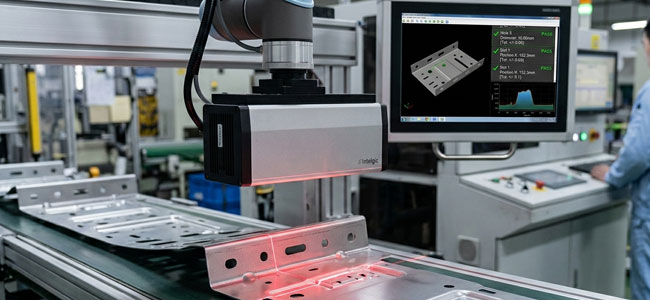
To overcome these limitations, manufacturers are increasingly adopting laser-based 3D profile sensors combined with machine vision software to automate stamping verification. These systems can automatically identify holes, measure their diameters, verify their positions, and compare the measurements with the original design specifications in real time.
Intelgic develops advanced automated inspection systems that use laser-based 3D profile cameras to perform accurate stamping validation directly on the production line.
Challenges in Manual Stamping Verification
Manual inspection processes often struggle to keep up with modern manufacturing speeds and quality requirements. Common challenges include:
- Inconsistent inspection results due to human judgment
- Slow measurement process when multiple holes must be inspected
- Limited ability to inspect 100% of produced parts
- Difficulty measuring hole positions precisely
- Lack of digital records for quality traceability
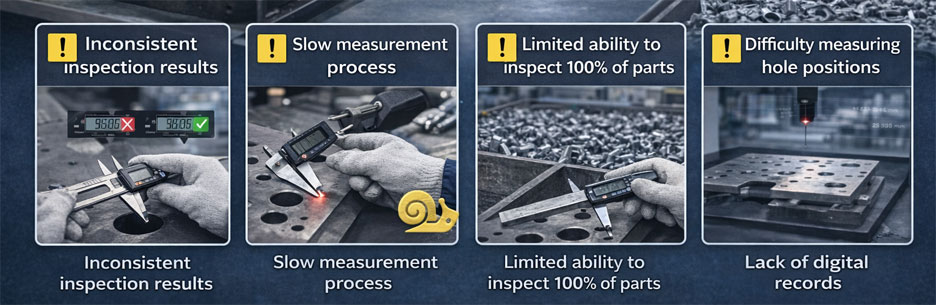
As production speeds increase and product complexity grows, these limitations make manual inspection inefficient and unreliable.
Automated inspection systems eliminate these issues by enabling high-speed, repeatable, and precise measurement of stamped features.
Why Laser-Based 3D Profile Sensors Are Ideal for Stamping Inspection
Traditional camera-based inspection systems rely on 2D images. While they can detect hole presence and approximate measurements, achieving high precision can be challenging when surface conditions vary or when parts have reflective finishes.
Laser-based 3D profile sensors provide a much more reliable solution for dimensional measurement. These sensors work using a technique called laser triangulation.
A laser line is projected across the surface of the part. A specialized camera inside the sensor observes how this laser line deforms when it encounters different surface geometries. Using triangulation algorithms, the system calculates the precise height and shape of the surface.
This process generates a 3D profile or point cloud of the scanned area, allowing the system to measure geometric features with extremely high accuracy.
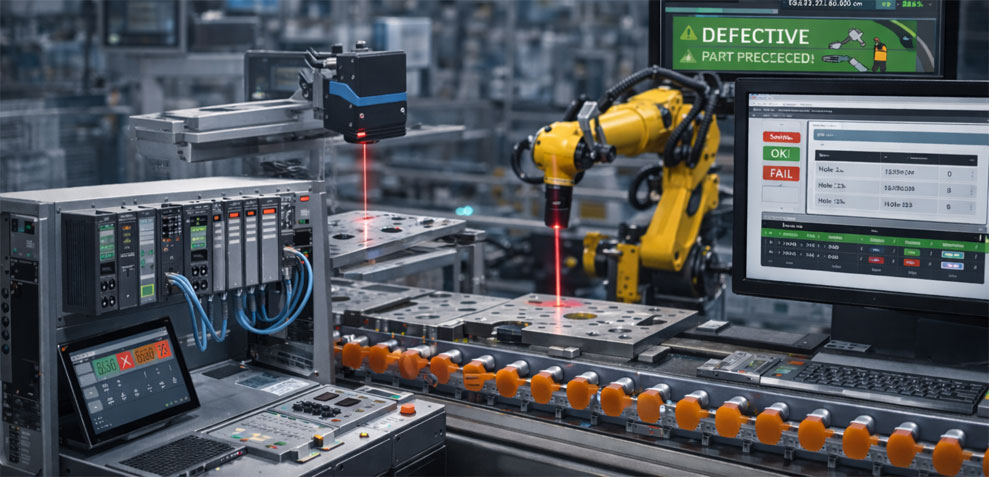
Advantages of using 3D profile sensors include:
- High measurement accuracy
- Reliable measurements on reflective metal surfaces
- Direct dimensional measurement instead of pixel-based approximation
- Ability to inspect parts while they are moving
- Generation of precise 3D data for analysis
Because of these capabilities, laser profile sensors are widely used for inline dimensional inspection in manufacturing lines.
How the Automated Stamping Verification System Works
Part Detection and Triggering
As stamped parts move along the production line, sensors or encoders detect the presence of the part. This signal triggers the inspection system to begin scanning the part.
Depending on the production setup, the part may be:
- Moving on a conveyor
- Indexed under the inspection station
- Positioned in a fixture for measurement
The triggering ensures that the laser sensor scans the correct section of the part.
Laser-Based 3D Scanning
Once triggered, the laser-based 3D profile sensor scans the part surface. The sensor projects a thin laser line across the metal sheet. As the part moves under the sensor, the system continuously captures the deformation of the laser line and converts it into a sequence of 3D profiles.
These profiles are combined to generate a 3D representation of the stamped section of the part. Because holes are essentially empty regions in the metal surface, the 3D profile clearly reveals their shape, depth, and boundaries.
Hole Identification
Intelgic's inspection software analyzes the 3D data to detect all stamped holes present in the part. Advanced algorithms identify the hole edges by analyzing variations in the 3D surface profile. The system automatically determines:
- Hole presence
- Hole shape
- Hole boundaries
- Hole geometry
This process allows the system to detect defects such as:
- Missing holes
- Partially stamped holes
- Deformed hole edges
- Burr formation around holes
- Irregular hole shapes
The 3D data provides far more reliable detection compared to traditional 2D image-based methods.
Diameter Measurement
Once a hole is detected, the system measures the exact diameter of the hole. The measurement is performed by calculating the distance between opposite edges of the hole in the 3D profile data.
Because the system measures actual geometric coordinates rather than pixel values, the measurement accuracy is extremely high. Manufacturers can define tolerance limits for each hole. If the measured diameter falls outside the acceptable range, the system flags the part as defective.
Hole Position Measurement
Correct hole placement is critical for downstream assembly processes. Even a small positional shift can lead to alignment issues during welding, bolting, or assembly.
The system calculates the precise X and Y coordinates of each hole using the 3D profile data. Hole positions are measured relative to reference features such as:
- Part edges
- Reference holes
- Alignment fixtures
- Defined datum points
These measurements allow the system to verify whether each hole is stamped at the correct location.
Comparison with Design Specifications
The inspection software compares the measured results with the original design specifications or CAD data. Parameters that can be verified include:
- Number of holes
- Hole diameter
- Hole spacing
- Hole alignment
- Hole position relative to reference points
If any measurement exceeds the specified tolerance, the system automatically identifies the deviation. This ensures that the stamping operation is producing parts that match the intended design.
Real-Time Inspection Results
After completing the inspection process, the system immediately generates a pass/fail decision. The output interface can display:
- Pass or fail status
- Measured dimensions of each hole
- Deviation values from the design
- Highlighted defect locations
- Inspection images or 3D profiles
Operators can quickly identify production issues and take corrective action if necessary.
Integration with Production Systems
Intelgic's automated inspection systems can integrate directly with factory automation infrastructure. Typical integrations include:
- PLC signals for production control
- Conveyor and handling systems
- Robotic systems for rejecting defective parts
- Manufacturing Execution Systems (MES)
- Quality management databases
This integration allows manufacturers to implement closed-loop quality control within their production lines.
Digital Reporting and Traceability
Another major advantage of automated inspection is the generation of digital inspection records. The system can store:
- Inspection images and 3D scan data
- Measurement values
- Part ID or batch number
- Timestamp of inspection
- Pass/fail results
These records provide complete traceability and help manufacturers maintain compliance with quality standards.
Industrial Applications
Automated stamping verification systems using laser profile sensors are widely used in industries such as:
Automotive Manufacturing
Inspection of stamped body panels, brackets, and chassis components.
Appliance Manufacturing
Verification of holes in washing machines, refrigerators, and air conditioning units.
Sheet Metal Fabrication
Inspection of punched holes in enclosures, cabinets, and structural frames.
Electronics and Electrical Equipment
Verification of mounting holes in electrical panels and control cabinets.
Heavy Equipment Manufacturing
Inspection of structural plates and machine components.
Benefits of Automated Stamping Inspection
Implementing laser-based stamping inspection provides significant advantages:
- 100% inspection of manufactured parts
- High-speed inline measurement
- Extremely accurate dimensional verification
- Reduced dependency on manual inspection
- Immediate detection of stamping defects
- Improved manufacturing consistency
- Complete digital traceability
These benefits allow manufacturers to maintain strict quality standards while improving productivity.
Automating stamping verification using laser-based 3D profile sensors and intelligent inspection software enables manufacturers to achieve highly accurate and reliable quality control.
By automatically detecting holes, measuring their diameters, verifying their positions, and comparing them with design specifications, the system ensures that every stamped part meets precise engineering requirements.
Intelgic's advanced inspection systems bring together 3D sensing technology, industrial automation, and intelligent software to deliver high-precision, real-time stamping validation for modern manufacturing lines.
As manufacturing continues to evolve toward Industry 4.0, automated 3D inspection solutions will play a crucial role in ensuring consistent product quality and efficient production.