In modern manufacturing, defects are not limited to scratches or missing features. One of the most expensive and risky failures is identity mismatch—when the wrong part is produced, the wrong version is assembled, or the wrong label is applied to an otherwise good part
To eliminate these errors, Intelgic has developed an advanced Vision Inspection System that does more than defect detection. It visually understands the part, matches it against the correct design reference, and then validates whether the applied label (barcode, QR code, or part ID) truly belongs to that part.
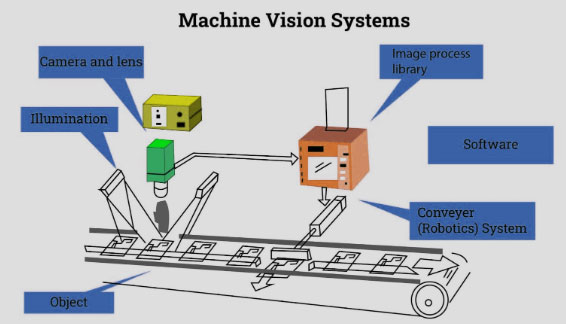
This creates a closed-loop, automated verification layer between what the part physically is, what it is supposed to be, and what its label claims it is.
The Challenge: Wrong Parts and Wrong Labels
Manufacturing lines often deal with:
- Multiple part variants that look similar
- Frequent changeovers and mixed production
- Manual or semi-automatic label application
- High dependency on downstream barcode scanners
In these environments, barcode readers alone are not enough. A barcode can be readable yet still be wrong for the physical part underneath it. Intelgic’s vision-based approach closes this gap by tying visual identity directly to digital identity.
Intelgic’s Vision-Driven Identity Verification Workflow
The system follows a structured four-stage process:
Visually recognize the part using stable features
Match the observed part with the correct design or reference model
Read and validate the label (barcode / QR / OCR / part ID)
Confirm that part identity = design reference = label data
Only when all three match does the system approve the part.
Part Recognition Using Visual Features
Instead of relying on labels, Intelgic’s system first identifies the part purely from visual information captured by industrial cameras.
Key Visual Features Used
Depending on the product, the system analyzes:
- Outer profile and silhouette
- Hole count, hole pattern, spacing, and alignment
- Slots, cut-outs, notches, ribs, tabs
- Relative position of functional features
- Embossed text, stamped marks, logos
- Molded structures and texture zones
- Weld marks or assembly interfaces
- Presence or absence of a feature
- Slight geometry differences between SKUs
- Feature ratios and spatial relationships
Hybrid Vision + AI Approach
Intelgic combines:
- Classical vision algorithms for edges, contours, and dimensional stability
- AI models for classification and differentiation between similar variants
This hybrid approach ensures robustness against lighting variation, surface finish changes, and acceptable manufacturing tolerances.
Matching the Part with the Design Reference
Once the part is recognized, the system validates whether it matches the correct approved design.
- CAD or drawing-based reference views
- Engineering drawings (DXF, PDF exports)
- Golden sample images
- Approved print or artwork files
- Feature maps defined inside Live Vision AI recipes
- The system aligns the captured image to the reference coordinate system
- Key features are overlaid digitally
- Deviations are measured against predefined tolerances
The part is approved or rejected based on compliance
This step ensures that:
- The correct variant is present
- No wrong or obsolete version enters the process
- Geometry and feature placement are within allowed limits
Automated Label, Barcode, and Part ID Validation
After confirming the physical part, the system validates its label.
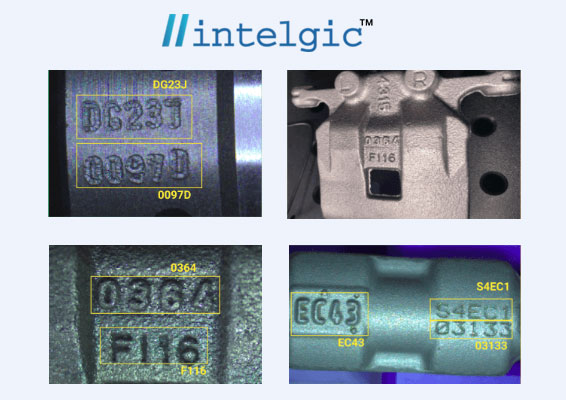
What the System Checks
Beyond simply decoding a barcode, Intelgic validates:
- Presence: Is a label applied or missing?
- Position : Is the label in the correct zone and within tolerance?
- Orientation Is it rotated, flipped, or skewed?
- Print quality: Contrast, damage, broken bars, unreadable modules
- Data accuracy: Correct part ID, SKU, format, or encoding
Labels that are readable but incorrectly placed or wrongly assigned are still rejected.
Closed-Loop Validation: Correct Label on the Correct Part
Closed-Loop Validation: Correct Label on the Correct Part
| Recognized Part | Design Match | Label Data | Result |
|---|---|---|---|
| Variant A | Variant A | Variant B | Fail |
| Variant A | Variant A | Variant A | Pass |
Integration with MES, ERP, and Automation
Intelgic’s system can integrate seamlessly with:
- PLCs for reject mechanisms and line control
- MES/ERP systems for expected SKU validation
- APIs for traceability, reporting, and audit logs
Every inspection can generate:
- Time-stamped images and overlays
- Part and label identity records
- Confidence scores and inspection outcomes
- Searchable history by barcode, shift, line, or batch
Where This Solution Delivers Maximum Value
This approach is especially effective for:
- Automotive and wiring harness parts
- Sheet-metal stampings with similar hole patterns
- Plastic molded parts with multiple variants
- Packaging lines with strict labeling rules
- High-mix, low-volume production environments
Intelgic’s vision-based part recognition and label validation system transforms identity verification into a fully automated, mistake-proof process. By visually understanding the part, matching it to the correct design, and validating its label in one continuous workflow, manufacturers can eliminate mix-ups, improve traceability, and ensure that only the right part with the right label moves forward.