In many manufacturing industries—structural fabrication, automotive, heavy machinery, HVAC, construction steel, and metal assembly—C-channels and metal parts come in dozens of variants. These variants look almost identical in overall size and shape, but they differ in:
- Number of holes
- Positions of holes
- Distances between holes
- Patterns (symmetrical/asymmetrical)
- Hole shapes or combinations
Manually identifying these parts or relying on operator memory often leads to:
Common Issues
- Wrong part selection during assembly
- Mismatch between part and order
- Incorrect routing or processing
- Delayed production
- Costly quality failures
Our Solution
Intelgic solves this with a camera-based AI solution that automatically identifies a part based on its hole pattern—a unique signature for that part.
Why Hole Patterns Are Ideal for Part Identification
Every engineered metal component has a unique hole configuration based on:
Functional requirements
Structural load conditions
Assembly connections
Wiring or fitting needs
Even if overall dimensions are similar, the hole pattern is extremely specific, making it the fingerprint of the part.
Advantages of Hole-Pattern-Based Recognition
- Extremely reliable compared to shape-only detection
- Insensitive to color, surface finish, or minor scratches
- Works even if part orientation changes
- Can identify hundreds of part variants
- New hole patterns can be added easily to the database
This approach eliminates human error and ensures zero-defect identification and sorting.
Challenges in Recognizing Hole Patterns Manually or with Traditional CV
Traditional image processing techniques struggle due to:
1 Variation in Part Orientation
A part may be slightly rotated or shifted, causing inconsistent feature detection.
2 Inconsistent Lighting on Metal Surfaces
Metal reflects light, creating hotspots that hide small holes.
3 Overlapping or Partial Occlusion
If the part is not placed properly, some holes may be partially visible.
4 Multiple Hole Sizes
Some variants may have a mix of 6 mm, 8 mm, 12 mm, or oval holes—creating complexity for classical approaches.
5 Dimensional Tolerance
Manufactured hole positions may vary by ±0.1 to ±1 mm, requiring intelligent tolerance handling.
AI-based algorithms overcome these limitations by learning robust hole patterns.
Intelgic's AI-Driven Part Recognition Approach
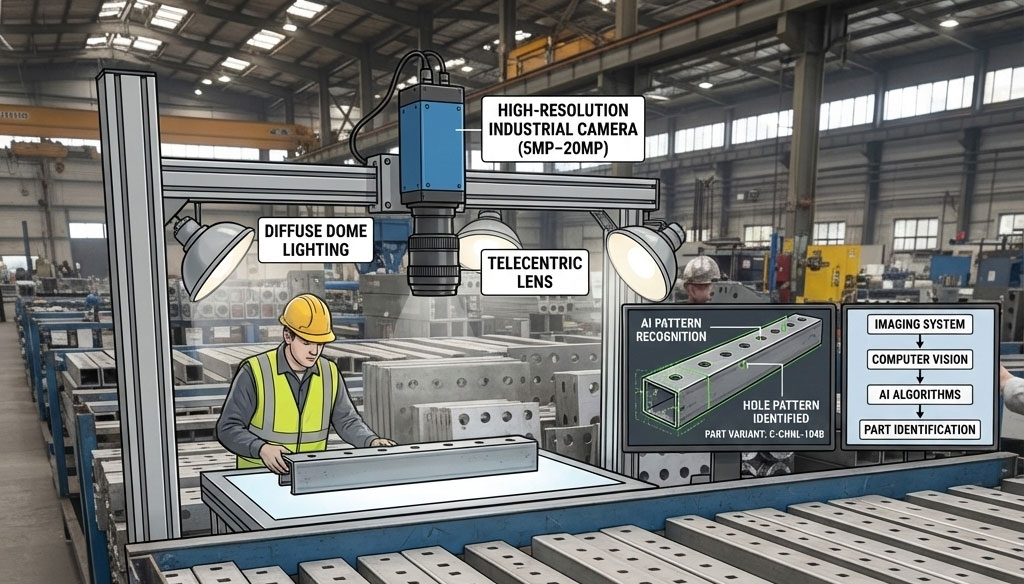
Intelgic uses a combination of industrial imaging, advanced Computer Vision, and AI pattern-recognition algorithms to accurately identify metal parts.
1 Imaging System
A high-resolution industrial camera is mounted above a designated inspection area. The operator simply places the C-channel under the camera; the system captures one or multiple images.
Camera Features:
- 5MP–20MP resolution
- Low-distortion lens
- Diffuse or dome lighting to eliminate reflections
- Optional telecentric lens for critical precision

2 Hole Detection
AI-enhanced CV algorithms detect:
Hole centers
Hole diameters
Relative distances between holes
Overall spatial pattern
Holes are extracted as coordinate sets forming a hole signature for each part.
3 Pattern Matching Against Reference Library
The system stores a mapping table of known patterns:
- Part ID → Hole pattern signature
- Part name → Dimensional features
- Variant → Hole arrangement
The captured signature is compared with this library using:
Geometric pattern matching
AI-based similarity scoring
Rotational invariance models
Tolerance-based matching
4 Part Identification
Once the hole pattern is recognized:
- Part ID is retrieved
- Variant name is displayed
- Material/operation routing is fetched from ERP/MES
- Order verification or assembly validation is performed
Results are shown instantly on the operator screen.
The Role of AI: Why AI Performs Better Than Classical Vision
AI models trained on thousands of hole pattern samples learn:
Variations in lighting
Rotational changes
Minor tolerance differences
Different thicknesses of C-channel
Surface irregularities
Missing or extra holes in defective parts
This ensures 99%+ accuracy even under non-ideal imaging conditions.
AI Capabilities Include:
Hole detection + classification
Pattern normalization
Noise & glare suppression
Auto-correction of part position
Handling partially visible patterns
System Workflow
Our AI-powered part recognition system follows a streamlined workflow to ensure accurate identification:
Step 1: Load the Part
Operator places the C-channel in the imaging area.
Step 2: Automatic Image Capture
Camera captures the top view with consistent lighting.
Step 3: AI-Based Hole Detection
AI extracts hole coordinates and pattern features.
Step 4: Pattern Matching
The system compares the extracted hole pattern with the reference mapping table.
Step 5: Part Identification
Part name, ID, and metadata are displayed on the screen.
Step 6: Integration & Output
Data may be:
- Sent to PLC for routing
- Sent to ERP for part verification
- Logged for traceability
- Used for automatic sorting
Real-World Industry Applications
Our AI-powered hole pattern recognition system delivers value across multiple manufacturing sectors:
Structural Fabrication
Identify beams, channels, angles with different drilling configurations.
Automotive Manufacturing
Recognize brackets, supports, and welded parts with complex hole groups
HVAC & Ducting
Identify duct brackets with variant-specific hole patterns.
Heavy Equipment Manufacturing
Track and identify metal assemblies with dozens of variants.
Assembly Line Automation
Prevent incorrect part feeding during robotic assembly.
Benefits of Intelgic’s Hole-Pattern-Based Part Recognition System
Zero Human Dependency
Eliminates manual measurement and visual comparison.
High Accuracy
Pattern-based identification is extremely reliable and robust.
Adaptability
New parts can be added to the reference library anytime.
Fast and Real-Time
Cycle time < 1 second per part..
Scalable
Works for C-channels, brackets, plates, mounting parts, and any metal component.
ERP/MES Integration
Automated part ID lookup and routing.
Error Prevention
Detects wrong part before assembly, avoiding costly production mistakes.
Improves Productivity
Operators don’t need to manually verify variants; system handles everything.
Technical Capabilities of Intelgic’s Platform
Industrial-grade cameras and lighting
Deep learning models trained for metal hole detection
Precision measurement accuracy up to 0.1–0.3 mm
GPU-accelerated processing for real-time inference
Recipe-based configuration for each part variant
Cloud or on-premise deployment
Digital Quality Certificate generation
Optional AI for defect detection (scratches, bends, wrong drilling)
Hole pattern recognition is one of the most reliable and scalable methods for identifying C-channels and metal parts in modern manufacturing. Intelgic’s AI-driven machine vision solution transforms a simple hole arrangement into a unique digital fingerprint, enabling:
By leveraging high-quality imaging, pattern-recognition algorithms, and AI-powered intelligence, Intelgic delivers a futuristic, robust, and industry-ready solution that meets the demands of modern smart factories.