Glass products are widely used across industries such as automotive, electronics, construction, and consumer goods. From smartphone screens and automotive windshields to architectural glass panels, maintaining high surface quality is essential.
However, detecting defects on transparent glass surfaces can be challenging. Many defects such as scratches, chips, bubbles, cracks, and contamination are difficult to detect using conventional inspection methods.
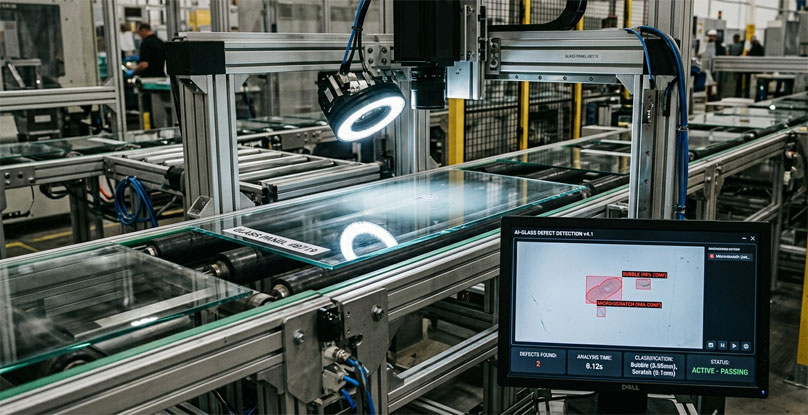
To overcome this challenge, manufacturers use dark field illumination combined with AI-powered machine vision systems. This approach highlights even the smallest defects on glass surfaces, enabling accurate automated inspection.
Challenges in Glass Surface Inspection
Glass inspection presents unique imaging challenges.
Transparent Material
Glass allows light to pass through, making it difficult to capture surface features.
Low Contrast Defects
Defects such as micro-scratches often have very low contrast.
Reflective Surfaces
Glass surfaces reflect light strongly, creating glare that can hide defects.
High Production Speeds
Glass manufacturing lines operate at high speeds, requiring rapid inspection.
Traditional inspection methods struggle to detect subtle defects under these conditions.
What is Dark Field Illumination?
Dark field illumination is a lighting technique used in machine vision to highlight surface irregularities and defects. Instead of shining light directly onto the object, dark field illumination uses very low-angle lighting.
How It Works
Light is projected at a shallow angle across the surface
Smooth surfaces reflect light away from the camera
Surface defects scatter light toward the camera
This makes defects appear bright against a dark background, allowing cameras to detect them easily.
Dark field illumination is particularly effective for detecting:
Scratches Cracks Chips Contamination Surface texture variationsHow AI Enhances Glass Defect Detection
AI-powered machine vision systems significantly improve the accuracy of glass inspection. AI algorithms analyze captured images and learn to identify complex defect patterns.
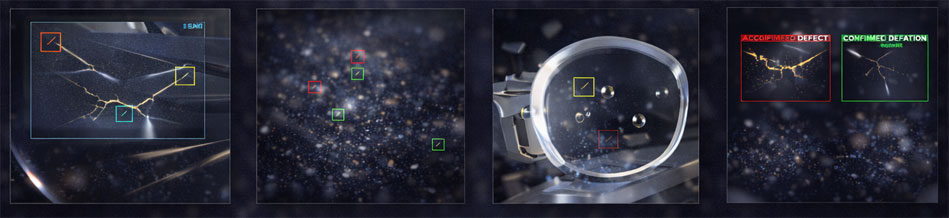
Capabilities of AI-Based Glass Inspection
Detect micro-scratches and cracks
Identify contamination or foreign particles
Detect bubbles or inclusions inside glass
Differentiate between real defects and acceptable variations
Deep learning models can also adapt to variations in glass type, lighting conditions, and production environments.
Inspection Workflow
AI-based glass inspection systems typically follow these steps.
Step 1 — Glass Positioning
Glass panels move through the inspection station on conveyors or rollers.
Step 2 — Dark Field Illumination
Low-angle lighting highlights surface defects.
Step 3 — Image Capture
High-resolution industrial cameras capture images of the glass surface.
Step 4 — AI Analysis
AI algorithms analyze images to detect defects.
Step 5 — Defect Classification
Defects are categorized based on type and severity.
Step 6 — Quality Decision
Defective glass pieces are rejected automatically.
Types of Glass Defects Detected
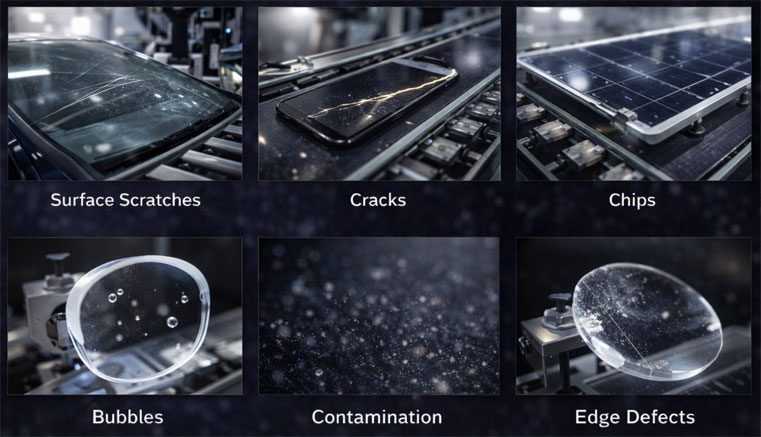
Surface Scratches
Fine scratches caused by handling or manufacturing.
Cracks
Structural cracks that weaken the glass.
Chips
Small pieces broken from the glass edges.
Bubbles
Air pockets trapped inside glass.
Contamination
Dust or foreign particles on the surface.
Edge Defects
Irregularities along glass edges.
Benefits of Automated Glass Inspection
High Detection Accuracy
Detect micro-defects that are difficult to see with the human eye.
High-Speed Inspection
Inspect glass panels at production line speeds.
100% Inspection Coverage
Every glass piece can be inspected automatically.
Reduced Human Error
Automation eliminates subjective manual inspection.
Data-Driven Quality Control
Inspection data can be stored for analysis and process improvement.
Industrial Applications
AI-based glass inspection systems are widely used across industries.
Automotive Industry
Inspection of windshields and side windows.
Consumer Electronics
Inspection of smartphone and tablet glass screens.
Solar Panel Manufacturing
Inspection of glass used in photovoltaic panels.
Architectural Glass Manufacturing
Inspection of large glass panels used in buildings.
Optical Glass Production
Inspection of lenses and optical components.
Intelgic’s Glass Inspection Solutions
Intelgic develops AI-powered glass inspection systems using advanced lighting techniques and machine vision technologies.
Intelgic solutions include:
These systems enable manufacturers to detect even the smallest defects on glass surfaces with high reliability.
Future of Glass Inspection Technology
Advancements in AI and machine vision are enabling more powerful glass inspection systems.
Future developments include:
Ultra-high-resolution imaging systems
AI models capable of detecting extremely small defects
3D glass surface inspection technologies
Integration with smart manufacturing systems
These innovations will enable fully automated glass quality inspection in modern manufacturing environments.
Glass defect detection using dark field illumination and AI-powered machine vision systems provides a highly effective solution for inspecting transparent materials.
By combining specialized lighting, high-resolution cameras, and AI-based analysis, manufacturers can detect even the smallest defects on glass surfaces and maintain high product quality.
As manufacturing continues to adopt automation and smart factory technologies, AI-driven glass inspection systems will become increasingly important for ensuring consistent quality and production efficiency.