High-Precision Automated Inspection for Automotive and Industrial Gears
Gears are one of the most critical components used in automotive transmissions, industrial machinery, robotics, aerospace systems, and power equipment. The performance, durability, and efficiency of these systems depend heavily on the dimensional accuracy of gears.
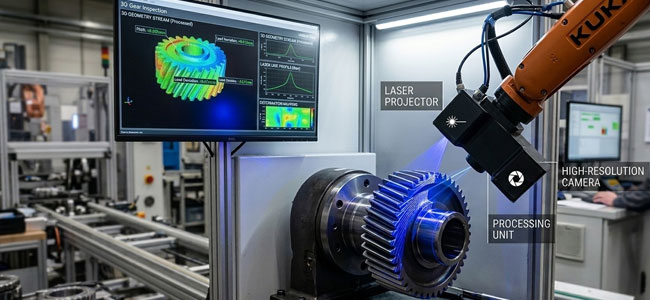
Even small deviations in gear geometry can cause vibration, noise, premature wear, or complete mechanical failure.
Traditionally, gear measurements were performed using contact-based metrology systems such as Coordinate Measuring Machines (CMM), gear measurement centers, or manual gauges. While these methods provide high accuracy, they are slow, labor-intensive, and difficult to integrate into automated production lines.
Modern manufacturers are increasingly adopting 3D laser profile cameras to perform high-speed, non-contact, and automated gear inspection directly within production environments.
What is a 3D Laser Profile Camera?
A 3D laser profile camera is an advanced measurement sensor that uses laser triangulation technology to capture the three-dimensional geometry of an object.
A laser line projector
Projects a thin line onto the surface of the gear.
A high-resolution camera
Captures the deformed laser line from a known angle.
A processing unit
Runs triangulation to compute 3D geometry.
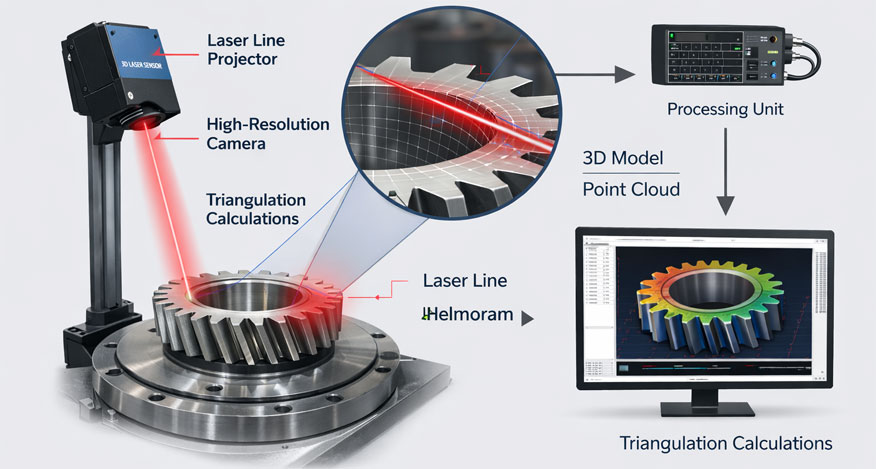
The laser projects a thin line onto the surface of the gear. When the gear surface deforms the laser line, the camera observes the deformation from a known angle. Using triangulation calculations, the system determines the precise height and position of each point along the laser line.
When the gear rotates or moves under the sensor, the camera continuously captures multiple profiles, which are combined to generate a complete 3D model or point cloud of the gear. This high-density data allows software systems to perform extremely precise dimensional measurements of gear features.
How It Works
- Laser projects a thin line onto the gear surface
- Camera observes the deformed laser line from a known angle
- Triangulation calculates precise height and position of each point
- Multiple profiles combine to create complete 3D model
Imaging Setup for Gear Measurement
The inspection setup typically includes several key components.
Mechanical Setup
- Rotary stage or spindle to rotate the gear
- 3D laser profile sensor mounted above or at an angle
- High-precision encoder to synchronize scanning
- Industrial controller or GPU processing unit
Inspection Process
- The gear is placed on a rotating spindle or fixture.
- The spindle rotates the gear at a controlled speed.
- The laser profile sensor scans the gear teeth as it rotates.
- Thousands of profile scans are captured during rotation.
- Software reconstructs the complete 3D geometry of the gear.
- Measurement algorithms extract critical gear parameters.
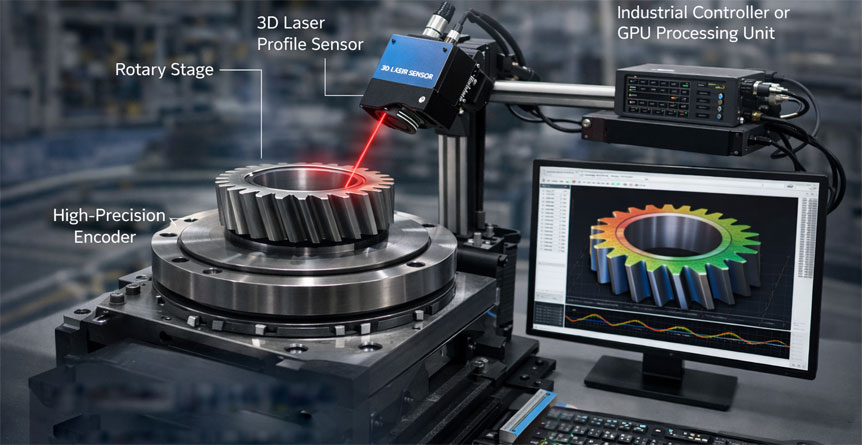
This automated system enables fast and repeatable gear inspection.
Key Gear Measurements Using Laser Profile Sensors
3D laser profiling systems can measure several critical gear parameters required for quality control.
1. Tooth Thickness
Tooth thickness directly affects how gears mesh together. If the thickness deviates from the design specification, it can cause improper contact between gears. The laser profile sensor captures the exact profile of each tooth, allowing the software to calculate the tooth thickness accurately.
2. Pitch Circle Diameter (PCD)
The pitch circle diameter represents the imaginary circle where the teeth of two gears effectively mesh. Using the 3D point cloud generated from the laser scan, the system calculates the pitch circle geometry and diameter with high precision.
3. Tooth Height and Depth
Laser profile cameras capture the complete height profile of each tooth, allowing accurate measurement of: addendum (tooth height above pitch circle), dedendum (depth below pitch circle), and total tooth height. This measurement ensures that the gear teeth will properly engage with mating gears.
4. Root Diameter
The root diameter is the diameter of the base circle where the tooth spaces end. Laser scanning provides a clear profile of the root area, allowing accurate measurement of root diameter and verification against CAD specifications.
5. Outside Diameter (OD)
The outside diameter of the gear is another important parameter that affects assembly and performance. By scanning the entire gear circumference, the system calculates the maximum radial dimension, providing an accurate outside diameter measurement.
6. Tooth Profile Accuracy
Laser profile sensors capture the complete shape of each gear tooth, enabling detailed profile analysis. Software algorithms compare the captured tooth geometry with the original CAD design or reference profile to detect deviations such as profile distortion, wear, and manufacturing defects.
7. Runout Measurement
Runout refers to the radial deviation of the gear during rotation. Using the 3D scan data, the system measures the variation in the gear’s circular motion to determine radial runout and axial runout. This is critical for preventing vibration and noise in gear systems.
Advantages of Laser Profile Based Gear Inspection
Non-Contact Measurement
Unlike CMM probes, laser sensors measure gears without touching the surface, preventing damage to delicate or finished gear surfaces.
High-Speed Inspection
Laser profile sensors can capture thousands of profiles per second, allowing gear inspection in seconds rather than minutes. This makes them ideal for production environments and automated inspection cells.
Automation Ready
Laser profile inspection systems can be easily integrated with robotic loading systems, conveyor lines, automated manufacturing cells, and PLC-based automation systems. This enables fully automated gear inspection without human intervention.
Full Surface Measurement
Traditional measurement systems often inspect selected points only, while laser profiling captures complete surface geometry, providing more comprehensive inspection.
High Data Density
Laser scanning produces dense point cloud data, enabling advanced analytics such as CAD comparison, wear analysis, deformation detection, and statistical process control.
Typical Industrial Applications
3D laser profile cameras are widely used for gear inspection in many industries.
Automotive Industry
- Transmission gears
- Differential gears
- Steering gears
- Timing gears
Industrial Machinery
- Heavy machinery gearboxes
- Robotic drive systems
- Industrial reducers
Aerospace Industry
- Turbine gears
- Aircraft actuation gears
Robotics and Automation
- Precision servo gears
- Planetary gears
Integration with Intelligent Inspection Software
Modern gear inspection systems integrate the 3D laser sensor with advanced software platforms. The software typically performs:
- 3D reconstruction
- Automatic feature extraction
- CAD comparison
- Tolerance validation
- Pass/fail decision making
- Statistical quality reporting
Results can be displayed on dashboards and integrated with MES systems, production monitoring systems, and cloud-based quality analytics platforms.
Example Workflow of Automated Gear Inspection
A typical automated gear inspection system works as follows:
- Gear is placed on a rotating spindle.
- The 3D laser profile sensor scans the gear teeth.
- The system generates a 3D point cloud model.
- Software extracts gear measurement parameters.
- The measurements are compared with tolerance limits.
- The system generates a pass/fail decision.
- A detailed inspection report is generated automatically.
3D laser profile cameras are transforming the way gears are inspected in modern manufacturing. By enabling fast, non-contact, and high-resolution measurement, these systems provide a powerful alternative to traditional gear measurement methods.
They allow manufacturers to perform automated, high-speed gear inspection directly on the production floor, improving product quality, reducing inspection time, and enabling real-time process monitoring.
As manufacturing moves toward Industry 4.0 and smart factories, laser-based 3D inspection systems are becoming an essential tool for automotive and industrial gear quality control.