In door manufacturing and sheet metal fabrication, dimensional accuracy is critical to ensure proper fit, smooth operation, and long-term durability of door assemblies. Door components such as panels, frames, reinforcements, and brackets must meet strict specifications for flatness, hole positions, hole diameters, and groove (rabbet) geometry.
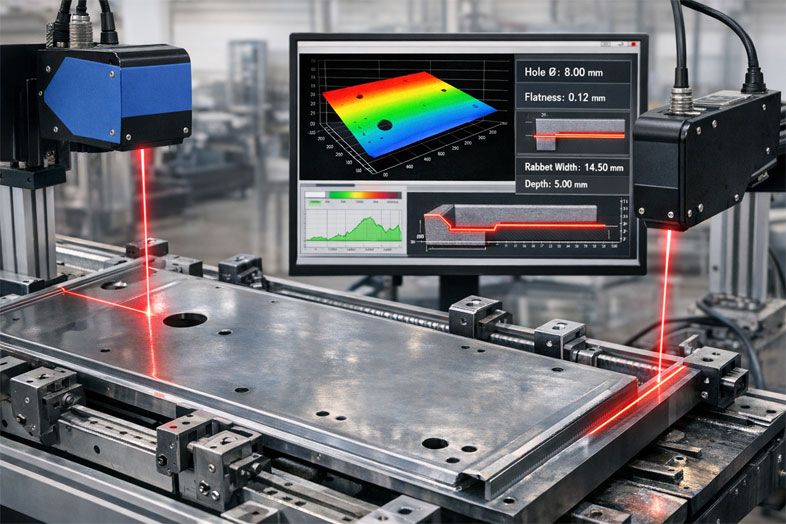
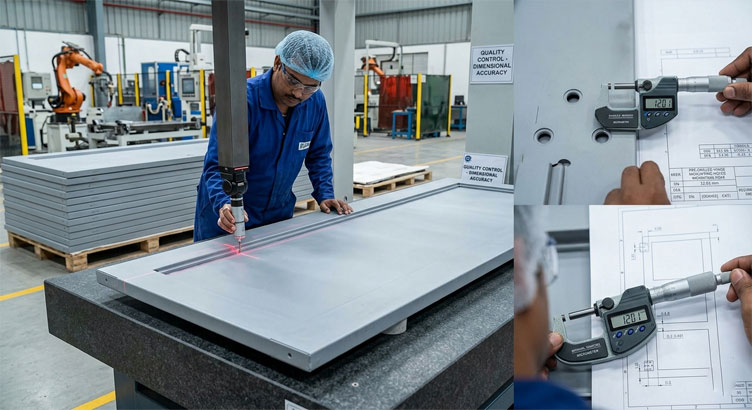
Traditional inspection methods—such as manual gauges, CMM machines, or template-based measurement—are often slow, labor-intensive, and unsuitable for high-volume production lines.
To address this challenge, Intelgic provides an advanced inspection system using laser profile-based 3D sensors. This technology enables accurate, non-contact measurement of door components to verify flatness, hole positions, diameters, and rabbet or groove dimensions with high precision.
Importance of Flatness and Dimensional Accuracy in Door Components
Door components must maintain precise geometric tolerances to ensure proper assembly and functionality. Common quality parameters include:
Flatness
Sheet metal door panels must remain flat to prevent alignment issues and structural distortion.
Hole Position Accuracy
Mounting holes for hinges, locks, and fasteners must be drilled at exact locations.
Hole Diameter
Incorrect hole sizes can cause fastening problems or assembly misalignment.
Rabbet or Groove Geometry
Grooves or rabbets used for panel alignment or sealing must meet precise depth and width specifications.
Even small deviations in these parameters can result in assembly issues, improper door alignment, or structural instability.
Laser Profile Sensor Technology
Laser profile sensors use laser triangulation technology to capture the cross-sectional shape of an object with high accuracy.
How It Works
A laser projects a thin line of light onto the surface of the door component.
A high-speed camera inside the sensor observes the deformation of the laser line.
Based on the deformation of the laser line, the system calculates the height profile of the surface.
As the component moves under the sensor, multiple profiles are captured and combined to generate a 3D point cloud of the component.
This method allows precise measurement of surface geometry and dimensional features.
Measurement Capabilities
Flatness Measurement Using Laser Profile Sensors
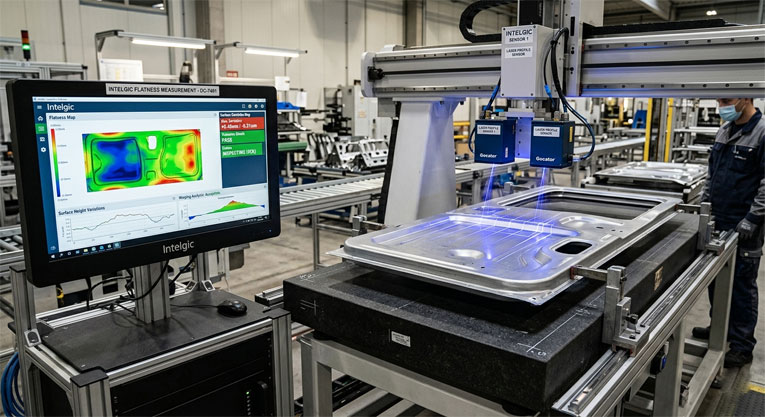
One of the key inspection parameters for door components is surface flatness. The laser sensor captures thousands of surface points across the door component.
Using this data, Intelgic's software calculates:
- Surface height variations
- Maximum deviation from the reference plane
- Warping or bending of the sheet metal
The system generates a flatness map, highlighting areas where the component deviates from the acceptable tolerance. This ensures that panels or frames meet design specifications before moving to the next manufacturing stage.
Hole Position Detection and Measurement
Laser profile sensors can accurately detect holes in metal components. As the sensor scans across the surface:
- The profile of the hole appears as a dip or discontinuity in the laser line
- Intelgic's software identifies the edges of the hole
- The center point of the hole is calculated
Using this information, the system measures:
- Hole position relative to reference edges
- Distance between holes
- Hole diameter
This ensures that holes are drilled exactly according to the design specifications.
Rabbet and Groove Measurement
Door components often include grooves or rabbets that are used for alignment, sealing, or structural assembly. Laser profile sensors are particularly effective at measuring these features because they capture the full cross-sectional geometry.
The system can measure:
- Groove depth
- Groove width
- Edge angle
- Distance between grooves
By analyzing the cross-sectional profile, the system ensures that rabbets and grooves meet the required dimensions.
Automated Inspection Workflow
A typical inspection system using laser profile sensors works as follows:
Component Placement
The door component is placed on a conveyor or inspection station.
Laser Scanning
The laser profile sensor scans across the component surface.
3D Point Cloud Generation
Multiple profiles are combined to create a full 3D representation.
Dimensional Analysis
Intelgic's software analyzes the point cloud to measure:
Pass/Fail Decision
The system compares measurements with the design tolerances.
Real-Time Visualization and Reporting
The inspection results are displayed on a user interface. The system can generate:
- 3D surface maps
- Flatness deviation graphs
- Hole measurement reports
- Groove dimension reports
Quality Traceability
Each inspected component can be stored with measurement results, inspection images, timestamp, and production batch information. This provides complete quality traceability for manufacturing operations.
Integration with Production Lines
Intelgic's laser profile inspection system can be integrated into automated manufacturing lines.
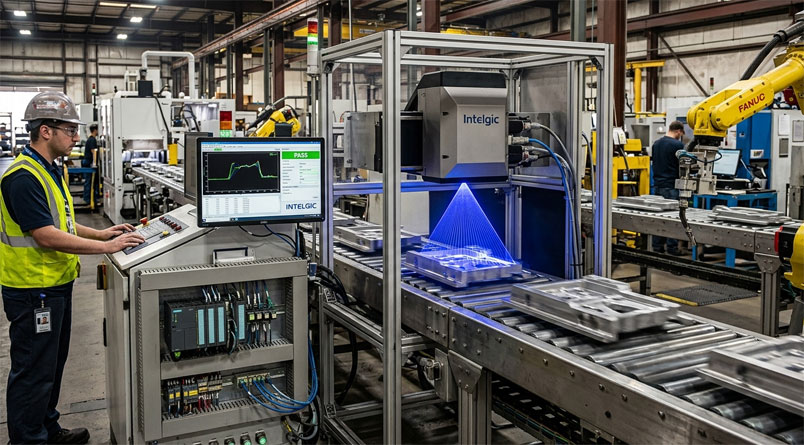
Integration options include:
- Conveyor-based inspection systems
- Robotic handling systems
- PLC-based automation control
- MES and ERP integration
This allows continuous inspection without slowing down production.
Benefits of Laser Profile-Based Inspection
High Measurement Accuracy
Laser triangulation sensors provide micron-level measurement precision.
Non-Contact Measurement
No physical contact with the component surface.
High-Speed Inspection
Suitable for inline inspection in production environments.
Comprehensive Geometry Analysis
Simultaneously measures flatness, holes, and grooves.
Reduced Manual Inspection
Automates complex dimensional measurements, reducing labor costs and human error.
Applications in Door and Metal Component Manufacturing
Laser profile-based inspection systems are widely used for:
- Door frame inspection
- Metal panel flatness testing
- Automotive body panel measurement
- Sheet metal component inspection
- Structural metal fabrication
Maintaining dimensional accuracy in door components is essential for ensuring proper assembly and product quality. Intelgic's laser profile-based inspection system provides a powerful solution for measuring flatness, hole positions, hole diameters, and rabbet or groove geometry with high precision.
By using advanced 3D laser scanning technology combined with intelligent analysis software, manufacturers can automate dimensional inspection, reduce quality defects, and ensure that every door component meets the required design specifications.
This technology transforms traditional quality inspection into a high-speed, automated, and data-driven process for modern manufacturing environments.