In industrial machine vision, camera resolution alone does not determine defect detection accuracy. The true performance of a vision system depends largely on lighting control.
Among all lighting components, diffusers and reflectors play a decisive role in extracting fine surface details, suppressing unwanted glare, and enhancing contrast for reliable AI-based defect detection.
At Intelgic, lighting geometry is engineered as carefully as the AI model itself—because without proper light control, even the best inspection algorithms cannot perform accurately.
Why Lighting Is More Important Than the Camera
Industrial defects such as micro scratches, surface dents, hairline cracks, coating inconsistencies, texture deviations, and print quality defects are often invisible without the correct lighting strategy.
⚡ Two identical cameras can produce completely different inspection results depending on whether diffusers and reflectors are properly integrated.
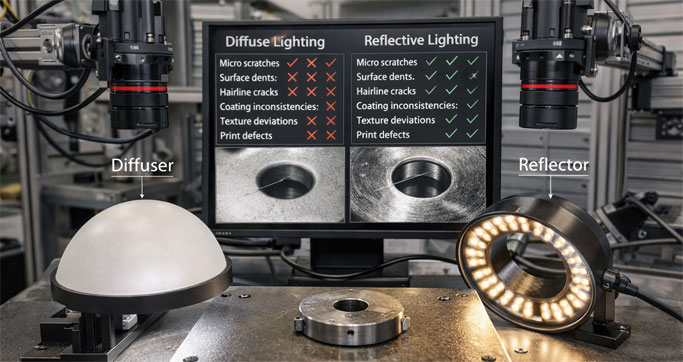
The Role of Diffusers in Machine Vision
A diffuser spreads light uniformly before it reaches the object. Instead of sharp, directional beams, it creates soft, evenly distributed illumination.
What Diffusers Do:
- Eliminate harsh reflections
- Reduce hot spots
- Improve uniformity across the field of view
- Minimize shadow formation
- Enhance image consistency
When Diffusers Are Essential:
- Shiny or reflective materials (chrome, polished metal, glass)
- Plastic or glossy surfaces
- Printed packaging
- Medical devices with smooth finish
Without diffusion, reflective surfaces cause glare that hides defects and misleads AI detection systems.
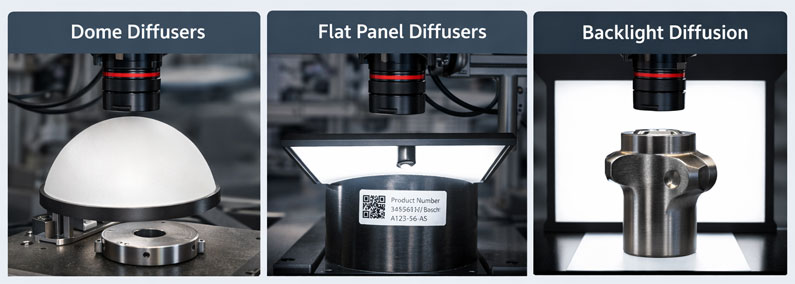
Types of Diffusion Used in Industrial Inspection
Dome Diffusers
Creates omni-directional soft light around the part.
Best for:
- Highly reflective components
- Curved parts
- Surface uniformity inspection
Flat Panel Diffusers
Used for even front lighting.
Ideal for:
- Label inspection
- Surface texture validation
- Color verification
Backlight Diffusion
Provides uniform silhouette imaging.
Used for:
- Dimensional measurements
- Edge detection
- Crack and contour inspection
At Intelgic, diffuser selection is determined based on product geometry, reflectivity, and inspection goals.
The Role of Reflectors in Defect Enhancement
While diffusers soften light, reflectors control and redirect light to emphasize surface irregularities.
Reflectors help create specific lighting effects such as bright-field illumination, dark-field illumination, low-angle grazing light, and specular reflection enhancement.
Bright Field vs Dark Field – Controlled Through Reflectors
Bright Field Lighting
Light is directed straight toward the camera axis. Reflectors help ensure maximum return reflection.
Best for:
- Print verification
- Color consistency
- Surface cleanliness
Dark Field Lighting
Light is projected at a very low angle across the surface. Surface defects scatter light upward while smooth surfaces reflect light away.
Powerful for detecting:
- Scratches
- Micro dents
- Burrs
- Cracks
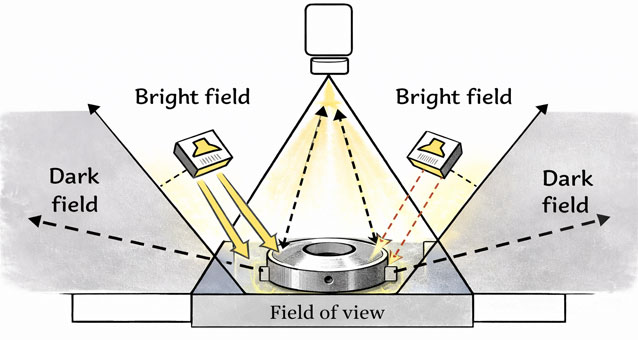
⚠️ Without proper reflector geometry, dark-field imaging will fail to highlight subtle defects.
How Diffusers and Reflectors Work Together
In advanced inspection systems designed by Intelgic:
System Integration Flow
The Combined Effect Creates:
High contrast defect boundaries
Stable image repeatability
AI-ready image quality
Reduced false positives
Real-World Example: Metal Surface Scratch Detection
Problem:
Highly polished aluminum surface reflects direct light, hiding scratches.
Solution:
- Dome diffuser to reduce direct glare
- Low-angle ring light
- Reflector positioned at calculated angle
- Polarizing filter to suppress specular reflection
Result:
Scratches scatter light differently than smooth areas, making them clearly visible to AI.
Controlled Lighting Environment
CFor reliable defect detection
- Ambient light must be blocked
- Lighting intensity must be stabilized
- Diffuser material must not yellow over time
- Reflector angle must be mechanically fixed
Even minor shifts in reflector angle can change inspection results significantly.
Impact on AI-Based Defect Detection
AI Models Perform Best When:
Proper diffusion and reflection engineering reduces:
Model retraining frequency
False reject rates
False acceptance rates
Data variability
At Intelgic, lighting is not an afterthought—it is engineered as part of the complete optical design.
Industries That Benefit from Optimized Diffusion & Reflection
In precision defect detection, lighting geometry defines success.
Diffusers create uniform illumination and eliminate unwanted reflections, while reflectors strategically direct light to amplify surface irregularities.
Together, they reveal hidden defects, improve AI accuracy, increase inspection reliability, and reduce system variability.
At Intelgic, we design custom diffuser-reflector geometries tailored to each product’s material and inspection requirement—ensuring the highest level of imaging precision for industrial automation.