Defect Detection On Metal Surfaces using Diffused Light Generated from Reflective Materials
Published on: Feb 17, 2026

Written by:Content team, Intelgic
An Educational Guide by Intelgic
In industrial inspection, highly reflective materials like polished metal, stainless steel, chrome, or coated aluminum present a major challenge. Direct illumination often produces glare, hot spots, and specular reflections that hide micro-defects instead of revealing them.
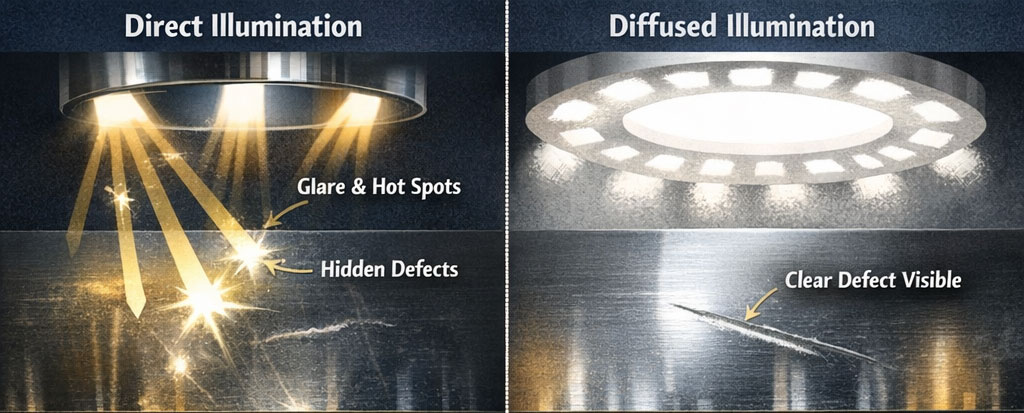
At Intelgic, we engineer controlled reflective lighting geometries to generate indirect diffused illumination — dramatically improving contrast between a defect and a “good” surface. This article explains the physics, methodology, and practical implementation of creating diffused light using reflective materials for precision defect detection.
Why Direct Illumination Fails on Metal Surfaces
When a light source directly hits a smooth metallic surface:
- Light reflects at a mirror angle (specular reflection)
- Bright hot spots appear in the image
- Camera sensors get saturated
- Micro defects become invisible
- AI models struggle with inconsistent contrast
Highly polished surfaces reflect light like mirrors. Instead of highlighting surface variation, direct light flattens the image. The solution is controlled reflection-based diffusion..
The Principle Behind Reflective Diffusion
Instead of shining light directly on the object, Intelgic uses this strategy:
- Light is aimed at a reflective surface (mirror or engineered white board)
- Light bounces off the reflective surface
- Reflected light spreads more uniformly
- The object is illuminated indirectly
This produces softer, evenly distributed illumination without harsh glare.
Types of Reflective Materials Used
Mirror-Based Reflection
Used when: Sharp directional control is needed, precise incident angles must be maintained, structured reflection geometry is required.
Matte White Reflective Panels
Used when: Soft, broad diffusion is required, surface has curved or complex geometry, contrast needs uniform enhancement.
High-reflectance white boards (>95% reflectivity) scatter light in multiple directions, effectively converting directional light into indirect diffuse light.
How Reflective Diffusion Enhances Defect Visibility
Defects such as micro scratches, hairline cracks, surface dents, coating irregularities, and texture inconsistencies change how light scatters.
Light reflects evenly
Light scatters irregularly
This difference creates measurable contrast that cameras and AI can detect.
Understanding the Physics: Why This Works
Direct Light
Causes Specular Reflection. On smooth metallic surfaces, specular reflection hides defects because the mirror-like surface reflects the light source directly away, flattening the appearance.
Indirect Reflected Light
Creates Controlled Diffused Reflection. When light is first scattered off a white reflective material, beam coherence reduces, illumination spreads uniformly, and surface scattering differences become visible.
Practical Implementation Strategy at Intelgic
Analyze Surface Reflectivity
Is it Polished? Brushed? Coated? Textured?
Select Reflective Medium
Mirror (for structured reflection) or White matte reflector (for diffusion). Consider hybrid reflective dome geometry.
Optimize Angle
The critical factor: Angle of reflection determines defect visibility. Small adjustments (2–5 degrees) can significantly change contrast.
Control Environment
Block ambient light, enclose inspection station, stabilize light intensity.
Validate With AI Feedback
Test image histogram stability, contrast enhancement, and defect edge sharpness.
When to Use Reflective Diffused Lighting
This technique is highly effective for:
Advanced Combination Techniques
At Intelgic, we often combine multiple technologies to achieve maximum sensitivity:
- Reflective diffusion lighting
- Low-angle grazing illumination
- Polarizing filters
- Multi-angle image capture
- HDR imaging
Case Example: Stainless Steel Scratch Detection
Problem
Direct light caused strong glare, hiding micro scratches.
Solution
- Light projected onto white reflective board
- Indirect illumination used
- Polarization filter added
- Controlled enclosure
Result
Micro scratches became visible as subtle contrast lines, improving AI detection accuracy significantly.
Advantages of Reflective Diffusion Technique
Reduces glare on shiny materials
Improves micro-defect contrast
Enhances AI detection accuracy
Stabilizes image quality
Reduces need for excessive algorithm tuning
Works in high-precision industrial environments
Why Lighting Engineering Matters in AI Inspection
"AI cannot compensate for poor lighting."
Lighting determines:
By engineering reflection-based diffusion geometries, Intelgic ensures that image quality is optimized before AI processing begins.
For highly reflective materials, direct illumination often fails to reveal subtle defects. By redirecting light onto reflective materials such as mirrors or engineered white panels, Intelgic creates controlled diffused illumination that enhances surface contrast and defect visibility.
This technique transforms difficult inspection challenges into stable, repeatable, AI-ready imaging systems.