Car Door Inspection Using AI, Machine Vision, and 3D Measurement Systems
Published on: Apr 17, 2026

Written by:Content team, Intelgic
In automotive manufacturing, car doors are among the most critical components from both a functional and visual quality perspective. A door must meet strict standards for dimensional accuracy, surface quality, hole positions, weld integrity, assembly completeness, and final fitment. Even a small defect in a car door can lead to poor aesthetics, water leakage, noise issues, improper closing, or costly rework downstream.
Traditional inspection methods for car doors often rely on manual visual checks, handheld gauges, fixture-based measurements, and offline quality stations. These methods are slow, inconsistent, labor-intensive, and difficult to scale for high-volume automotive production.
This is where automated car door inspection systems become highly valuable. By combining machine vision cameras, AI-powered defect detection, 3D laser profile sensors, robotics, and industrial automation, manufacturers can inspect every car door with speed, consistency, and traceability.
At Intelgic, we develop turnkey AI-powered inspection systems for automotive parts, including complex sheet metal and assembled components such as car doors. Our systems are designed to detect cosmetic defects, verify dimensions, inspect holes and features, measure profile and flatness, and generate inspection results in real time.
Why Car Door Inspection Is Challenging
A car door is not a simple flat metal panel. It is a complex part with multiple surfaces, curves, cutouts, holes, edges, bends, flanges, reinforcements, and assembly features. Depending on the inspection stage, the door may be inspected as:
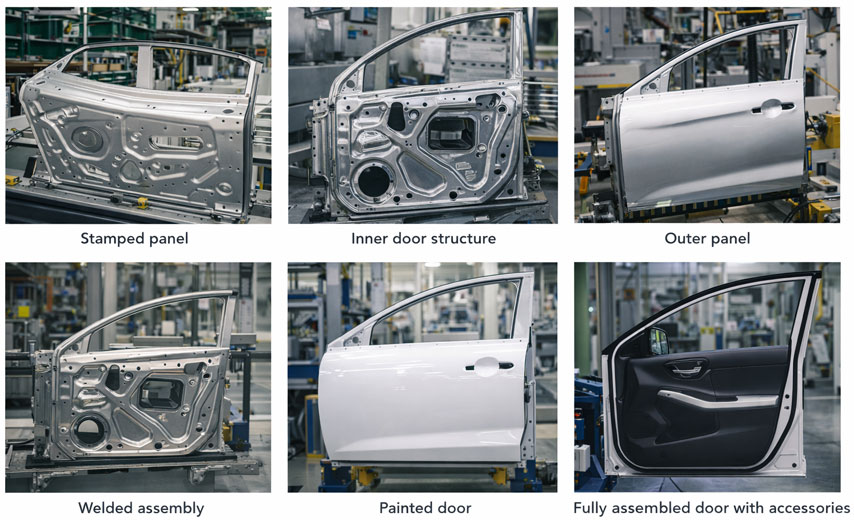
- A stamped panel
- An inner door structure
- An outer panel
- A welded assembly
- A painted door
- A fully assembled door with accessories
Each stage introduces different inspection requirements.
Common challenges in car door inspection include:
- Large part size with multiple inspection zones
- Reflective metallic or painted surfaces
- Curved geometry and varying heights
- Tight dimensional tolerances
- Presence of holes, slots, bends, and flanges
- Detection of dents, scratches, waviness, and deformation
- Verification of weld points and assembly completeness
- Need for fast cycle time in automotive lines
- Requirement for repeatable and traceable inspection results
Because of these challenges, automotive manufacturers increasingly move toward automated inspection systems that combine optical imaging, AI, and 3D measurement.
What Needs to Be Inspected in a Car Door
The exact inspection criteria depend on the manufacturing stage, but a complete car door inspection system may include the following checkpoints.
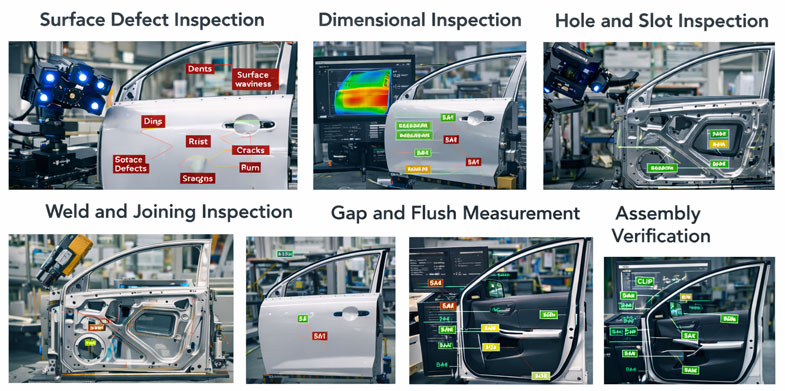
Surface Defect Inspection
Machine vision and AI can be used to inspect visible surface defects such as:
- Scratches
- Dents
- Dings
- Surface waviness
- Cracks
- Pits
- Rust spots
- Coating defects
- Paint blemishes
- Burn marks
- Stains or contamination
- Handling damage
For painted or class-A surfaces, the inspection system must detect even subtle visual variations without being affected by reflections and glare. This requires specialized lighting and robust image processing.
Dimensional Inspection
3D laser profile sensors and measurement algorithms can verify dimensional parameters such as:
- Overall door width and height
- Edge profile
- Flange height
- Bend angle
- Step height
- Contour shape
- Opening dimensions
- Feature positions
- Bracket alignment
- Reinforcement placement
This helps ensure the door meets design tolerances and will fit properly in downstream assembly.
Hole and Slot Inspection
Car doors typically contain multiple holes, slots, and cutouts for hinges, handles, locks, glass mechanisms, fasteners, clips, and mounting points. An automated system can inspect:
- Hole presence or absence
- Hole diameter
- Hole shape
- Hole position in X and Y
- Slot dimensions
- Cutout profile
- Missing or deformed features
Accurate hole position measurement is essential because any deviation can affect assembly quality.
Weld and Joining Inspection
For inner door assemblies and welded structures, the inspection system can verify:
- Weld presence
- Weld location
- Weld spacing
- Missing weld points
- Deformation around weld zones
- Assembly alignment after joining
This helps detect structural issues early in the production line.
Gap and Flush Measurement
When doors are inspected at assembly or fitment stage, the system may measure:
- Door-to-body gap
- Flushness with adjacent panels
- Hinge-side alignment
- Latch-side position
- Top and bottom fitment consistency
These checks are critical for vehicle appearance and door performance.
Assembly Verification
For partially or fully assembled doors, AI vision systems can verify:
- Presence of clips
- Fasteners installed correctly
- Handle components
- Wiring harness routing
- Seal placement
- Adhesive bead presence
- Bracket orientation
- Subcomponent completeness
This reduces assembly errors and prevents defective units from moving to final assembly.
Technologies Used in Automated Car Door Inspection
An effective car door inspection system often uses multiple technologies together rather than relying on a single sensor.
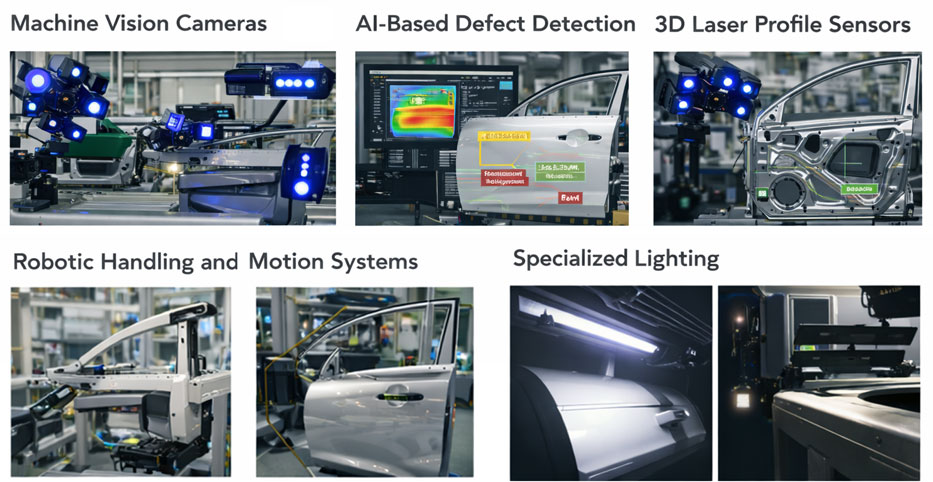
Machine Vision Cameras
High-resolution industrial cameras are used to capture images of surface features, holes, edges, welds, and assembly details. Depending on the application, the system may use:
- Area scan cameras for stationary imaging
- Line scan cameras for large surface inspection
- Multiple cameras for different sides and zones
- Overhead and side cameras for full coverage
These cameras are combined with controlled lighting for high-contrast imaging.
AI-Based Defect Detection
AI models are trained to detect defects that are difficult to define with conventional rule-based image processing. AI is especially useful for identifying:
- Complex surface anomalies
- Cosmetic defects with variable appearance
- Subtle scratches and dents
- Shape irregularities
- Assembly deviations
Intelgic's AI-powered inspection software can analyze images in real time and classify defects with high accuracy.
3D Laser Profile Sensors
For measurement inspection, 3D laser profile sensors generate precise profile and point cloud data. These sensors are ideal for inspecting:
- Contour geometry
- Flange dimensions
- Bends and deformations
- Hole profiles
- Step heights
- Flatness and warpage
- Edge positions
3D inspection is especially useful when the part geometry is not suitable for 2D-only inspection.
Robotic Handling and Motion Systems
Because a car door is large and has multiple inspection zones, robotic or automated motion systems are often used to bring the cameras or sensors to the right positions. The system may include:
- Robotic arms
- Linear motion stages
- Gantry systems
- Rotary fixtures
- Conveyors and part positioning systems
This enables repeatable imaging of all required surfaces.
Specialized Lighting
Lighting plays a major role in reliable automotive inspection. Different lighting methods may be used for different checks:
- Diffused lighting for reflective surfaces
- Dark field lighting for scratches and dents
- Low-angle lighting for texture defects
- Coaxial lighting for certain flat regions
- Backlighting for edge and hole profile measurement
A controlled enclosure is often used to eliminate ambient light interference.
How an Automated Car Door Inspection System Works
A typical automated inspection workflow for car doors may look like this:
Step 1: Part Loading
The car door is loaded manually, through a conveyor, or by a robot onto the inspection station.
Step 2: Part Identification
The system receives the model or variant information from PLC, barcode, QR code, or MES so the correct inspection recipe can be loaded automatically.
Step 3: Positioning
The part is positioned using fixtures, locators, conveyors, or robotics to ensure repeatable inspection.
Step 4: Imaging and Scanning
Industrial cameras and 3D sensors capture images and profile data from all required inspection regions. If needed, actuators or robots move cameras around the part for detailed imaging.
Step 5: AI and Measurement Processing
The software processes the captured data to:
- Detect visual defects
- Verify dimensions
- Measure holes and slots
- Inspect weld presence
- Identify missing components
- Classify pass/fail status
Step 6: Result Display
Inspection results are shown on the HMI or operator screen with:
- Pass/fail decision
- Defect type
- Defect location
- Measurement values
- Annotated images
- Trend information
Step 7: Integration and Traceability
The results are sent to PLC, MES, ERP, or cloud database. The system can also generate digital inspection records for traceability.
Benefits of AI-Powered Car Door Inspection
Automating car door inspection offers significant advantages over manual inspection methods.
Higher Inspection Consistency
Manual inspection depends on operator skill, attention, and fatigue. Automated systems inspect every part using the same logic and acceptance criteria.
Faster Cycle Time
Automated inspection systems can work inline or near-inline and keep pace with automotive production lines.
Early Defect Detection
Defects can be identified early in stamping, welding, or assembly stages before additional value is added to the part.
Reduced Rework and Scrap
By catching defects early and accurately, manufacturers can reduce downstream rework, assembly issues, and scrap costs.
Better Traceability
Every inspected door can be linked to images, defect data, measurements, timestamps, and model information.
Scalable Multi-Variant Inspection
Recipe-based systems can automatically switch between door variants and inspection criteria.
Improved Final Vehicle Quality
Better door inspection leads to improved fitment, aesthetics, and customer satisfaction.
Car Door Inspection Use Cases in Automotive Manufacturing
Automated inspection can be applied at multiple points in the door manufacturing process.
Stamped Panel Inspection
Inspect raw stamped door panels for:
- Dents
- Cracks
- Cdge deformation
- Hole position
- Trimming quality
- Flange condition
Welded Door Structure Inspection
Inspect inner structures and joined assemblies for:
- Missing welds
- Feature alignment
- Structural deformation
- Dimensional conformance
Paint and Surface Finish Inspection
Inspect painted doors for:
- Orange peel
- Blemishes
- Scratches
- Contamination
- Color inconsistency
- Dents visible under finish
Assembly Inspection
Inspect assembled doors for:
- Missing clips
- Fasteners installed correctly
- Handle components
- Wiring harness routing
- Seal placement
- Adhesive bead presence
- Bracket orientation
- Subcomponent completeness
Gap and Flush Inspection
Inspect vehicle-side fitment for:
- Gap uniformity
- Panel alignment
- Flushness relative to body panels
Key Design Considerations for a Car Door Inspection System
Every car door inspection application is different. The final system design depends on part size, line speed, defect type, and inspection objectives. Important design considerations include:
- Stage of inspection in manufacturing
- Type of defects to be detected
- Required dimensional tolerance
- Line cycle time
- Part handling method
- Number of variants
- Reflective or painted surface behavior
- Integration with existing automation
- Traceability requirements
- Operator interaction and reporting needs
At Intelgic, we design custom turnkey systems based on the exact production environment and quality objectives of the customer.
Intelgic's Approach to Car Door Inspection Automation
Intelgic provides complete AI-powered inspection automation systems for complex automotive components. For car door inspection, our solution can include:
Our systems are not limited to cameras and software alone. We develop the complete solution, including automation, imaging architecture, control integration, defect analytics, and reporting.
Depending on the application, Intelgic can build:
Why Automotive Manufacturers Need Smarter Door Inspection
As automotive quality expectations increase, traditional inspection approaches are becoming inadequate. Car doors are highly visible, highly functional, and highly sensitive to dimensional and cosmetic variation. Manufacturers need inspection systems that are fast, accurate, repeatable, and capable of handling complex geometries.
AI and machine vision make it possible to inspect large automotive components more intelligently. Combined with 3D measurement and industrial automation, these systems help manufacturers move closer to zero-defect production.
For car door manufacturers, Tier 1 suppliers, and automotive OEMs, automated inspection is no longer just a quality tool. It is a productivity, traceability, and brand-protection tool.
Car door inspection is a critical part of automotive quality assurance. From surface defects and hole positions to dimensional accuracy and assembly verification, each door must be inspected thoroughly to ensure quality, fitment, and customer satisfaction.
An AI-powered inspection system using machine vision cameras, 3D laser profile sensors, and industrial automation can transform this process. It improves accuracy, reduces manual dependency, increases throughput, and delivers reliable traceability.
Intelgic develops turnkey automated inspection systems for complex automotive components, including car door inspection solutions tailored to the customer's production process and quality requirements.
If you are looking to automate car door inspection using AI, machine vision, and 3D measurement technology, Intelgic can help design and implement the right solution for your manufacturing environment.