Automotive Parts Quality Inspection Using Robot, Camera, and AI
Published on: Apr 17, 2026

Written by:Content team, Intelgic
Automotive manufacturing demands extremely high quality standards. Components used in vehicles must meet strict dimensional, cosmetic, and functional requirements before they move to assembly. Even a tiny defect in a critical automotive part can lead to performance issues, safety risks, warranty claims, and brand damage.
Many automotive parts are not simple flat components. They often have complex geometries, multiple surfaces, pockets, ribs, holes, curves, edges, and hard-to-reach regions. Because of this, a single camera image is often not enough to inspect the entire part properly. Important defects may remain hidden if only one viewing angle is used.
This is where robotic quality inspection systems become highly effective. By combining robots, industrial cameras, controlled lighting, and AI-powered defect detection, manufacturers can inspect complex automotive parts from multiple angles with speed, repeatability, and precision.
At Intelgic, we develop robotic inspection systems that move the camera around the part to capture multiple images of all critical surfaces. These images are processed by AI to detect defects smaller than 100 microns, helping manufacturers achieve high inspection accuracy and move closer to zero-defect production.
Why Complex Automotive Parts Are Difficult to Inspect
Automotive parts are often challenging to inspect because of their shape, finish, and inspection requirements. Components such as die-cast housings, machined parts, engine components, transmission parts, structural brackets, castings, molded parts, and assemblies may have several visible and hidden surfaces.
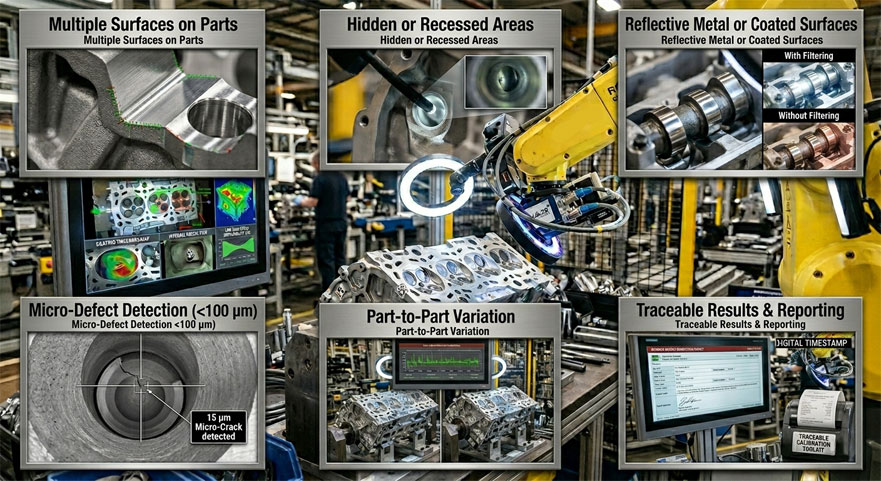
A single top-view image cannot cover all these regions. Some surfaces may be vertical, curved, recessed, shadowed, reflective, or partially blocked by the part geometry itself. In many cases, defects are very small and require close-up imaging with the correct angle and lighting.
Common inspection challenges include:
These challenges make manual inspection inconsistent and make fixed-camera systems insufficient for many applications.
Why a Single Camera Shot Is Not Enough
For simple flat products, one overhead camera may be enough. But in automotive manufacturing, many components have three-dimensional geometry and critical features on multiple sides.
For example, a complex automotive part may have:
A fixed camera can only see what is visible from one direction. If the part has multiple inspection zones, several images from different angles are needed. In many cases, the camera must be brought very close to specific features for detailed imaging.
This is why Intelgic uses robots to move the camera and imaging head around the part. The robot allows the inspection system to capture multiple images from optimized positions and angles, ensuring full coverage of all required surfaces.
How Robotic Inspection Works
In a robotic quality inspection system, the automotive part is placed in a defined inspection station. A robot arm moves the camera, lighting, and sometimes additional sensors around the part according to a programmed inspection path.
At each position, the system captures a high-resolution image of a particular surface or feature. This process continues until all the relevant areas of the part are covered.
The captured images are then processed by Intelgic’s AI software to detect defects and make a pass/fail decision.
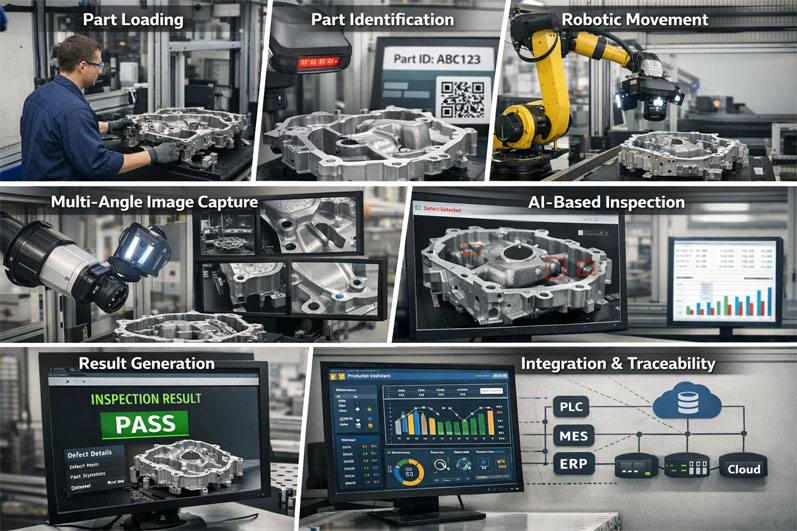
A typical workflow includes:
Part Loading
The operator, conveyor, or automation system loads the automotive part into the inspection station.
Part Identification
The system reads the part model, barcode, QR code, or receives the variant information from PLC or MES so that the correct inspection recipe can be loaded.
Robotic Movement
The robot follows a predefined path and moves the camera to multiple imaging points around the part.
Multi-Angle Image Capture
The camera captures detailed images of different surfaces, edges, pockets, holes, and critical zones.
AI-Based Inspection
Images are processed by AI algorithms trained to identify defects, anomalies, and quality deviations.
Result Generation
The software provides pass/fail decisions, defect classification, defect position, and image-based evidence.
Integration and Traceability
Results sent to PLC, MES, ERP, databases, or cloud dashboards for production monitoring.
Technologies Used in Automotive Parts Quality Inspection
An advanced robotic inspection system combines multiple technologies to achieve reliable results.
Robot for Camera Movement
The robot is used to move the camera and lighting to the exact positions needed for imaging. This ensures repeatability and full coverage of complex parts. The robot can inspect multiple sides and reach angles that are difficult for fixed-camera systems.
Industrial Cameras
High-resolution machine vision cameras capture fine details on the part surface. Depending on the application, different lenses and resolutions are selected so the system can detect very small defects, including defects less than 100 microns.
Specialized Lighting
Lighting is critical in machine vision. The right lighting helps highlight scratches, dents, burrs, cracks, contamination, machining defects, and surface anomalies. Depending on the material and defect type, the inspection system may use diffused lighting, dark field lighting, coaxial lighting, or structured illumination.
AI-Powered Defect Detection
AI processes the captured images to detect and classify defects automatically. Unlike traditional rule-based vision alone, AI can learn defect patterns and handle natural variation better, which improves detection accuracy for difficult and complex surfaces.
GPU-Based Processing System
The images captured from multiple viewpoints are processed in a GPU-based industrial computer. This enables fast inference and supports real-time or near-real-time decision making.
PLC and Software Integration
The robotic inspection system can integrate with industrial PLCs, HMIs, MES, ERP systems, and cloud platforms for production control and traceability.
What Defects Can Be Detected?
Robotic AI inspection systems can be used to detect a wide variety of defects in automotive parts depending on the application, imaging setup, and training data.
When designed correctly, the system can detect micro-level defects smaller than 100 microns on selected surfaces.
Detecting Defects Smaller Than 100 Microns
Detecting defects below 100 microns requires more than just a good camera. It requires the right combination of optics, illumination, motion stability, image resolution, and AI.
At Intelgic, the inspection strategy is designed around the defect size requirement. To detect fine defects less than 100 microns, the system may include:
- High-resolution machine vision cameras
- Precision optics for close-up imaging
- Stable robotic positioning
- Carefully engineered lighting
- Enclosed inspection environment to eliminate ambient interference
- Image enhancement and preprocessing
- AI models trained specifically on defect samples
This combination allows the system to capture usable defect information with high consistency.
Benefits of Using Robot, Camera, and AI for Automotive Inspection
Full Surface Coverage
The robot moves the camera to multiple positions, inspecting surfaces that fixed cameras cannot see properly.
Higher Inspection Accuracy
With optimized angles, controlled lighting, and AI analysis, detect small and difficult defects reliably.
Better Repeatability
Robotic movement is highly repeatable. Every part is inspected using the same imaging sequence.
Reduced Manual Dependency
Reduces dependence on operator judgment and fatigue, improving consistency.
Faster Inspection of Complex Parts
One robotic system can inspect multiple regions in a structured sequence vs. several manual checks.
Traceability & Reporting
Each part linked to stored images, defect locations, timestamps, and pass/fail records.
Multi-Variant Capability
Recipe-based software allows the same robotic inspection cell to handle multiple part variants with automatic program switching.
Applications in Automotive Manufacturing
Robotic camera-based AI inspection can be applied to many automotive components and manufacturing stages. This approach is especially useful where geometry is complex and the inspection area cannot be covered with one camera position.
Key Design Considerations for a Robotic Inspection System
Every automotive part inspection project is different. The final system design depends on the part geometry, defect type, takt time, and quality requirement. A successful inspection system is not just about adding a robot and camera. It requires complete system engineering so that imaging quality, AI performance, and automation flow all work together.
Intelgic's Approach to Robotic Automotive Parts Inspection
Intelgic provides turnkey AI-powered robotic inspection systems for complex manufacturing applications. For automotive parts inspection, our solution includes:
Industrial Robot
For precise camera movement
High-Resolution Camera
Machine vision cameras
Specialized Lenses
For micro-defect imaging
Application-Specific Lighting
Optimized illumination system
Inspection Enclosure
Blocks ambient light
GPU-Based Processing
Industrial computer systems
Intelgic AI Software
For defect detection
Recipe-Based Inspection
Multiple part variants support
System Integration
PLC, MES, ERP, and cloud
Real-Time Visualization
Defect reporting and dashboards
Our robotic systems are designed to inspect complex automotive parts thoroughly by imaging multiple surfaces in a controlled and repeatable way. This makes them ideal for manufacturers looking to improve quality control, reduce escapes, and automate inspection of difficult parts.
Why This Inspection Method Matters for the Future of Automotive Manufacturing
As vehicles become more advanced and quality expectations become higher, manufacturers need smarter inspection systems. Manual inspection and fixed single-camera systems are often not enough for modern automotive parts with complex geometry and fine defect requirements.
Robotic vision inspection powered by AI offers a practical path toward smarter manufacturing. It gives manufacturers the ability to inspect more thoroughly, detect smaller defects, and maintain consistent quality across production volumes.
For OEMs and Tier 1 Suppliers, this means:
Complex automotive parts cannot always be inspected reliably with a single camera shot. Multiple surfaces, hidden features, curved geometry, and micro-level defects require a more advanced approach.
By using robots to move the camera, capture multiple images, and cover the entire part, manufacturers can achieve far better inspection coverage. When those images are processed by AI, the system becomes capable of detecting extremely small defects, including defects smaller than 100 microns.
Intelgic develops turnkey robotic inspection systems that combine robots, cameras, lighting, AI, and industrial automation for high-precision quality inspection in automotive manufacturing.
If your automotive parts require multi-angle imaging and accurate AI-based defect detection, robotic camera inspection is one of the most effective ways to automate the process.