Automated Insulator Inspection Using Machine Vision Cameras and Intelgic’s AI
Published on: Mar 16, 2026

Written by:Content team, Intelgic
High-voltage insulators are critical components in power transmission and distribution infrastructure. These components electrically isolate energized conductors from towers and supporting structures while withstanding extreme environmental and electrical stresses.
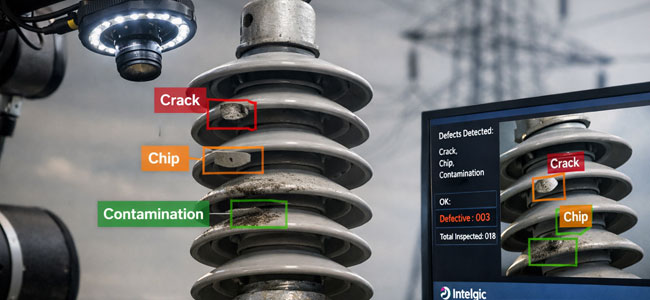
Insulators come in multiple forms such as ceramic, porcelain, and polymer composite insulators, and their geometry is inherently complex. The sheds of the insulator resemble umbrella-like shapes designed to prevent leakage currents and improve insulation performance during rain, dust, or pollution conditions.
Because of their complex structure, manual inspection of insulators is time-consuming, inconsistent, and often unable to detect small defects that could eventually lead to electrical failures.
Intelgic provides an automated insulator inspection solution using industrial machine vision cameras and AI, designed to accurately image and analyze insulators regardless of their size or geometric complexity.
Challenges in Inspecting Insulators
Insulators are difficult to inspect using traditional imaging systems due to several structural and manufacturing characteristics.
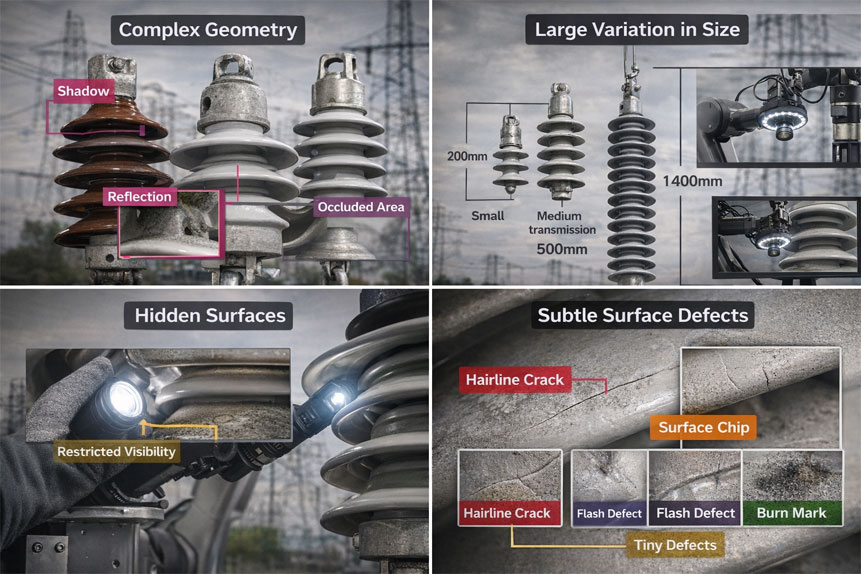
1. Complex Geometry
Insulators consist of multiple umbrella-shaped sheds, ridges, and curved surfaces. These shapes create shadows, reflections, and occluded areas that are difficult to capture with a single camera.
2. Large Variation in Size
The length of insulators can vary significantly depending on application:
| Insulator Type | Typical Length |
|---|---|
| Small distribution insulators | 150 mm – 300 mm |
| Medium transmission insulators | 300 mm – 800 mm |
| Large high-voltage insulators | 800 mm – 1500 mm or more |
Because of this variation, inspection systems must be flexible enough to handle multiple sizes and geometries.
3. Hidden Surfaces
Many defects occur in areas between sheds, where visibility is restricted.
4. Subtle Surface Defects
Critical defects may include:
- Hairline cracks
- Surface chips
- Flash defects from molding
- Contamination or burn marks
- Dimensional deviations
- Surface texture anomalies
These defects are often very small and difficult to detect manually.
Intelgic's Automated Insulator Inspection Solution
Intelgic provides a fully automated machine vision inspection system specifically designed for inspecting complex insulator geometries.
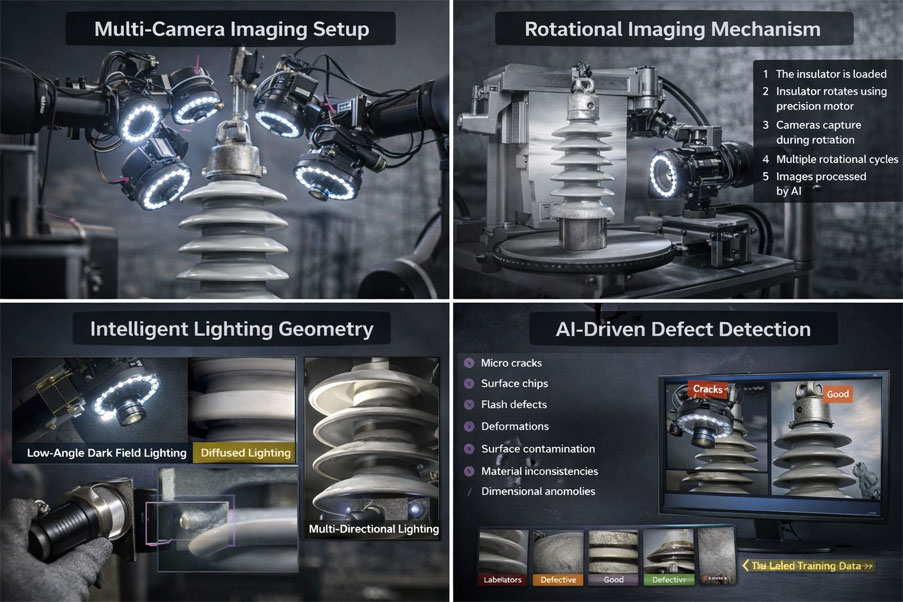
The system combines multi-camera imaging, controlled lighting, precision mechanical motion, and AI-driven defect detection.
Key Components of the System
Multi-Camera Imaging Setup
Because a single camera cannot capture all surfaces of an insulator, Intelgic uses multiple industrial cameras positioned around the insulator.
These cameras capture images from different angles to ensure:
- Full surface coverage
- Imaging between sheds
- Detection of hidden defects
- High-resolution inspection
Rotational Imaging Mechanism
To capture the entire surface of the insulator, the inspection system rotates the insulator during imaging.
The workflow typically includes:
- 1 The insulator is loaded into the inspection fixture
- 2 The insulator rotates using a precision motor
- 3 Cameras capture images continuously during rotation
- 4 Multiple rotational cycles ensure full coverage
- 5 Images are processed by Intelgic's AI system
Rotation allows the cameras to capture 360-degree views of every shed and surface.
Intelligent Lighting Geometry
Lighting plays a critical role in defect detection.
Intelgic designs custom lighting geometries including:
- Low-angle dark field lighting for surface cracks
- Diffused lighting for overall surface inspection
- Multi-directional lighting to reduce shadowing
- Specialized lighting for polymer and ceramic materials
Proper lighting helps highlight defects that are otherwise invisible to the human eye.
Intelgic's AI-Driven Defect Detection
At the core of the system is Intelgic's robust AI architecture, designed specifically for industrial defect detection.
The AI system is trained using thousands of labeled images of insulators with both good and defective conditions.
The AI models can detect:
Unlike rule-based vision systems, Intelgic's AI learns complex defect patterns and improves over time as more production data becomes available.
Inspection Workflow
The automated inspection process follows a structured workflow.
Step 1 — Part Loading
The insulator is loaded manually or by a robotic arm into the inspection fixture.
Step 2 — Rotational Imaging
The insulator rotates while cameras capture images from multiple angles.
Step 3 — Image Processing
Images are transferred to the GPU processing unit running Intelgic's software.
Step 4 — AI Defect Detection
The AI model analyzes images and identifies defects in real time.
Step 5 — Result Generation
The system generates:
- Pass / Fail decision
- Defect classification
- Defect location
- Image evidence
Step 6 — Data Logging
Inspection results are stored for traceability and quality analytics.
Advantages of Intelgic's Insulator Inspection System
100% Inspection
Every insulator can be inspected automatically without manual intervention.
Detection of Micro Defects
AI can detect very small defects that are often missed by human inspectors.
Consistent Quality Control
Inspection results remain consistent across shifts and operators.
High Throughput
The automated system can inspect insulators much faster than manual inspection.
Data-Driven Manufacturing
Inspection data can be used for:
- Process improvement
- Root cause analysis
- Quality reporting
- Predictive maintenance
Integration with Smart Manufacturing
Intelgic's inspection system can integrate with factory infrastructure including:
- PLC systems
- Manufacturing execution systems (MES)
- ERP systems
- Production dashboards
This allows manufacturers to build a fully digital quality control system.
The Future of Insulator Manufacturing
As power infrastructure expands worldwide, the demand for reliable high-voltage components continues to grow. Automated inspection technologies powered by machine vision and AI are becoming essential for ensuring product reliability and safety.
Intelgic's automated insulator inspection solution enables manufacturers to achieve higher quality, reduce manual labor, and detect defects with unprecedented accuracy. By combining advanced imaging, precision mechanics, and AI-driven analytics, Intelgic delivers a scalable solution capable of inspecting even the most complex insulator geometries.