The challenge of inspecting a tyre
Tyres are complex products. Unlike flat or simple geometries, a tyre has:
- A fully cylindrical outer surface
- Sidewalls with branding, text, and fine surface details
- An inner liner that must also be inspected for cracks, bubbles, or material inconsistencies
Trying to inspect all these surfaces with a single stationary camera is impractical. One camera cannot see the complete circumference, and adding more fixed cameras quickly increases system complexity, calibration effort, and cost—while still leaving blind spots.
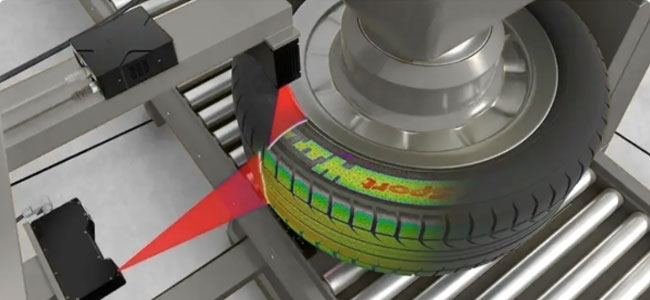
This is where rotational inspection with AI-powered machine vision becomes a much smarter approach.
Why multiple static cameras are not always ideal
If you want to inspect:
Outer tread surface
Both sidewalls
Inner surface
You would typically need many cameras placed at different angles. This leads to:
- Complex mechanical mounts
- Difficult alignment and calibration
- Higher hardware cost
- Increased maintenance effort
Even with multiple cameras, ensuring uniform image quality and consistent inspection across the entire tyre surface is challenging.
Intelgic’s rotational inspection approach
Instead of surrounding the tyre with many cameras, Intelgic uses a rotational stage–based inspection strategy.
Core Concept
The tyre is placed on a precision rotational stage
The tyre is rotated at a controlled speed
Industrial cameras capture images automatically as the tyre rotates
AI processes all captured images to detect surface defects
This method ensures 100% surface coverage with fewer cameras and far greater consistency.
System Architecture Overview
Key Components
Rotational Stage
- Holds and rotates the tyre smoothly
- Speed is synchronized with camera triggering
- Supports different tyre sizes through adjustable fixtures
Industrial Cameras
- High-resolution area-scan cameras
- Strategically positioned to view outer tread surface, sidewalls, and inner surface
Controlled Lighting
- Uniform, glare-free illumination is critical for rubber surfaces
- Combination of diffused lighting for sidewalls and angled lighting for tread texture
- Enclosed inspection area eliminates ambient light interference
AI-powered Inspection Software
- Images captured during rotation are stitched logically into inspection zones
- AI models analyze every segment of the tyre surface
- Defects are detected, classified, and logged automatically
Image Acquisition During Rotation
As the tyre rotates:
Cameras are triggered at predefined angular intervals
Each trigger captures a small surface segment
Over a full 360° rotation, the system captures hundreds of overlapping images
This creates a complete digital representation of:
- Entire outer circumference
- Both sidewalls
- Inner liner surface
No surface area is missed.
Defects Detected Using AI
Using AI-based vision models, the system can detect:
Surface-related defects
- Cuts and cracks
- Foreign material embedded in rubber
- Bulges or deformities
- Surface contamination
Manufacturing and finishing defects
- Texture inconsistencies
- Improper curing marks
- Sidewall branding defects
- Inner liner wrinkles or air pockets
AI learns from real defect samples and continuously improves detection accuracy through fine-tuning.
Why AI is Essential for Tyre Inspection
Traditional rule-based vision struggles with tyres because:
Rubber surfaces vary naturally
Texture and color are non-uniform
Defects are often subtle and irregular
AI-based inspection:
Learns acceptable vs unacceptable surface patterns
Adapts to variation between tyre models
Reduces false positives while catching real defects
Advantages of Rotational AI Inspection
Full surface coverage
A single rotation ensures no blind spots—something fixed cameras struggle to guarantee.
Fewer cameras, simpler mechanics
Instead of many cameras around the tyre, a small number of well-positioned cameras do the job.
High repeatability
Every tyre is inspected in exactly the same way, independent of operator skill.
Scalable and flexible
- Easy to adapt for different tyre sizes
- Recipes can be created for multiple tyre models
- Suitable for offline inspection cells or inline production setups
Inspection Results and Reporting
After inspection:
Each tyre receives a pass/fail decision
Detected defects are highlighted with images
Defect location (angle and surface zone) is logged
Historical data can be analyzed for:
- Shift-wise trends
- Defect type frequency
- Process improvement insights
Tyre surface inspection demands complete coverage, consistency, and high sensitivity to subtle defects. A rotational-stage-based inspection system combined with AI and industrial cameras offers a practical, scalable, and highly accurate solution.
By rotating the tyre and synchronizing image capture with AI-driven analysis, TyreVision's approach achieves:
- 100% surface inspection
- Reduced hardware complexity
- Reliable defect detection across inner and outer surfaces
This method represents a modern, production-ready approach to tyre quality inspection—designed for today's high standards and tomorrow's zero-defect manufacturing goals.