Reading Serial Numbers and Printed Text from Metal Devices Using Machine Vision and AI

Reading Serial Numbers and Printed Text from Metal Devices Using Machine Vision and AI

Published on: Dec 11, 2025

team

Written by:Content team, Intelgic

Introduction

Serial numbers, part numbers, and other alphanumeric markings on metal devices play a crucial role in traceability, warranty management, quality control, and compliance. However, reading these numbers manually is slow, error-prone, and often impractical on fast-moving production lines.
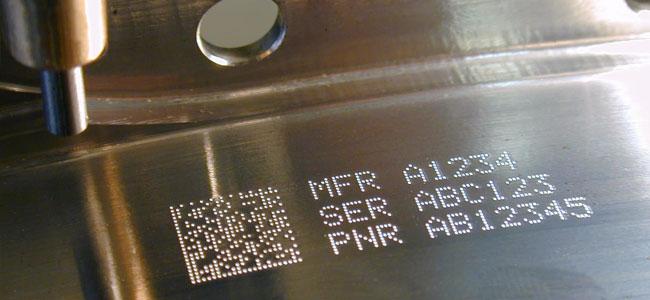
Modern Machine Vision combined with AI-driven Optical Character Recognition (AI-OCR) now enables highly accurate reading of text from challenging metal surfaces—even when the markings are:

  • Laser engraved
  • Dot-peened
  • Stamped or etched
  • Embossed or debossed
  • Printed with inkjet or thermal ink
  • Low-contrast due to reflections
  • Partially worn out

This article explains how such systems work, the challenges involved, and best practices for achieving near-perfect text extraction accuracy.

Why Reading Text on Metal Surfaces Is Challenging

Metal components introduce several complexities that make traditional OCR unsuitable.

Reflective and Shiny Surfaces

Most metal parts (stainless steel, aluminum, chrome-coated components) reflect ambient light intensely. This causes:

  • Specular glare
  • Hotspots
  • Washed-out characters
  • Unstable contrast

These distortions drastically reduce OCR accuracy.

Varying Depth and Texture

Because markings can be engraved, embossed, dot-peened, or shallowly laser etched, text may appear with:

  • Uneven depth
  • Irregular edges
  • Micro-textures that break character continuity

AI-based OCR models are more resilient than classical OCR for such variability.

Low Contrast & Faded Markings

Serial numbers on metal often appear only a few grayscale levels apart from the background. Even human eyes struggle to differentiate faded engravings.

Curved or Angled Surfaces

Cylindrical, conical, or curved metal parts (pipes, shafts, housings) distort text shape, requiring:

  • Geometric correction
  • Region perspective transformation
  • Special optics and lighting

How Machine Vision + AI Solves the Problem

A modern industrial text-reading system uses a combination of specialized imaging hardware and deep learning-based OCR.

High-Resolution Industrial Cameras

Choosing the right camera is critical:

  • 5MP–20MP area scan cameras → ideal for stationary reading
  • Line-scan cameras → for high-speed conveyor text reading
  • Telecentric lenses → eliminate perspective errors for small metal parts
  • Macro lenses → for microscopic engravings or micro-text
Specialized Lighting Techniques

Lighting is 70% of OCR success on metal.

a. Dome Light

Creates soft, uniform illumination removing harsh reflections.

b. Coaxial Light

Ideal for reading engraved or recessed text by highlighting depth contrast.

c. Low-Angle Darkfield Illumination

Enhances dot-peen, etched, or shallow engravings.

d. Polarized Light

Removes glare and improves contrast on shiny metals.

e. Backlight (When Possible)

For edge detection and shape-based reading.

Intelgic solutions typically test several lighting combinations to determine the best imaging conditions.

Deep Learning OCR Models

Traditional OCR struggles with:

  • Low contrast
  • Irregular characters
  • Engraved text
  • Distortions

AI-OCR models, trained on thousands of variations of metal text, can:

  • Interpret incomplete characters
  • Handle rotated or curved text
  • Read multi-line serial numbers
  • Recognize alphanumeric, symbols, and custom fonts
  • Tolerate noisy backgrounds

AI-OCR achieves 95–99.5% accuracy under optimal imaging conditions.

Preprocessing Pipelines

Before feeding an image into OCR, several transformations ensure readability:

  • Contrast enhancement
  • Specular reflection removal
  • Perspective correction
  • Image sharpening
  • Noise filtering
  • Region-of-Interest detection (ROI extraction)

Intelgic's preprocessing uses both classical CV and AI-based enhancement.

System Workflow: From Imaging to Text Extraction

Here is a typical end-to-end workflow:

1 Image Capture

Camera captures high-resolution images of the metal surface.

2 ROI Localization Using AI

AI detects the exact location of the serial number or text block—even if it appears in varying positions.

3 Image Enhancement

Algorithms correct glare, align the image, and enhance text visibility.

4 AI-OCR Processing

Deep learning OCR reads and interprets characters with position-aware sequence modeling.

5 Verification & Formatting

Text is validated using:

  • Expected format (e.g., SN-XXXXX-YY)
  • Character whitelist
  • Checksum rules
  • Database lookup

6 Integration with Manufacturing Systems

The extracted text is typically used for:

  • Traceability databases
  • Warranty management
  • ERP/MES connectivity
  • Labeling & compliance checks
  • Product identification and matching

Real-World Use Cases in Manufacturing

Electronics and PCB Assemblies

Reading serial numbers, batch codes, PIN/IC markings, and PCB text.

Automotive & Aerospace

Engine blocks, brake discs, fasteners, aircraft components—all require traceable stamping or engraving.

Medical Devices

Implants, surgical tools, casings, and sterile-pack markers often have laser-etched identifiers.

Industrial Machinery

Gear housings, shafts, hydraulic parts, bearings with dot-peen serial numbers.

Consumer Electronics

Mobile housings, laptop frames, battery casings with micro-text.

Best Practices for High OCR Accuracy

1 Ensure stable part positioning

Even a few millimeters of movement can distort engraving visibility.

2 Maintain consistent lighting

Use enclosures to eliminate ambient variations.

3 Use higher resolution than required

Better to downsample than to lose fine detail.

4 Train AI on your own part dataset

Each factory has unique markings—fine-tuning boosts accuracy drastically.

5 Validate outputs automatically

Use predefined templates or regex validation.

6 Periodically retrain the model

Metal wear patterns change over time—AI adapts with refreshed data.

Intelgic’s Advanced Solution for Serial Number OCR

Intelgic’s Advanced Solution for Serial Number OCR

Key Features:

  • AI-OCR for engraved, dot-peen, laser-etched, embossed, and printed text
  • High-accuracy reading under challenging reflections
  • Automatic ROI detection
  • GPU-optimized inference for real-time performance
  • Integration with ERP/MES, PLCs, and external apps
  • Cloud dashboard for batch tracking, warranty data, and audit trails
  • Digital Quality Certificate generation
  • Multi-camera support for 360° inspection

Supported Markings:

  • Serial numbers
  • Part numbers
  • Model numbers
  • Manufacturing codes
  • Batch/lot IDs
  • QR codes, barcodes, DataMatrix
  • Custom alphanumeric formats

As manufacturing becomes increasingly data-driven, automated reading of serial numbers and alphanumeric text on metal devices is no longer optional—it is essential for quality assurance and traceability.

By combining industrial imaging, advanced lighting, AI-based OCR, and intelligent data workflows, manufacturers can achieve:

99% Accuracy
Real-time Inspection
Zero Manual Intervention
Complete Digital Traceability
Reduced Quality Costs

Intelgic’s solutions are purpose-built to handle the toughest metal surfaces, ensuring reliable performance even in high-speed production environments.

Book a call

©2025 Intelgic Inc. All Rights Reserved.