Manufacturing is undergoing a major transformation in 2026, driven by artificial intelligence (AI), machine vision, and smart automation. Quality inspection—once dominated by manual visual checks—is now increasingly automated through AI-powered inspection systems that use cameras, sensors, and deep learning algorithms to detect defects in real time.
As production speeds increase and product complexity grows, manufacturers are adopting AI to ensure higher quality, faster inspection, and lower operational costs. AI-based inspection systems can analyze images and sensor data to identify defects with high precision and consistency, enabling smarter and more efficient manufacturing processes.
Why Traditional Quality Inspection Is Changing
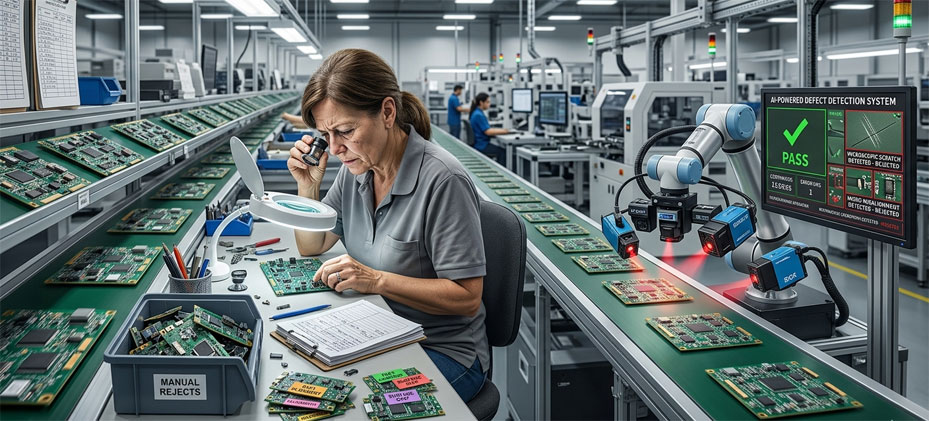
For decades, factories relied on human visual inspection to identify defects. While experienced inspectors can detect many issues, manual inspection has several limitations.
Human Limitations
Manual inspection is prone to fatigue, inconsistent judgments, and missed defects—especially when production runs continuously. Even skilled inspectors may struggle to maintain accuracy over long shifts.
Increasing Production Speed
Modern factories operate at extremely high speeds, making it difficult for humans to inspect every product reliably.
Micro-Defect Detection
Tiny defects such as microscopic scratches, cracks, or misalignments are often invisible to the human eye. AI-based inspection systems address these challenges by providing continuous, automated inspection with consistent accuracy.
What Is AI-Based Quality Inspection?
AI-based inspection uses computer vision and machine learning algorithms to analyze images of products captured by industrial cameras.
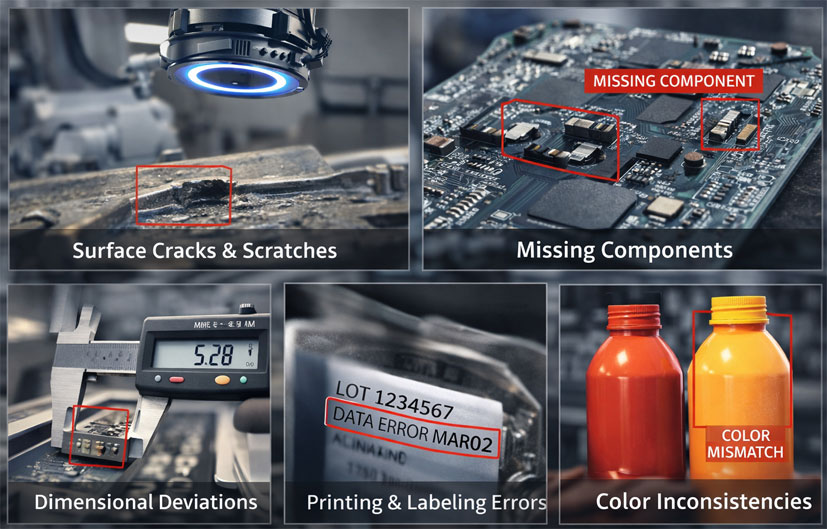
The system automatically detects defects such as:
- Surface cracks and scratches
- Missing or incorrectly assembled components
- Dimensional deviations
- Printing and labeling errors
- Color inconsistencies
These systems can inspect products at production speed while achieving 97–99% detection accuracy, significantly higher than manual inspection in many cases.
How AI Inspection Systems Work
AI-driven inspection systems combine several technologies into an integrated workflow.
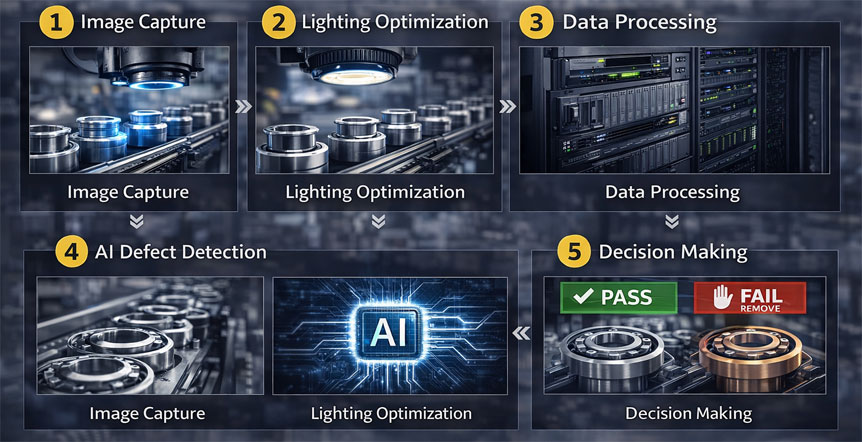
Image Capture
Industrial cameras capture high-resolution images of products as they move through the production line.
Lighting Optimization
Specialized lighting systems ensure defects are clearly visible in captured images.
Data Processing
Images are sent to industrial computers or GPU servers that prepare the data for AI analysis.
AI Defect Detection
Deep learning models analyze images and detect anomalies or defects based on trained datasets.
Decision Making
The system automatically classifies the product as pass or fail, and defective parts can be removed from the line.
AI inspection systems can also learn from new data, improving detection accuracy over time.
Key Benefits of AI in Manufacturing Quality Inspection
1. Real-Time Defect Detection
AI systems can detect defects immediately during production, preventing defective products from moving further in the manufacturing process.
2. 100% Inspection Coverage
Traditional quality control often relies on sampling, meaning only a small portion of products are inspected. AI systems can inspect every product in real time.
3. Higher Detection Accuracy
Deep learning algorithms can identify complex defect patterns that traditional systems or humans might miss.
4. Reduced Waste and Rework
Detecting defects early prevents defective products from reaching later stages of production, reducing scrap and rework costs.
5. Continuous 24/7 Inspection
AI inspection systems can operate continuously without fatigue, ensuring consistent inspection quality.
6. Data-Driven Manufacturing
AI systems collect large volumes of inspection data that can be used to identify process improvements and optimize production.
Industries Benefiting from AI Inspection
AI-powered inspection is transforming multiple manufacturing sectors.
Automotive Manufacturing
Used to inspect engine components, tires, welds, and assembly processes.
Electronics Manufacturing
AI inspects printed circuit boards (PCBs), microchips, and electronic assemblies.
Textile Industry
Machine vision systems detect fabric defects, printing errors, and color variations.
Metal and Steel Manufacturing
AI detects surface defects, scratches, and dimensional inaccuracies.
Glass and Ceramics
Inspection systems detect cracks, bubbles, and surface defects in glass and tiles.
Real-World Examples of AI in Manufacturing
Major manufacturers are already deploying AI inspection systems in production.
- Automotive factories use AI cameras to detect millimeter-scale defects and assembly errors during production.
- Smart factories integrate AI with robotics and digital monitoring to improve production quality and efficiency.
- Modern plants deploy AI systems across multiple inspection stations to monitor quality continuously.
These implementations demonstrate how AI is moving from pilot projects to core manufacturing infrastructure.
AI and Industry 4.0
AI-based inspection systems are a key component of Industry 4.0, the next generation of digital manufacturing.
Industry 4.0 integrates:
Together, these technologies create smart factories where machines continuously monitor and optimize quality.
The Future of AI in Manufacturing Quality Inspection
The role of AI in manufacturing inspection will continue to expand in the coming years.
Key trends include:
As AI technology advances, manufacturers will move closer to achieving zero-defect production environments.
AI is fundamentally transforming quality inspection in manufacturing. By combining machine vision, deep learning, and automation, manufacturers can detect defects faster, improve product quality, and reduce operational costs.
AI-based inspection systems enable 100% product inspection, real-time defect detection, and data-driven quality management, making them essential tools for modern smart factories.
As industries continue to adopt AI-driven quality control systems, manufacturing will become more efficient, reliable, and intelligent.