Modern manufacturing environments handle thousands of different components, each with subtle differences in geometry, design, markings, or surface features. Identifying the correct SKU (Stock Keeping Unit) for each part is critical for traceability, quality control, and automated production workflows.
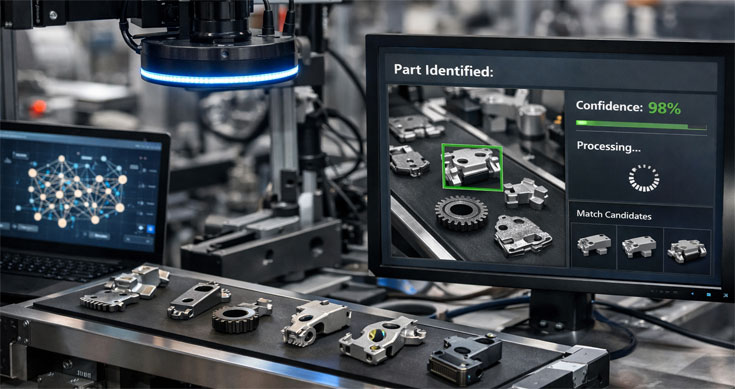
Manual identification methods—such as visual inspection, barcode scanning, or part labeling—often fail when parts are unmarked, worn, or visually similar. To overcome this challenge, camera-based machine vision combined with Artificial Intelligence (AI) provides a powerful and reliable solution for automated part identification.
Intelgic's AI-driven vision systems can analyze complex visual features of a component and automatically determine its SKU with high accuracy, even when the parts appear nearly identical to human operators.
The Challenge of Part Identification in Manufacturing
Manufacturers often face several challenges when identifying parts in automated or semi-automated production environments.
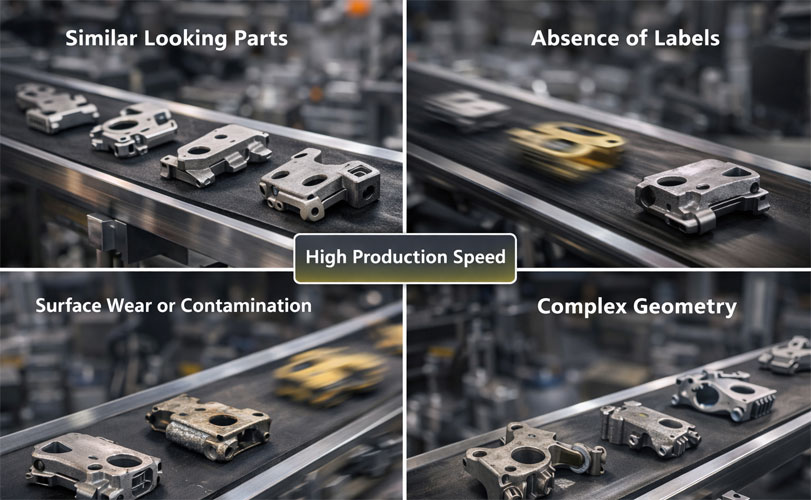
Similar Looking Parts
Many components differ only slightly in shape, hole location, edge profile, or surface design.
Absence of Labels
Parts may not have barcodes, labels, or printed identifiers.
Surface Wear or Contamination
Oil, dust, scratches, or surface treatment can make identification difficult.
High Production Speed
Manual inspection becomes impractical when parts move rapidly through production lines.
Complex Geometry
Parts may contain curved surfaces, grooves, cavities, threads, or irregular shapes that require advanced imaging techniques.
These challenges require a vision system capable of understanding the geometric and visual signature of each part.
Intelgic's AI-Based Part Identification Approach
Intelgic uses industrial cameras combined with advanced AI algorithms to capture the visual characteristics of a part and determine its SKU automatically.
The system analyzes multiple types of features including:
This allows the system to distinguish between parts that look extremely similar.
Imaging System Setup
A reliable part identification system begins with a robust imaging setup.
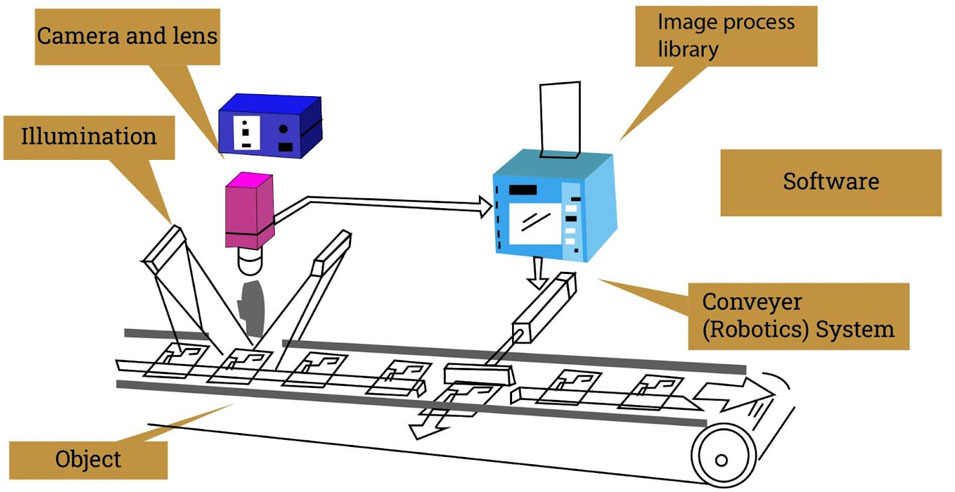
Industrial Cameras
High-resolution industrial cameras capture detailed images of the part.
Optimized Lighting Geometry
Different lighting techniques may be used depending on the product surface:
- Bright field illumination
- Dark field illumination
- Diffused lighting
- Structured lighting
Proper lighting helps highlight edges, contours, and surface textures.
Controlled Inspection Station
Parts are placed in a fixed inspection area or captured while moving on a conveyor system.
Multi-Camera Setup (if required)
For complex parts, multiple cameras may capture images from different angles to analyze all relevant features.
AI-Based Feature Extraction
Once the image is captured, Intelgic's AI software analyzes the part and extracts important visual features.
The AI identifies:
Key geometric features
Edge structures
Hole patterns
Surface textures
Shape signatures
Deep Learning Architecture
Using deep learning models such as Vision Transformers or convolution-based architectures, the system converts the visual information into a feature vector that uniquely represents the part. This feature signature acts like a visual fingerprint of the component.
SKU Classification Using AI
After extracting the features, the AI compares the detected feature signature with the trained SKU database.
AI Training Process
The system is trained using images of different SKUs:
- 1 Images of each SKU are captured under controlled conditions.
- 2 AI models learn the unique visual characteristics of each part.
- 3 The system builds a classification model capable of distinguishing between SKUs.
During Operation
The entire process typically takes less than a second.
Identification of Complex Parts
Intelgic's AI can handle parts with highly complex geometry.
Examples include:
Automotive brackets
Gears and mechanical components
Stamped sheet metal parts
Injection molded components
Medical device parts
Electronic housings
Even when two parts differ by only a small hole location or slight contour change, the AI can reliably detect these differences.
Real-Time Identification in Production Lines
The system can be integrated directly into the manufacturing workflow.
Conveyor-Based Identification
Parts moving on a conveyor are automatically identified in real time.
Robotic Systems
Robots can use AI identification results to pick and place the correct parts.
Assembly Line Integration
The system verifies that the correct part enters each assembly stage.
Warehouse Automation
Vision systems can automatically classify parts before packaging or storage.
Data Logging and Traceability
Each inspection can be logged for traceability.
Typical data recorded includes:
This data can be integrated with:
- MES systems
- ERP platforms
- Quality dashboards
This provides complete digital traceability of manufactured parts.
Advantages of AI-Based Part Identification
High Accuracy
AI models can detect subtle differences that human inspectors may miss.
Works Without Barcodes
Parts can be identified based on their physical features.
Scalable for Large SKU Libraries
The system can handle hundreds or thousands of SKUs.
High-Speed Operation
Suitable for high-speed production environments.
Reduced Human Error
Automates identification tasks and eliminates manual mistakes.
Applications Across Industries
AI-based part identification is widely used in several industries:
Automotive Manufacturing
- Identification of stamped metal components
- Sorting similar mechanical parts
Electronics
- PCB component recognition
- Housing identification
Medical Devices
- Identification of surgical components
Industrial Manufacturing
- Casting identification
- Forged part classification
Camera-based AI systems are transforming how manufacturers identify and track parts across production environments. By analyzing the visual fingerprint of each component, Intelgic's machine vision solutions can accurately determine the SKU even when parts appear extremely similar.
This technology enables manufacturers to automate identification, eliminate manual inspection errors, and improve production traceability—creating smarter, more efficient factories.