Tubular lugs are widely used in electrical connections, power distribution systems, automotive wiring harnesses, and industrial control panels. These components ensure secure electrical conductivity between cables and terminals. Because they carry electrical current and provide mechanical stability, even a small defect in a tubular lug can lead to overheating, poor conductivity, or electrical failure.
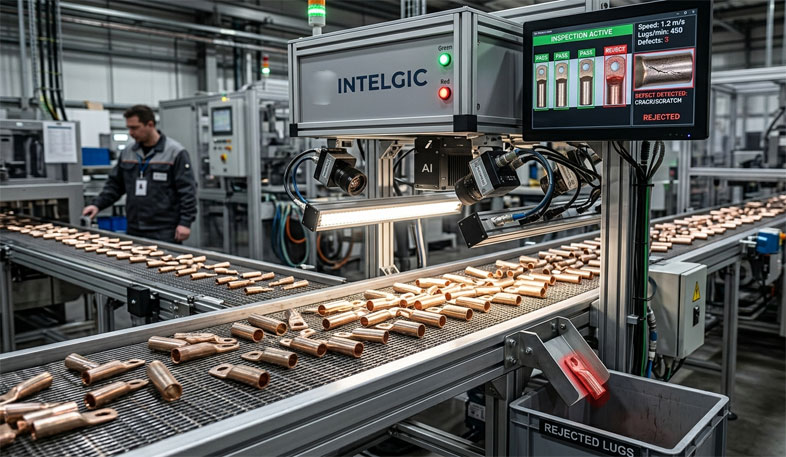
Traditionally, tubular lug inspection has been performed manually. However, manual inspection is slow, inconsistent, and unreliable, especially in high-speed manufacturing environments.
To overcome these limitations, Intelgic has developed an advanced automated inspection system using machine vision cameras, line scan technology, and AI-powered defect detection algorithms. This system allows manufacturers to inspect tubular lugs automatically while they move continuously on a conveyor.
Challenges in Tubular Lug Inspection
Although tubular lugs appear simple, inspecting them accurately presents several manufacturing challenges.
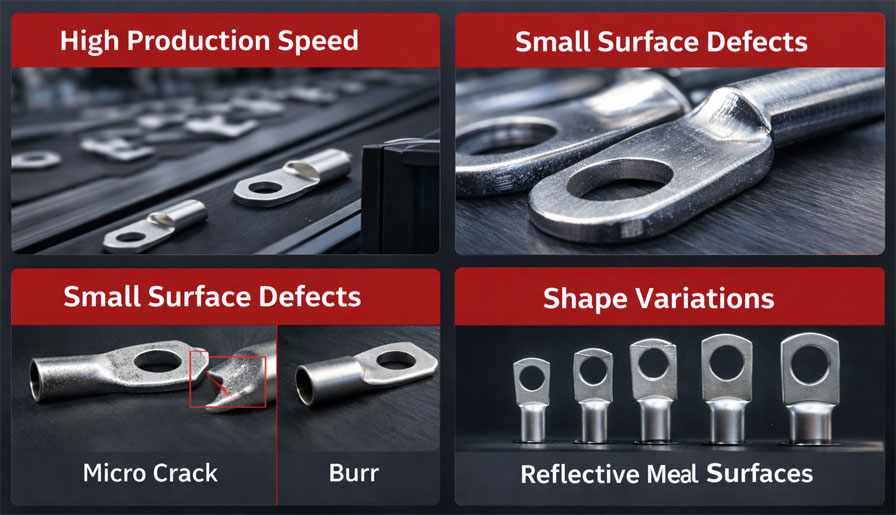
High Production Speed
Manufacturing lines produce thousands of lugs per hour. Manual inspection cannot keep up with these speeds.
Small Surface Defects
Defects such as micro cracks, scratches, burrs, and dents are often very small and difficult to detect visually.
Reflective Metal Surfaces
Tubular lugs are usually made of copper or aluminum, which are highly reflective materials. These surfaces can hide defects under standard lighting conditions.
Shape Variations
Different lug sizes and shapes make it difficult to maintain consistent inspection without automated systems.
Strict Quality Standards
Since these components carry electrical current, manufacturers must maintain strict quality control.
Intelgic's AI-Powered Tubular Lug Inspection System
Intelgic's automated inspection solution uses high-speed line scan cameras combined with AI-based defect detection to inspect tubular lugs in real time.
Unlike conventional cameras, line scan cameras capture images line-by-line, which allows extremely high-resolution imaging of moving products. As tubular lugs pass under the camera, the system reconstructs a complete image of each component.
This allows the system to inspect the entire surface of the lug while it moves along the conveyor.
System Components
The inspection system consists of several integrated technologies:
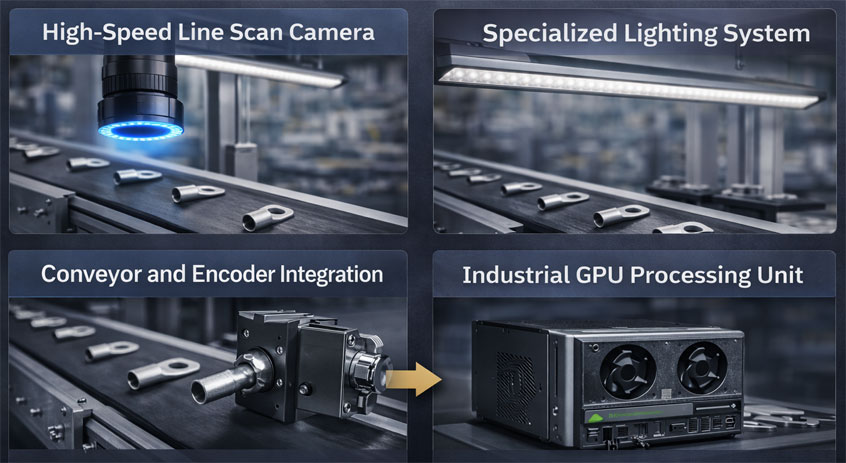
High-Speed Line Scan Camera
Captures high-resolution images of moving tubular lugs.
Specialized Lighting System
Custom lighting geometry enhances defect visibility on reflective metal surfaces.
Conveyor and Encoder Integration
The camera is synchronized with the conveyor movement to ensure accurate imaging.
Industrial GPU Processing Unit
Images are processed in real time using an industrial edge AI computer.
Intelgic Vision AI Software
The software analyzes images, detects defects, classifies them, and generates inspection reports.
Inspection Workflow
The automated inspection process operates continuously during production.
Step 1 – Lug Movement
Tubular lugs move on the conveyor through the inspection station.
Step 2 – Image Capture
The line scan camera captures high-resolution images while the lugs move.
Step 3 – Image Reconstruction
Captured lines are stitched together to generate a complete image of the lug.
Step 4 – AI-Based Analysis
Intelgic's AI algorithms analyze the image to detect defects.
Step 5 – Defect Classification
Detected defects are classified based on severity and type.
Step 6 – Sorting and Reporting
Defective parts can be automatically rejected and inspection reports are generated.
Types of Defects Detected
Intelgic's system can detect multiple types of tubular lug defects, including:
Surface Defects
- Scratches
- Surface cracks
- Dents
- Oxidation marks
- Surface contamination
Manufacturing Defects
- Burrs on edges
- Improper punching
- Deformed lug body
- Misaligned holes
Dimensional Defects
- Incorrect lug length
- Diameter variation
- Deformation of tubular section
Crimping Defects
- Improper crimp shape
- Uneven crimp compression
- Missing crimp marks
Advantages of Intelgic's Automated Inspection
High-Speed Inspection
Thousands of parts can be inspected every hour without slowing down production.
100% Inspection Coverage
Every lug is inspected automatically instead of relying on sampling.
Higher Accuracy
AI algorithms can detect extremely small defects that are often missed by human inspectors.
Consistent Quality
Automated inspection ensures the same quality standard across all shifts.
Real-Time Alerts
Operators are notified immediately when defects exceed tolerance levels.
Data Traceability
Inspection results are stored and can be accessed through dashboards for quality analytics.
Industrial Applications
Automated tubular lug inspection systems are used in many industries, including:
Future of AI-Driven Electrical Component Inspection
As manufacturing becomes more automated, AI-powered machine vision inspection systems will become essential for maintaining quality and reliability.
Intelgic's solution combines line scan cameras, advanced lighting, and AI-based defect detection to provide a powerful inspection platform capable of operating in high-speed production environments.
With this system, manufacturers can achieve:
- Zero-defect production
- Improved electrical safety
- Reduced manual inspection costs
- Higher manufacturing efficiency