Automotive systems rely heavily on precision-manufactured rubber and elastomer components such as bellows, grommets, diaphragms, seals, and dust covers. These components play critical roles in sealing, vibration isolation, pressure control, and protection of mechanical assemblies. Even a minor defect in these parts can lead to system failures, leakage, contamination, or reduced lifespan of automotive systems.
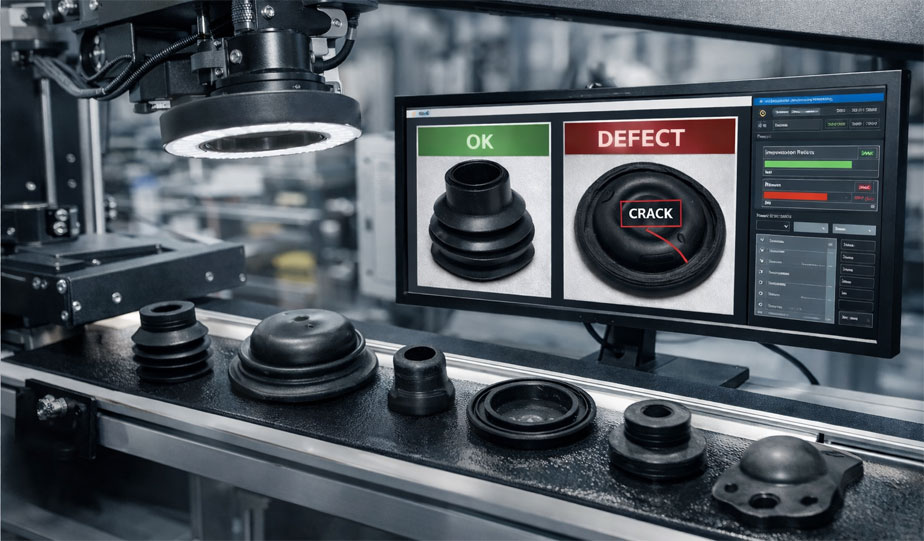
Traditionally, inspection of rubber components has been performed manually. However, manual inspection is slow, inconsistent, and incapable of detecting subtle defects that may compromise product reliability. To overcome these limitations, Intelgic offers an AI-powered automated inspection system designed specifically for complex rubber automotive components.
Automotive Rubber Parts That Require Automated Inspection
The Intelgic automated inspection platform can inspect a wide range of automotive rubber components, including:
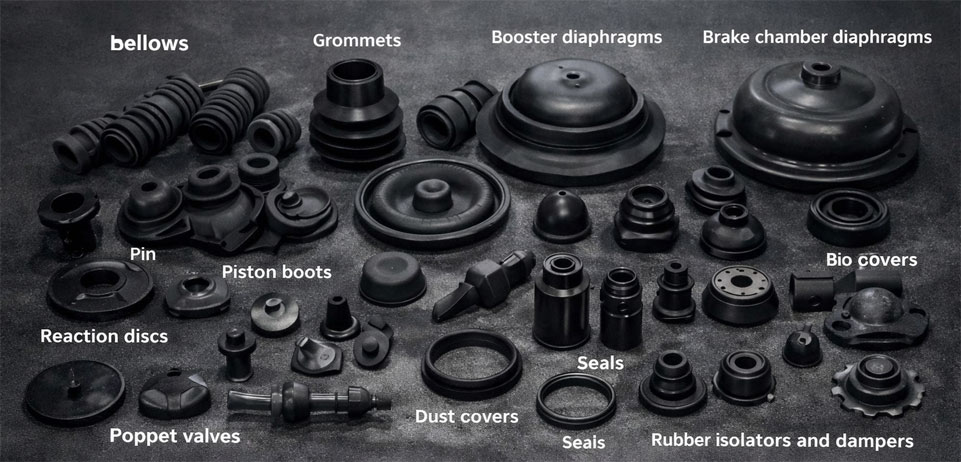
Bellows
Grommets
Booster diaphragms
Brake chamber diaphragms
Pin boots
Piston boots
Reaction discs
Poppet valves
Seals
Dust covers
Rubber isolators and dampers
Other molded elastomer components
These parts often have complex shapes, flexible surfaces, grooves, and internal cavities, making them difficult to inspect using conventional vision systems. Intelgic's solution combines advanced imaging techniques with AI algorithms to ensure accurate inspection of these challenging parts.
Typical Defects Found in Rubber Automotive Components
During manufacturing, rubber parts can develop several types of defects due to molding issues, contamination, material inconsistencies, or handling errors.
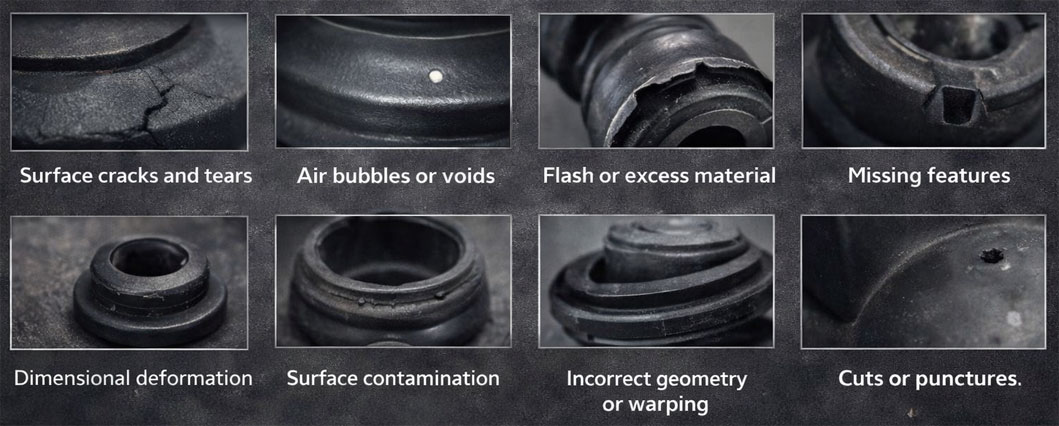
Common defects include:
Surface cracks and tears
Air bubbles or voids
Flash or excess material
Missing features or incomplete molding
Dimensional deformation
Surface contamination
Incorrect geometry or warping
Cuts or punctures
Color inconsistencies
Detecting these defects early in production ensures higher product reliability and prevents defective parts from reaching the assembly line.
Intelgic's Automated Rubber Part Inspection System
Intelgic designs customized automated inspection machines specifically tailored to the geometry and inspection requirements of automotive rubber parts.
The system typically includes:
Industrial Cameras
The inspection machine uses a combination of:
- Area scan cameras for capturing full images of individual parts
- Line scan cameras for high-resolution scanning of surfaces during motion
This hybrid imaging approach allows the system to capture both global geometry and fine surface defects.
Specialized Lighting
Rubber surfaces can be difficult to inspect because they are often dark, matte, or reflective. Intelgic uses specialized lighting techniques such as:
- Dark-field illumination
- Low-angle lighting
- Diffused lighting
- Structured lighting
These lighting geometries help reveal small cracks, flash, and surface defects that are otherwise difficult to detect.
Automated Conveyor and Handling System
The inspection machine includes a conveyor system designed to transport parts through the imaging zone.
Depending on the part geometry, the system may include:
- Rotating fixtures
- Multi-angle imaging stations
- Part positioning mechanisms
- Robotic handling for complex parts
This ensures complete inspection of all visible surfaces.
AI-Powered Defect Detection
At the core of the system is Intelgic's advanced AI software platform, designed to detect defects on complex materials such as rubber.
The AI system learns from large sets of good and defective samples, allowing it to detect both known and unknown defects.
Key capabilities include:
- Surface anomaly detection
- Pattern deviation analysis
- Feature detection
- Shape and geometry validation
- Contamination detection
Because rubber parts often have natural surface variations, traditional rule-based inspection systems fail. Intelgic's AI models can intelligently distinguish between normal variations and true defects.
Recipe-Based Inspection for Multiple Parts
One of the major advantages of Intelgic's system is its recipe-based inspection architecture.
A single inspection machine can handle multiple types of rubber parts.
For each part, a dedicated inspection recipe can be created within the software.
A recipe defines:
- Camera positions and imaging angles
- Lighting configuration
- Trigger timing for cameras
- Conveyor movement parameters
- AI model used for inspection
- Defect thresholds and tolerances
When switching production from one part to another, operators simply select the appropriate recipe, and the machine automatically adjusts the inspection parameters.
This flexibility makes the system ideal for high-mix manufacturing environments.
Intelligent Data Management and Reporting
Intelgic's inspection software also provides a comprehensive data management and reporting system.
The system can:
- Store inspection images
- Save defect locations and classifications
- Generate inspection reports
- Provide production analytics
- Enable multi-user dashboards
Manufacturers can use this data to identify process issues, improve molding quality, and reduce defect rates.
Benefits of Automated AI Inspection for Rubber Components
Implementing Intelgic's automated inspection solution provides several advantages:
100% inspection of all parts
Consistent quality control
Detection of micro-defects invisible to the human eye
Reduced dependency on manual inspection
Improved traceability and reporting
Higher production efficiency
By eliminating defective parts early in the process, manufacturers can significantly reduce warranty risks and improve overall product reliability.
Automotive rubber components are essential for the safe and reliable operation of vehicles, but their complex shapes and flexible materials make inspection challenging.
Intelgic's AI-powered machine vision inspection system, combining line scan cameras, area scan cameras, advanced lighting, and intelligent software, enables manufacturers to automatically detect defects in rubber automotive parts with high accuracy.
With recipe-based configuration and multi-part capability, a single Intelgic inspection machine can adapt to multiple rubber components, making it a highly scalable solution for modern automotive manufacturing.