Heat Transfer Inspection Using AI and Machine Vision Cameras
Published on: Mar 12, 2026

Written by:Content team, Intelgic
Heat transfer printing is widely used in manufacturing to apply logos, labels, graphics, and identification markings onto products such as metal parts, plastic components, textiles, electronics, and packaging materials. The process involves transferring printed graphics from a carrier film onto a product using heat and pressure.
Although heat transfer printing is highly efficient, it can introduce several quality issues such as misalignment, incomplete transfer, wrinkles, color variations, and surface defects. Traditionally, these defects are detected through manual inspection, which is slow, inconsistent, and prone to human error.
To address these challenges, Intelgic has developed an AI-powered machine vision inspection system that automatically verifies heat transfer quality using industrial cameras and intelligent defect detection algorithms.
This automated inspection system ensures accurate, high-speed, and consistent quality control directly on the production line.
Challenges in Heat Transfer Inspection
Heat transfer printing introduces several inspection challenges that make manual inspection difficult.
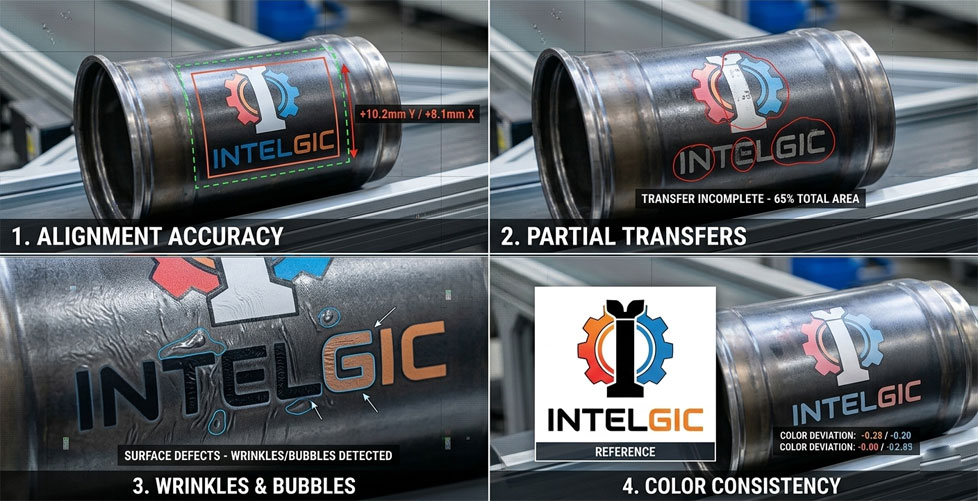
1. Alignment Accuracy
Heat transfer graphics must be placed precisely on the product. Even small positional deviations can affect product quality.
2. Partial Transfers
Sometimes the graphic does not fully transfer due to insufficient heat or pressure, leaving incomplete prints.
3. Surface Wrinkles and Air Bubbles
Wrinkles or bubbles may appear during the transfer process, degrading product appearance.
4. Color Consistency
Color shades may vary due to process variations, ink changes, or temperature fluctuations.
5. High Production Speed
Many production lines run at high speeds, making manual inspection impractical.
Intelgic's AI-Based Heat Transfer Inspection System
Intelgic's inspection solution combines industrial cameras, optimized lighting systems, and advanced AI models to detect defects in heat transfer printing in real time.
The system captures images of each product after the heat transfer process and analyzes them using deep learning algorithms trained to identify printing defects and alignment errors.
The inspection is performed while the product moves on a conveyor, allowing manufacturers to perform 100% inspection without slowing down production.
System Components
The automated heat transfer inspection system consists of several integrated components.
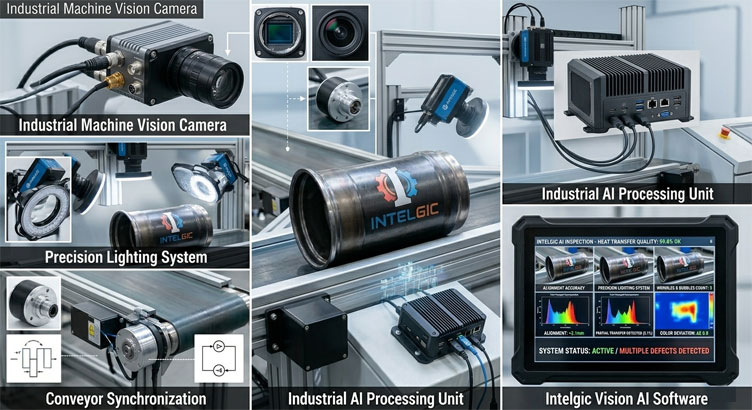
Industrial Machine Vision Camera
High-resolution cameras capture images of products after the heat transfer process.
Precision Lighting System
Specialized lighting enhances contrast between the transferred graphic and the product surface.
Conveyor Synchronization
Encoders synchronize the camera with the production line to capture accurate images.
Industrial AI Processing Unit
An edge AI computer processes images in real time using Intelgic's AI algorithms.
Intelgic Vision AI Software
The software detects defects, verifies alignment, and generates inspection reports.
Inspection Workflow
The inspection process operates automatically during production.
Step 1 – Product Movement
Products move along the conveyor after the heat transfer process.
Step 2 – Image Capture
Industrial cameras capture high-resolution images of the printed area.
Step 3 – Image Preprocessing
The system enhances contrast and removes noise for accurate analysis.
Step 4 – AI Defect Detection
AI algorithms analyze the image to detect defects and verify graphic alignment.
Step 5 – Classification and Reporting
The system classifies defects and stores inspection data for quality reporting.
Types of Heat Transfer Defects Detected
Intelgic's AI inspection system can detect multiple defect types including:
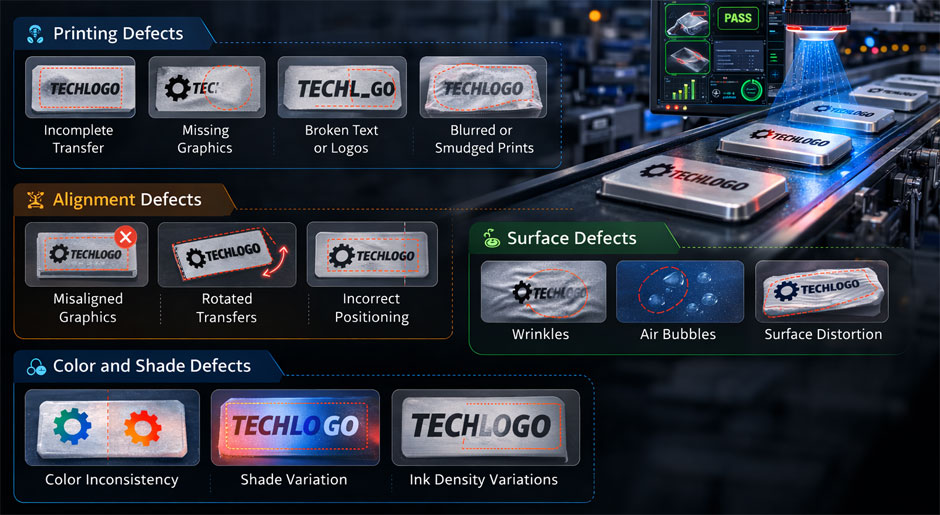
Printing Defects
- Incomplete transfer
- Missing graphics
- Broken text or logos
- Blurred or smudged prints
Alignment Defects
- Misaligned graphics
- Rotated transfers
- Incorrect positioning
Surface Defects
- Wrinkles
- Air bubbles
- Surface distortion
Color and Shade Defects
- Color inconsistency
- Shade variation
- Ink density variations
Advantages of AI-Based Heat Transfer Inspection
100% Automated Inspection
Every product is inspected automatically without human intervention.
High-Speed Operation
The system can inspect products running at high production speeds.
High Accuracy
AI algorithms detect even very small printing defects.
Consistent Quality
Automated inspection ensures uniform quality across all production batches.
Real-Time Alerts
Operators are immediately notified when defects exceed tolerance limits.
Production Analytics
Inspection results are stored and analyzed to improve process performance.
Industrial Applications
Heat transfer inspection systems are widely used in various industries.
Future of AI in Print Quality Inspection
AI-powered machine vision inspection systems are rapidly transforming quality control in manufacturing. By combining high-speed imaging, advanced lighting, and deep learning algorithms, manufacturers can achieve zero-defect production and improved brand quality.
Intelgic's heat transfer inspection solution ensures that every product leaving the production line meets strict visual and dimensional quality standards.