Dot peen marking is widely used in manufacturing to permanently mark serial numbers, part IDs, batch codes, and traceability information directly onto metal components. While dot peen markings are robust and durable, they are also among the most challenging types of text to read—especially on reflective or brushed metal surfaces such as stainless steel.
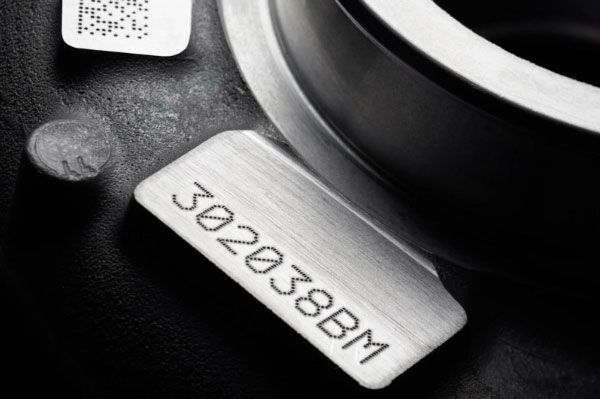
Inteligic’s AI-powered machine vision system is specifically designed to overcome these challenges and reliably read dot peen text that is difficult or sometimes impossible for the human eye to interpret consistently.
Why Dot Peen Text Is Difficult to Read
Dot peen text is created by a series of small indented dots rather than continuous strokes. On metal parts, this introduces several inspection challenges:
- Low contrast: The text is formed by surface deformation, not ink or color
- Reflective surfaces: Stainless steel and machined metals cause glare and uneven reflections
- Small character size: Often below 2–3 mm in height
- Inconsistent dot depth: Tool wear, pressure variation, or curved surfaces affect readability
- Orientation sensitivity: Humans often tilt parts to “catch the light” and see the text
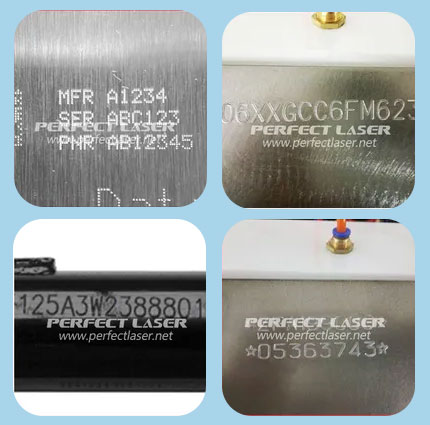
Because of these factors, manual reading is slow, operator-dependent, and error-prone—making it unsuitable for modern production and traceability requirements.
Intelgic’s Approach: Vision + AI Working Together
Inteligic’s solution combines precision machine vision imaging with AI-driven text recognition. Instead of treating dot peen like printed text, the system is designed to read surface geometry and micro-topography.
The process can be broken into four critical stages:
-
1. Controlled imaging
-
2. Image enhancement and feature extraction
-
3. AI-based dot peen OCR
-
4. Validation, visualization, and data storage
1. Controlled Imaging of Dot Peen Markings
Imaging is the foundation of accurate dot peen reading. Intelgic designs a controlled imaging environment that removes variability from the process.
Key imaging principles:
- High-resolution industrial cameras to resolve individual dots clearly
- Fixed overhead geometry to maintain repeatable field of view
- Specialized lighting that emphasizes surface depth rather than color
- Low-angle or directional lighting enhances dot shadows
- Glare is minimized through enclosure-based light control
- Enclosed inspection station to eliminate ambient light effects
This controlled setup allows the camera to capture consistent images where the dot peen pattern is clearly visible to the vision system.
2. Image Preprocessing and Dot Peen Enhancement
Once the image is captured, Intelgic's vision software performs multiple preprocessing steps before AI analysis.
Typical preprocessing techniques include:
Contrast amplification to highlight dot indentations
Surface normalization to reduce reflection variability
Noise suppression to isolate true dot structures
Region-of-interest (ROI) extraction focused only on the marked area
Unlike conventional OCR pipelines, the goal is not just to read text, but to enhance dot geometry and spacing patterns that define each character.
3. AI-Based OCR Specialized for Dot Peen
Traditional OCR engines are optimized for printed or laser-marked text. Dot peen text behaves very differently. Intelgic uses AI models trained specifically on dot peen datasets, including variations in:
How the AI reads dot peen text:
-
Identifies dot clusters instead of continuous strokes
-
Learns spatial relationships between dots forming each character
-
Distinguishes characters with similar shapes (e.g., 5 vs S, 8 vs B)
-
Performs confidence scoring for each recognized character
Because the AI is trained on real industrial dot peen samples, it can successfully read markings that appear unclear or borderline unreadable to human inspectors.
4. Validation, Visualization, and Traceability
After the serial number is read, the system performs validation and reporting steps:
The recognized serial number is displayed on a monitor in real time
Results are automatically stored in a centralized database
Data is made available through a secure, multi-user web dashboard
Inspection history can be searched, filtered, and exported as Excel files
This ensures that every inspected part is digitally logged, traceable, and audit-ready—without manual data entry.
Advantages of Intelgic’s Dot Peen Reading System
By combining advanced vision engineering with AI-based interpretation, Intelgic delivers key benefits:
Reliable reading of low-contrast dot peen text
Elimination of operator subjectivity
High repeatability across shifts and operators
Improved inspection speed and throughput
Digital traceability and compliance-ready records
Reading dot peen text on metal parts is a complex inspection challenge that cannot be solved reliably with manual inspection or generic OCR tools. Intelgic’s AI and machine vision system addresses this challenge by controlling the imaging environment, enhancing surface features, and applying AI models specifically trained for dot peen text recognition.
The result is an automated, accurate, and scalable solution that transforms a difficult manual task into a robust digital inspection process—enabling manufacturers to improve quality, efficiency, and traceability across their operations.