Suitcases and trolley bags are widely used in travel and logistics, and customers expect them to be durable, aesthetically perfect, and free from manufacturing defects. Manufacturers producing luggage components such as hard shell cases, zipper sections, wheels, handles, and interior assemblies must maintain strict quality standards to protect brand reputation.
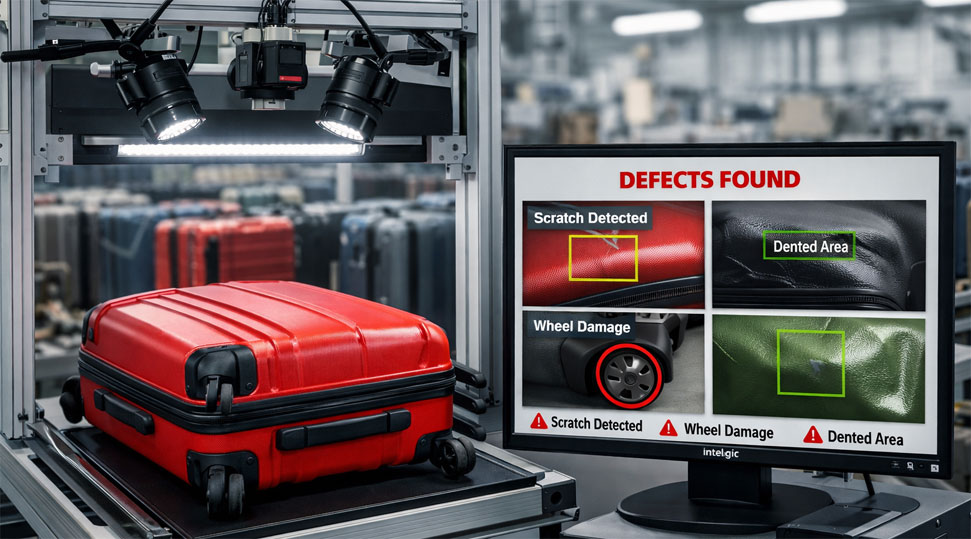
However, manual inspection of suitcase components is often slow, subjective, and inconsistent, especially when dealing with large production volumes. Small scratches, dents, molding defects, or color variations can easily be missed during human inspection.
To address these challenges, Intelgic offers an AI-powered machine vision inspection system that automatically detects defects on suitcase and trolley bag components using industrial cameras and advanced artificial intelligence algorithms.
Typical Components Inspected in Suitcases and Trolley Bags
A modern suitcase contains several molded and assembled components that must meet strict quality standards.
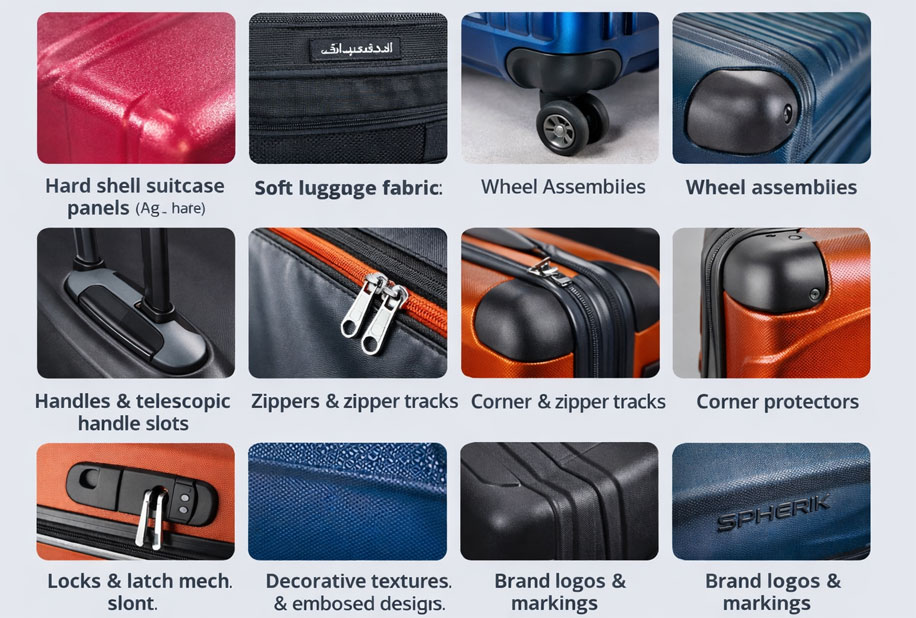
Intelgic's automated inspection system can inspect:
Hard shell suitcase panels (polycarbonate, ABS, polypropylene)
Soft luggage fabric surfaces
Wheel assemblies
Handles and telescopic handle slots
Zippers and zipper tracks
Corner protectors
Locks and latch mechanisms
Decorative textures and embossed designs
Brand logos and markings
Each of these components may develop defects during injection molding, forming, painting, assembly, or handling.
Common Defects Found in Luggage Manufacturing
During manufacturing, suitcase parts can develop multiple types of defects that affect both appearance and functionality.
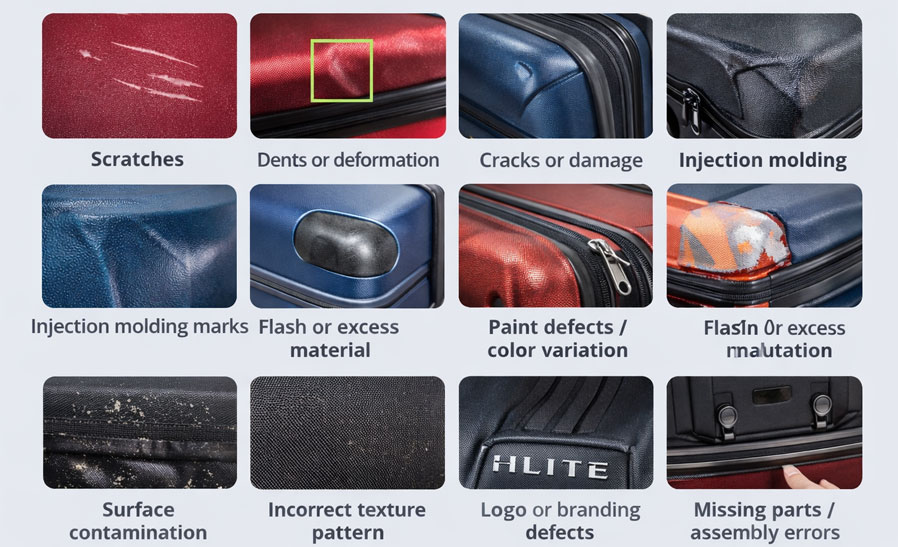
Typical defects include:
- Scratches on hard shell surfaces
- Surface dents or deformation
- Cracks or structural damage
- Injection molding marks
- Flash or excess material
- Paint defects or color variation
- Surface contamination
- Incorrect texture patterns
- Logo or branding defects
- Missing components or assembly errors
Detecting these defects early helps manufacturers maintain product quality and reduce returns or warranty claims.
Intelgic's AI-Based Vision Inspection System
Intelgic builds customized automated inspection machines designed specifically for luggage and travel product manufacturers.
The system typically includes:
1 Industrial Cameras
The inspection machine uses high-resolution industrial cameras to capture images of suitcase surfaces and components.
Depending on the inspection requirement, the system may use:
- Area scan cameras for full surface inspection
- Line scan cameras for continuous scanning of large suitcase panels
This enables the system to capture fine surface details and detect even small defects.
2 Specialized Lighting Geometry
Proper lighting is critical for detecting surface defects on plastic and textured luggage surfaces.
Intelgic designs customized lighting setups such as:
- Low-angle dark field lighting for scratches
- Diffused lighting for color and texture inspection
- Structured lighting for detecting dents and deformation
These lighting techniques enhance defect visibility, making it easier for AI algorithms to detect irregularities.
3 Conveyor-Based Automated Inspection
The system typically includes a conveyor mechanism that transports suitcase components through the inspection station.
Depending on the product geometry, the system may also include:
- Multi-camera imaging tunnels
- Rotational inspection stages
- Robotic positioning mechanisms
This ensures complete inspection of all surfaces of the luggage components.
4 AI-Powered Defect Detection
Intelgic's software platform includes advanced AI models trained specifically for industrial defect detection.
The AI learns from both good samples and defective samples, enabling it to detect:
- Surface anomalies
- Texture deviations
- Color inconsistencies
- Structural defects
- Assembly issues
Unlike traditional rule-based systems, AI can handle complex textures and patterns often present in luggage surfaces, ensuring accurate defect detection.
5 Recipe-Based Inspection for Multiple Luggage Models
One of the most powerful features of Intelgic's system is its recipe-based inspection architecture.
A single inspection machine can handle multiple suitcase models and designs.
Each recipe defines:
- Camera configurations
- Lighting geometry
- Conveyor speed
- AI models used for inspection
- Defect thresholds and tolerance limits
Operators simply select the correct recipe when switching between suitcase models, allowing the system to quickly adapt to different products without manual reconfiguration.
6 Data Analytics and Quality Reporting
The system automatically stores inspection results and provides advanced analytics dashboards.
Manufacturers can:
- Track defect trends
- Store defect images for traceability
- Generate production quality reports
- Identify root causes in manufacturing processes
This data helps manufacturers continuously improve product quality and manufacturing efficiency.
Benefits of AI-Based Luggage Inspection
Implementing Intelgic's automated inspection system provides several advantages:
100% inspection of luggage components
Consistent and objective quality control
Detection of micro-defects invisible to human inspectors
Reduced labor dependency
Improved production efficiency
Better traceability and quality reporting
Conclusion
As luggage manufacturing scales to meet global demand, maintaining high quality becomes increasingly important. Manual inspection methods are no longer sufficient to detect subtle defects across large production volumes.
Intelgic's AI-powered machine vision inspection system enables manufacturers to automatically detect defects in suitcases and trolley bags using industrial cameras, intelligent lighting systems, and advanced AI software.
With customizable inspection machines and recipe-based configuration, Intelgic provides a flexible and scalable solution that ensures consistent quality and reliable defect detection in luggage manufacturing.