Manufacturing industries are under constant pressure to deliver high-quality products, reduce defects, and increase production efficiency. Even minor defects can lead to product recalls, warranty claims, customer dissatisfaction, and financial losses.
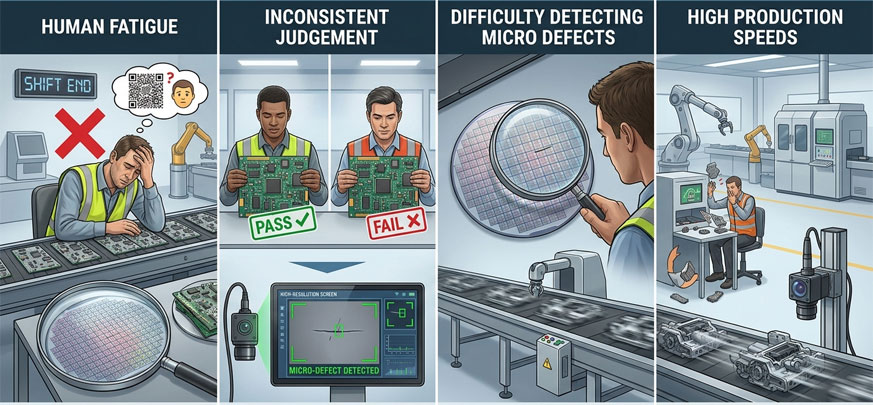
Traditionally, quality inspection in factories has relied heavily on manual visual inspection, where human operators examine products for defects. However, manual inspection has significant limitations including inconsistency, fatigue, and difficulty detecting micro defects.
With the advancement of Artificial Intelligence (AI) and machine vision technology, manufacturers can now automate defect detection with exceptional accuracy and speed.
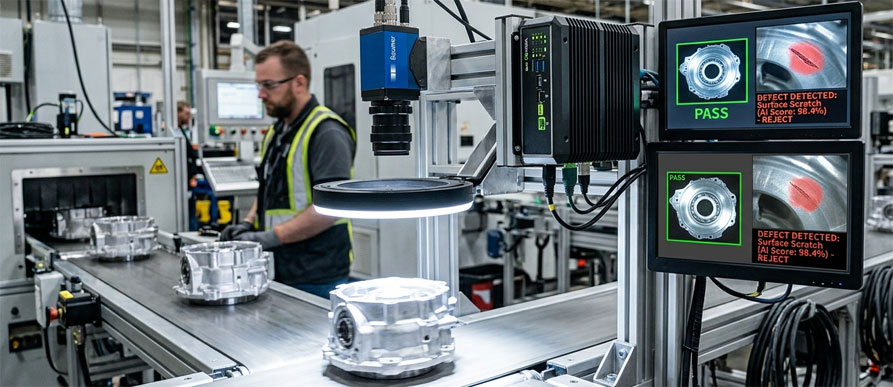
AI-based defect detection systems use industrial cameras, specialized lighting, high-performance computing, and deep learning algorithms to automatically identify defects in real time.
Intelgic develops advanced AI-powered machine vision inspection systems that help manufacturers detect defects, improve quality, and achieve smarter manufacturing processes.
What is AI-Based Defect Detection?
AI-based defect detection refers to the use of artificial intelligence algorithms to analyze images of products and identify defects automatically.
These systems combine several technologies:
- Industrial machine vision cameras
- Advanced lighting systems
- Image processing software
- Deep learning models
- GPU-powered processing systems
The system captures images of products during manufacturing and uses AI to detect abnormalities, defects, or inconsistencies.
Why Traditional Inspection Methods Fail
Manual inspection has been used for decades, but modern manufacturing environments expose its limitations.
Human Fatigue
Operators inspecting products continuously may experience fatigue, leading to missed defects.
Inconsistent Judgement
Different inspectors may interpret defects differently, resulting in inconsistent quality standards.
Difficulty Detecting Micro Defects
Very small defects such as micro cracks or scratches are difficult for humans to detect consistently.
High Production Speeds
Modern production lines often operate at speeds where manual inspection becomes impractical.
AI-based inspection systems address these limitations by providing continuous, objective, and high-speed inspection.
How AI-Based Defect Detection Works
AI-based inspection systems operate through a structured workflow.
Image Capture
Industrial cameras capture high-resolution images of products as they move through the production line.
Lighting Optimization
Specialized lighting is used to highlight surface features and defects.
Lighting techniques may include:
Proper lighting ensures defects are visible in captured images.
Image Processing
Captured images are processed using industrial computing systems equipped with GPUs. The system prepares images for AI analysis.
AI Analysis
Deep learning models analyze the images and identify patterns associated with defects. The AI model compares the captured image against trained patterns of good and defective products.
Defect Classification
The system classifies the product as:
Data Logging
Inspection results are stored for traceability and quality analytics.
Types of Defects AI Can Detect
AI-based inspection systems can detect a wide range of defects across different industries.
Surface Defects
- Scratches
- Cracks
- Dents
- Contamination
Structural Defects
- Missing components
- Incorrect assembly
- Deformation
Print and Label Defects
- Missing labels
- Incorrect logos
- Printing errors
Dimensional Defects
- Incorrect measurements
- Shape irregularities
Machine Vision Technologies Used in AI Inspection
Area Scan Cameras
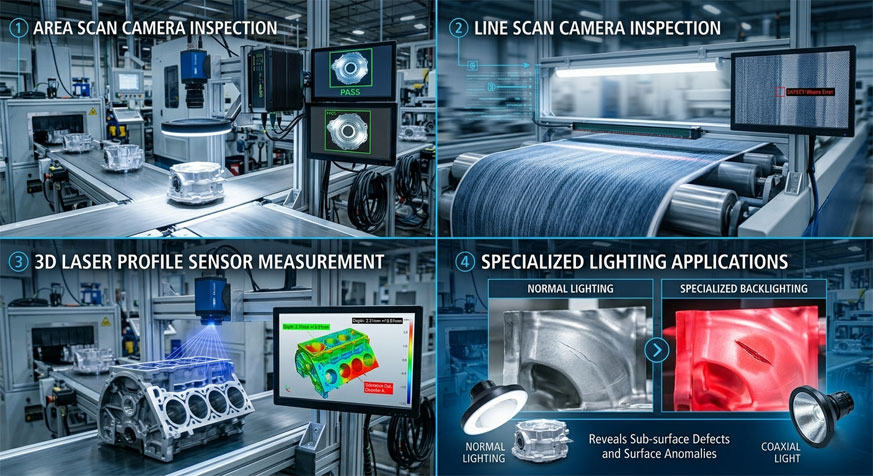
Capture full-frame images of products and are suitable for inspecting individual parts.
Line Scan Cameras
Capture images line-by-line and are ideal for inspecting continuous materials such as sheets, fabrics, and leather.
3D Laser Profile Sensors
Generate 3D surface profiles used for accurate dimensional measurements.
Specialized Lighting
Lighting plays a crucial role in revealing defects that are not visible under normal illumination.
Benefits of AI-Based Defect Detection
100% Product Inspection
Every product can be inspected automatically without sampling.
Detection of Micro Defects
AI systems can detect defects smaller than those visible to the human eye.
Improved Production Efficiency
Inspection is performed without slowing down the production line.
Reduced Labor Costs
Automation reduces reliance on manual inspectors.
Data-Driven Quality Control
Manufacturers gain valuable insights from inspection data.
Industries Using AI-Based Defect Detection
AI inspection systems are widely used across manufacturing sectors.
Automotive Manufacturing
- Engine component inspection
- Tire inspection
- Surface defect detection
Textile Industry
- Fabric defect detection
- Print inspection
Electronics Manufacturing
- PCB inspection
- Component verification
Metal Manufacturing
- Sheet metal inspection
- Surface defect detection
Glass and Ceramics
- Glass defect detection
- Ceramic tile inspection
Rubber & Polymer
- Rubber sheet inspection
- Tire manufacturing
Role of AI in Industry 4.0
AI-based inspection systems are an important part of Industry 4.0 and smart manufacturing.
These systems enable:
- Automated quality control
- Real-time production monitoring
- Predictive quality analysis
- Integration with MES and ERP systems
By digitizing inspection processes, manufacturers gain complete visibility into product quality.
Why Manufacturers are Adopting AI Inspection
Manufacturers are rapidly adopting AI inspection systems because they provide:
Companies that implement AI inspection gain a competitive advantage in quality and efficiency.
Intelgic’s AI-Based Defect Detection Solutions
Intelgic provides custom machine vision inspection systems powered by AI, designed for complex manufacturing environments.
Intelgic’s solutions include:
These systems can be customized for various applications including:
The Future of AI in Manufacturing Quality Control
AI is rapidly transforming the future of manufacturing quality inspection.
Advancements in deep learning, computer vision, and industrial automation will enable even more powerful inspection systems capable of detecting defects with unprecedented accuracy.
Manufacturers adopting AI inspection systems today are building the foundation for fully autonomous quality control in smart factories.
AI-based defect detection is revolutionizing quality control in manufacturing. By combining machine vision cameras, advanced lighting systems, and AI algorithms, manufacturers can detect defects automatically and maintain consistent product quality.
Intelgic’s AI-powered inspection solutions help manufacturers achieve higher quality standards, improved efficiency, and smarter manufacturing operations.
As industries continue to embrace automation and digital transformation, AI-based inspection systems will become an essential component of modern manufacturing.