In manufacturing, assembly lines, warehouses, and packaging operations, the ability to accurately identify parts or products is essential for:
While traditional systems depend on barcodes, QR codes, or RFID tags, many real-world scenarios require recognizing a part purely by its visual appearance—shape, color, texture, text, geometry, or unique visual patterns.
Intelgic’s camera-based AI solution enables high-accuracy part and product recognition using visual features, even when:

This article educates readers on how such systems work, their benefits, challenges, and real-world applications.
What Is Visual Feature-Based Part Recognition?
Visual feature-based recognition uses images captured by industrial cameras and AI algorithms to identify a part or product by analyzing its unique characteristics.
Typical visual features include:
Shape & geometry
Contours & edges
Hole patterns
Surface texture
Color shades
Printed text or markings
Logos, symbols, labels
Physical dimensions
Pattern symmetry
Material reflectivity
These features are learned by AI models during training so the system can distinguish between dozens or hundreds of part variants.
Why Visual Recognition Is Needed Beyond Barcodes and Labels
Many industrial environments face limitations:
Missing or Damaged Labels
Barcodes or QR codes may peel off, get scratched, or be unreadable.
Unlabeled Components
Raw metal parts, machined components, fasteners, and molded plastics often have no labels at all.
Multiple Variants with Subtle Differences
Products differ by shape, a small slot, hole position, or design variation.
Wrong Part Feeding in Assembly Lines
Even a single incorrect part in an assembly can cause production failure.
Need for Touch-Free, Fast Recognition
High-speed lines require instant and automated identification.
Visual feature-based recognition solves all these issues.
How Intelgic’s AI-Powered Visual Recognition System Works
Intelgic combines industrial imaging, deep learning, and classical computer vision to build a robust recognition system.
Image Acquisition
A high-resolution industrial camera captures the product image under optimized lighting. Lighting may include:
- Dome or diffuse light
- Low-angle light
- Backlight
- Coaxial illumination (for reflective surfaces)
This ensures consistent image quality regardless of shadows or glare.
Feature Extraction
AI analyzes the image to extract:
These elements collectively form the visual signature of the part.
AI-Based Classification and Matching
Each recognized part is mapped to a reference database:
- Product ID
- Variant
- Category
- Specifications
- Order information
Intelgic's model is trained on thousands of images, ensuring reliability across:
- Different angles
- Different lighting
- Minor defects
- Partial visibility
The system can also identify new or unknown parts by noticing that the visual signature does not match the trained database.
Output & System Integration
Once identified, the system:
- Displays the part identity on screen
- Sends the part ID to ERP/MES/PLC
- Logs the recognition event for traceability
- Validates whether the correct part is used in assembly
- Triggers sorting or routing mechanisms
Processing happens in real-time (<1 second) using GPU acceleration.
Key AI Technologies Used
Convolutional Neural Networks (CNNs)
Extracts deep visual features such as shape and texture.
Object Detection Models
Locates parts and differentiates multiple objects in a single image..
Image Segmentation
Separates the part from the background for cleaner recognition.
Metric Learning / Feature Embedding
Creates a unique vector signature for each part to enable pattern-to-pattern matching.
OCR Integration
Reads serial numbers, model numbers, or labels if available.
Hybrid Models
Combining classical CV tools with deep learning for hole detection, edge detection, and geometric correction.
System Capabilities
Intelgic’s solution supports:
Additional features include:
Real-World Applications
Automotive
Recognizing brackets, clips, fasteners, engine components, wiring harness parts.
Electronics Manufacturing
Identifying PCB variants, connectors, casings, and IC sockets.
Warehouse & Distribution
Recognizing packaged products by shape, print, or colors—when barcodes are missing.
Metal Fabrication
Identifying plates, C-channels, welded parts by hole patterns and geometry.
Packaging Lines
Ensuring the right product goes inside each box or tray.
Consumer Goods
Classifying cosmetic items, personal care products, medical devices.
Assembly Lines
Verifying components before robotic assembly.
Benefits of Intelgic’s Visual Feature-Based Recognition System
Zero Dependency on Labels or Barcodes
AI identifies the product simply by looking at it.
Ultra-High Accuracy (>98–99%)
Reliable even under challenging lighting or positioning.
Real-Time Processing
Ideal for high-speed industrial lines.
Scalable and Trainable
New parts can be added quickly through image datasets.
Reduces Operational Errors
Prevents wrong part assembly and shipping mistakes.
Improves Quality & Traceability
Each inspected part is logged and verified.
Robust & Versatile
Works on reflective metal, textured plastic, printed surfaces, etc.
Integrates with Any Industrial System
Supports PLC, ERP, MES, SCADA, APIs, and cloud dashboards.
Example Workflow in a Manufacturing Setup
- Camera images the part when placed on the station or moving on a conveyor.
- AI extracts visual features and compares them with the library.
- Correct part ID is displayed and sent to downstream systems.
- If the wrong part appears, the system raises an alert.
- Recognition data is stored for reporting and analytics.
This fully automates what previously required skilled operators and manual checks.
Why Intelgic’s Solution Is Superior
Intelgic's part recognition platform is designed specifically for industrial environments:
Unlike generic computer vision tools, Intelgic's models are optimized for:
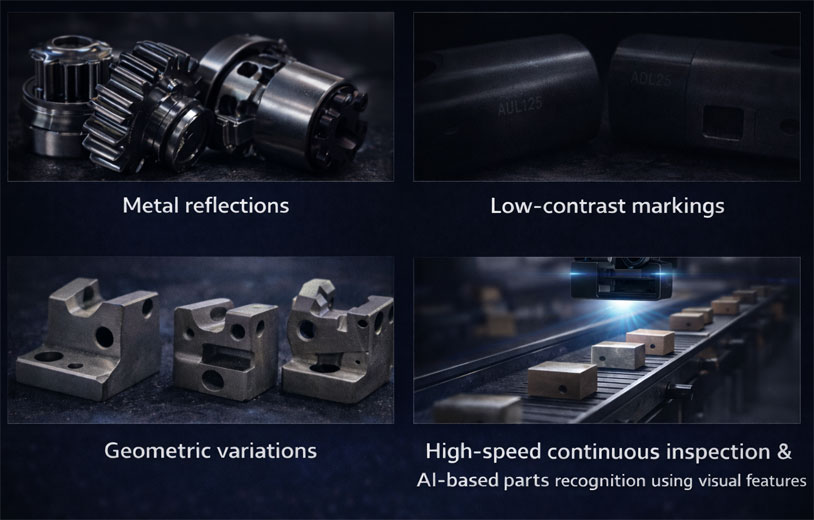
Visual feature-based part and product recognition is transforming modern manufacturing. With Intelgic's advanced AI and industrial camera systems, companies can:
Whether it’s recognizing C-channels by hole patterns, identifying packaged goods by color and text, or classifying complex mechanical parts, Intelgic’s AI-driven solution provides a fast, accurate, and scalable method for industrial part recognition.