Vibration is one of the earliest indicators of mechanical problems in industrial environments. Excessive or abnormal vibration can signal issues such as bearing wear, loose fasteners, shaft misalignment, imbalance, structural fatigue, or impending equipment failure.
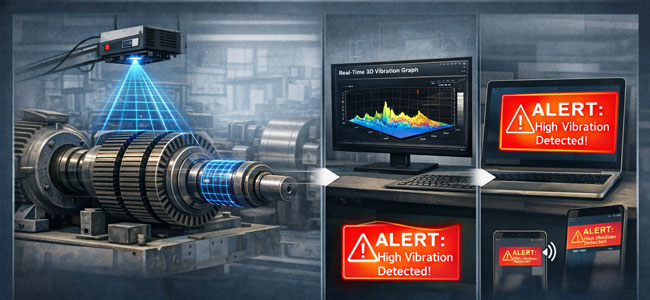
Traditionally, vibration monitoring has relied on contact-based sensors like accelerometers. While effective, these sensors are limited by mounting constraints, maintenance needs, and the inability to measure vibration across large or moving surfaces.
Intelgic addresses these limitations by combining 3D laser profiler technology with its advanced Live Vision AI 2.0 software, enabling non-contact, high-precision vibration measurement and real-time alerting for industrial assets.
Understanding Vibration Measurement with a 3D Laser Profiler
A 3D laser profiler works on the principle of laser triangulation. The sensor projects a thin laser line onto a surface and captures its reflection with a high-speed imaging sensor. From this, it calculates precise distance (Z-height) values across the laser line.
When the monitored object vibrates:
- The measured height values change over time
- Even micron-level surface displacement becomes detectable
- Repeated profiles captured at high frequency form a time-series displacement signal
Key Difference
Instead of measuring acceleration (as in accelerometers), a laser profiler directly measures physical displacement, which is often more intuitive and easier to correlate with structural movement.
Why Laser-Based Vibration Measurement Is Different
Laser profilers offer several advantages over traditional vibration sensors:
Non-contact measurement
No physical mounting or sensor mass influence
High spatial resolution
Vibration can be measured at multiple points along a line
Safe for harsh environments
Works on hot, moving, or sterile environments
Works on moving components
Rotating, oscillating, or translating components
Captures mode shape
Both amplitude and vibration mode shape
This makes laser profilers particularly valuable for conveyors, rollers, motors, frames, robotic arms, large panels, and moving machine assemblies.
Role of Live Vision AI 2.0 in Vibration Intelligence
While the laser profiler captures raw displacement data, the real value is unlocked by Live Vision AI 2.0, where signal processing, AI analysis, and contextual intelligence converge.
Developed by Intelgic, Live Vision AI 2.0 introduces a new AI architecture and multi-modal analysis framework that transforms raw vibration data into actionable insights.
Step-by-Step: How the System Measures Vibration
High-Speed Profile Acquisition
The laser profiler captures height profiles at high frequency (hundreds to thousands of profiles per second). Each profile provides X-position along the laser line and Z-height at each point. Over time, this builds a displacement signal for every measured location.
Stable Reference and Drift Compensation
Live Vision AI 2.0 automatically identifies stable reference zones, compensates for slow thermal drift or mechanical offset, and filters environmental noise without removing true vibration signals. This ensures that alerts are not triggered by gradual changes or background movement.
Time-Domain Vibration Analysis
The software analyzes displacement data over time to compute peak-to-peak vibration amplitude, RMS displacement, and instantaneous and average motion patterns. Sudden spikes or gradual increases are detected with high sensitivity.
Frequency-Domain Analysis
Using FFT and advanced signal transforms, Live Vision AI 2.0 extracts dominant vibration frequencies, harmonics linked to rotating components, and resonance patterns of structures. These frequency signatures are critical for identifying why vibration is occurring, not just that it exists.
Multi-Modal Intelligence for False-Alert Reduction
One of the key strengths of Live Vision AI 2.0 is its multi-modal approach. Vibration data is correlated with machine state (running, idle, ramp-up), process timing and cycles, data from multiple measurement zones or sensors, and historical vibration patterns. By combining these inputs, the system dramatically reduces false alarms caused by normal process variations.
Intelligent Alerting and Threshold Management
Instead of static thresholds, Live Vision AI 2.0 supports adaptive alert logic:
- Baseline vibration profiles are learned during normal operation
- Alert limits adjust based on speed, load, or recipe
- Deviation trends are monitored over time
Early warning
(trend-based)
Critical threshold breach
Frequency-specific anomalies
(e.g., bearing fault frequency)
Real-Time Alerts and System Integration
When abnormal vibration is detected, the system can:
Trigger visual alerts on the dashboard
Send digital outputs or PLC signals
Log events with time-stamped vibration evidence
Notify maintenance teams via integrated systems
Because the solution is non-contact and software-driven, alerts are generated without stopping the machine.
Industrial Use Cases
This approach is especially effective in:
Conveyor and roller vibration monitoring
Motor and gearbox condition monitoring
Robotic arm oscillation detection
Structural vibration in frames and gantries
Packaging and high-speed automation lines
In many cases, the laser-based system complements or even replaces contact sensors, especially where access or mounting is difficult.
From Measurement to Predictive Maintenance
By continuously monitoring vibration trends, Live Vision AI 2.0 enables:
- Early fault detection
- Root-cause frequency analysis
- Maintenance scheduling based on real condition, not intervals
- Reduced unplanned downtime
The result is a shift from reactive maintenance to predictive, data-driven decision making.
By combining high-resolution 3D laser profiler sensors with the intelligence of Live Vision AI 2.0, Intelgic delivers a powerful, non-contact vibration monitoring solution that goes beyond traditional methods. It not only measures vibration with exceptional accuracy, but also understands context, reduces false positives, and generates actionable alerts—helping manufacturers protect equipment, improve reliability, and maintain continuous production.