How Intelgic Uses 3D Laser Profiling for High-Accuracy Automotive Dimensional Inspection
In modern automotive manufacturing, dimensional accuracy and surface quality directly impact assembly fit, sealing performance, NVH behavior, aesthetics, and long-term reliability. Traditional contact gauges, CMMs, or 2D camera systems often struggle to keep up with production speed, part variability, and complex geometries.
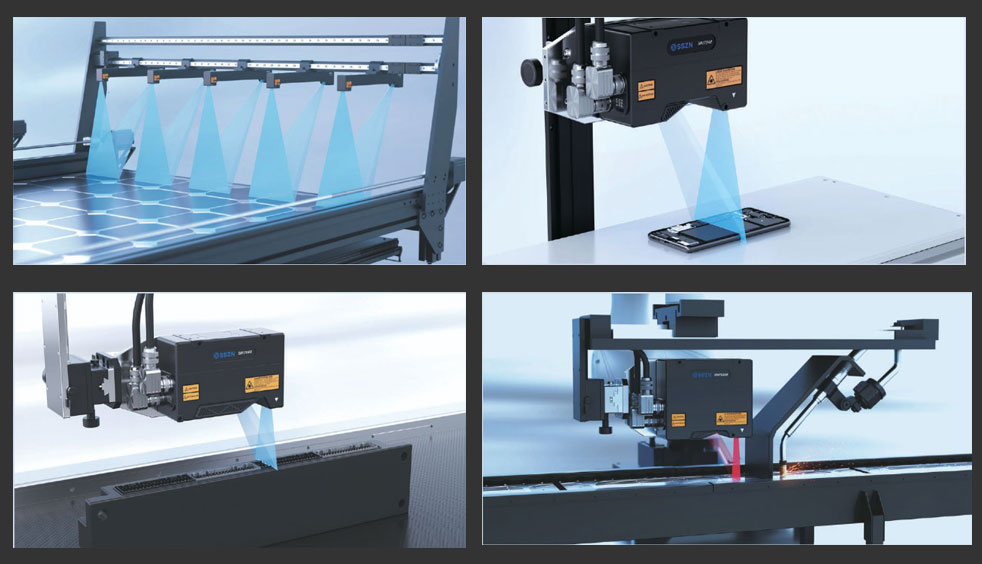
A 3D laser profiler overcomes these challenges by capturing true surface geometry—enabling precise, repeatable, and non-contact measurement of surface smoothness, rabbet dimensions, drilled holes, hole position, and gaps.
Intelgic implements 3D laser profiling as a fully automated measurement platform, combining sensors, mechanics, software, analytics, and PLC/MES integration for shop-floor deployment.
How a 3D Laser Profiler Measures Real Geometry
A 3D laser profiler projects a thin laser line onto the part surface and observes it from a known angle. Any change in height causes a shift in the laser line’s position in the sensor image. Using laser triangulation, the system converts this shift into accurate Z-height data.
As the part or sensor moves, thousands of profiles are captured and stitched together to form:
- Cross-sectional profiles (fast, line-based measurements)
- Height maps (2.5D topography)
- 3D3D point clouds (full geometric representation)
This data foundation makes it possible to measure features that are difficult or unreliable with 2D vision.
Surface Smoothness Testing Using 3D Laser Profilers
Surface smoothness is critical for:
Sealing faces
Gasket interfaces
Machined mating surfaces
Bbearing seats and precision fits
How the measurement works
- The profiler scans the surface across a defined region.
- A reference plane is mathematically fitted to the surface.
- Deviations from this plane are calculated at every point.
- Metrics such as peak-to-valley variation, waviness, local height deviation, and surface uniformity are computed.
What can be detected
- Machining marks and chatter
- Localized dents or raised areas
- Warpage or bowing
- Uneven polishing or grinding
Because the measurement is geometric (not image-based), it remains reliable even on shiny or low-contrast metallic surfaces.
Accurate Rabbet Measurement (Depth, Width, and Uniformity)
A rabbet—a stepped recess used for seating seals, panels, or mating components—must meet tight tolerances to ensure proper fit and load distribution.
Measurement approach
The laser scans across the rabbet cross-section.
The system detects:
- Top surface
- Step edge
- Bottom surface
From the extracted 3D profile, the software computes:
- Rabbet depth
- Rabbet width
- Step angle and sharpness
- Depth consistency along the length
Why 3D Profiling Excels
Sharp step transitions are clearly visible in height data.
Depth is measured directly, not inferred from pixel contrast.
Wear, tool drift, or incomplete machining is identified early.
Drilled Hole Measurement: Depth, Diameter Indicators, and Geometry
Drilled holes are critical features in engine blocks, housings, brackets, and structural parts.
What a 3D laser profiler measures
- Hole depth (by detecting top surface and bottom surface)
- Countersink or counterbore depth
- Edge condition (burrs, chamfers, breakouts)
- Partial obstruction or debris
Measurement Method
- The profiler scans across the hole opening
- 3D edge points define the hole boundary
- Bottom surface points define the hole base
- Depth is calculated as the vertical distance between reference planes
Unlike probes, the laser profiler performs this without touching the part, avoiding tool wear and cycle-time penalties.
Hole Position Testing and Alignment Verification
Correct hole position is essential for assembly alignment and fastening accurac
How hole position is measured
- Multiple scans capture the 3D edge of each hole.
- A circle (or ellipse) is mathematically fitted to the edge points
- The hole center is calculated in real-world coordinates.
- The measured center is compared against CAD nominal, mechanical datum, or reference holes/features
Typical Checks
- X/Y positional deviation
- Relative distance between holes
- Angular misalignment
- Tilt detection (with multi-line or indexed scans)
This enables fast in-line positional verification that traditionally required CMM inspection.
Gap Testing Using 3D Laser Profilers
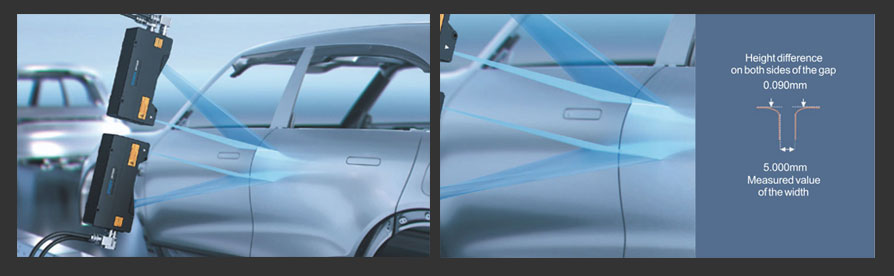
Gap measurement is widely used in:
Body-in-white
Closures and trims
Battery packs
Structural assemblies
Measurement Technique
- The laser scans across the gap region
- Both opposing edges are detected in the height profile
- The distance between edges is computed at multiple points
- Minimum, maximum, and average gap values are reported
Advantages Over 2D Vision
Works even when edges have similar color or texture.
Measures true physical distance, not visual separation.
Supports continuous gap measurement along a seam.
Automation and Industrial Deployment with Intelgic
Intelgic integrates 3D laser profiling into fully automated measurement systems that include:
Precision Fixtures
Precision mechanical fixtures and motion system
Conveyor Integration
Encoder-based synchronization for moving conveyors
PLC Integration
PLC integration for triggers, interlocks, and decisions
Real-time Monitoring
Real-time pass/fail outputs and alarms
Analytics
SPC dashboards, trend analytics, and traceability
Measurement results are seamlessly connected to MES, QMS, or ERP systems, enabling closed-loop process control and data-driven manufacturing.
Why 3D Laser Profiling Is Ideal for These Applications
Non-contact & fast
No tool wear, suitable for high-speed in-line inspection
True Geometry
Independent of lighting conditions and surface color
High Repeatability
Stable results across shifts and operators
Multi-feature
Measure surfaces, steps, holes, and gaps with one sensor
Process Insight
Dimensional trends reveal upstream process drift
Surface smoothness testing, accurate rabbet measurement, drilling hole inspection, hole position verification, and gap testing can all be performed reliably using 3D laser profilers.
By capturing true 3D geometry at production speed, this technology enables manufacturers to maintain tight tolerances, improve assembly quality, and reduce costly rework or re
With Intelgic’s end-to-end 3D laser profiling solutions—covering sensors, automation, software, analytics, and system integration—automotive manufacturers can transform dimensional inspection from a quality checkpoint into a powerful process-control and optimization tool.