Windshield Inspection Automation Using Intelgic IG5 AI and the Certainty Platform
Windshield inspection automation combines controlled material handling, robot-mounted imaging systems, specialized illumination, industrial machine vision cameras, synchronized image acquisition, and AI-based defect analysis.
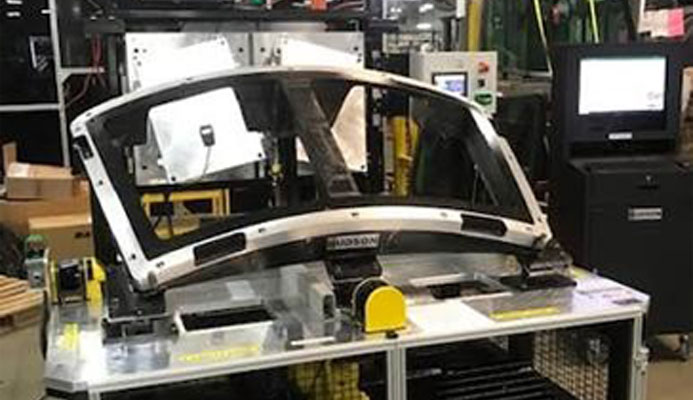
Intelgic develops application-specific windshield inspection systems around its Certainty platform and IG5 AI model. The system captures the windshield under carefully engineered optical conditions, transfers the images into Certainty, analyzes them using IG5, and communicates the inspection result to production equipment and manufacturing software.
The solution can be configured for windshields at different manufacturing stages, including formed glass, laminated glass, printed glass, coated glass, and finished windshields containing functional components.
Understanding the Windshield as an Inspection Object
A windshield is a large, curved, transparent, laminated component. Its optical behavior changes across the surface because of curvature, glass thickness, viewing angle, printed borders, coatings, and reflections.
Because the windshield is not a flat surface and is highly transparent, inspection becomes challenging. Large windshields, especially those used in trucks, helicopters, and aircraft, require advanced imaging strategies to reliably detect defects.
Intelgic addresses this by using robot-mounted cameras and lighting systems that move across the windshield surface. The robot carries cameras and multiple light sources, allowing the system to inspect the glass from different angles. In some cases, multiple lights are used simultaneously from different directions to reveal subtle defects that are otherwise invisible.
An imaging system may simultaneously capture:
The inspection system must create controlled and repeatable optical conditions before AI analysis begins.
Grid-Based Optical Inspection Approach
In addition to conventional imaging, Intelgic uses a grid-based inspection method for optical distortion and surface deformation analysis.
A structured grid is placed as a controlled background behind or within the optical path. When the camera captures images of the windshield from multiple angles, any deviation, bending, or displacement of the grid lines is analyzed.
By comparing the expected grid geometry with the observed deformation, the system can quantify subtle optical defects that are difficult to detect using standard imaging alone.
Windshield Defects and Features That Can Be Inspected
The exact inspection scope depends on whether a defect creates a measurable visual, optical, or geometric signal under the selected imaging conditions.
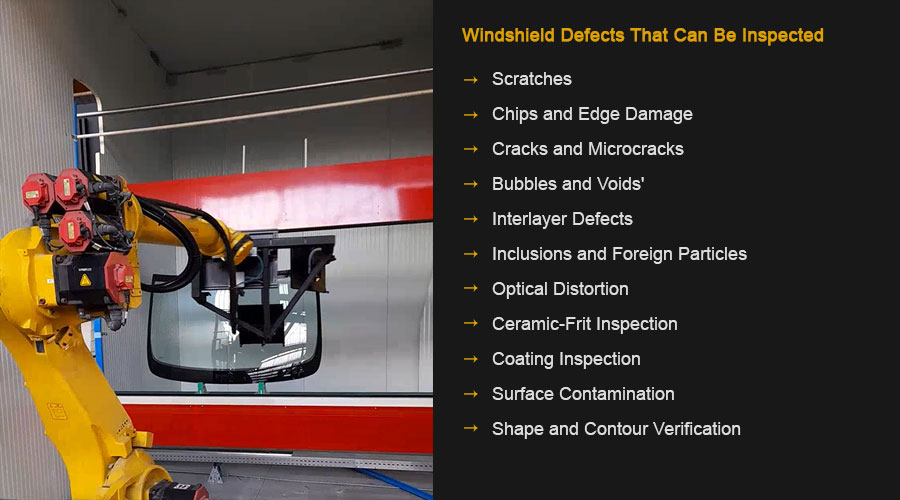
Scratches can appear on the inner or outer glass surface. They may be straight, curved, isolated, or grouped. IG5 can be trained to analyze scratches according to:
Robot-mounted cameras combined with directional and multi-angle lighting help reveal low-contrast scratches that are otherwise difficult to detect.
Windshield edges may contain chips, shelling, cracks, rough areas, localized breakage, and incorrect edge finishing.
Because edges are difficult to capture with fixed cameras, robot-mounted imaging systems are often used to move along the perimeter and capture multiple viewing angles.
Visible cracks may occur on the glass surface, near edges, around holes, or within specific formed regions. Their detectability depends on crack width, length, contrast, orientation, surface location, glass curvature, lighting direction, and camera resolution.
Multi-angle robot-mounted lighting is often used to highlight cracks that only appear under specific illumination directions.
Laminated windshields may contain bubbles, voids, or localized separation within the interlayer. Transmitted illumination combined with moving camera positions can make these conditions visible as variations in light transmission and texture.
Dust, fibers, glass particles, coating material, and other foreign matter may be located on a surface or within the laminate. The inspection system can analyze inclusions according to:
Windshield curvature, forming variation, and lamination conditions can distort a reference pattern viewed through the glass. Intelgic uses a grid-based background approach for this inspection. When the camera moves across the windshield and captures images from multiple angles, deviations in the grid are measured to detect distortion.
Windshields may include solar-control, infrared-reflective, conductive, hydrophobic, or other functional coatings. Where the coating creates a detectable optical difference, the imaging system can identify missing coating, uneven coating, streaks, spots, contamination, coating boundaries, and localized appearance variation.
Machine vision or 3D sensing can verify visible geometric characteristics such as:
Robot-Mounted Camera Inspection System
A key feature of Intelgic windshield inspection is the use of robot-mounted cameras and lighting systems.
In many cases, multiple lights are used from different angles simultaneously to enhance defect visibility.
Windshield Identification, Mechanical Presentation, and Custom Booths
Before inspection begins, the system can determine the correct windshield recipe using information from:
A windshield must be presented to the imaging system in a repeatable and stable manner. Intelgic can integrate the inspection station with:
The windshield may be inspected horizontally, vertically, or at a controlled angle depending on the application.
Intelgic can develop a custom inspection booth to isolate the windshield from changing factory light and unwanted reflections. The booth may integrate:
Specialized Lighting for Windshield Inspection
Different defects require different optical conditions. Intelgic may capture multiple images of the same windshield under different lighting modes.
Reveals:
Reveals:
Enhances:
Robot-mounted lighting enables dynamic angle variation to reveal defects that appear only under specific illumination directions.
A structured grid background is used to detect optical distortion by analyzing deviations in grid geometry across multiple camera positions.
Camera Configuration and Complete Surface Coverage
Intelgic selects cameras according to windshield size, required resolution, minimum defect size, and production cycle time.
Fixed cameras may not provide sufficient coverage for large curved windshields.
Intelgic uses robot-mounted or motion-controlled systems to move cameras and lighting across the surface, ensuring full inspection coverage.
Each windshield may be represented by a sequence of images rather than a single photograph.
Automated Inspection Workflow
Intelgic Certainty Platform for Windshield Inspection
Certainty is Intelgic's AI inspection platform for managing industrial image acquisition, AI inference, inspection logic, traceability, analytics, and manufacturing integration.
Certainty is integrated with Intelgic's IG5 AI model, designed for industrial defect detection. IG5 supports:
The IG5 training dataset includes:
IG5 can report defect location with high precision, including camera position, robot position, and inspection zone.
Certainty combines AI results with configurable inspection rules to determine final outcomes.
Certainty exchanges real-time signals with PLC systems for full production synchronization.
Inspection data can be transmitted to enterprise systems for traceability and analytics.
Certainty provides dashboards for defect trends, production quality, and system performance.
Deploy Windshield Inspection with Intelgic Certainty and IG5
Intelgic combines robot-mounted imaging systems, multi-angle lighting, grid-based optical analysis, Certainty software, and IG5 AI into a complete windshield inspection solution.
The system ensures reliable defect detection even on large, curved, transparent windshields used in automotive, heavy vehicle, aerospace, and specialty applications.