Automated Inspection of Transparent Materials Using Machine Vision
Published on: Apr 23, 2026

Written by:Content team, Intelgic
Transparent materials such as glass, plastic films, optical lenses, and packaging materials are widely used across modern manufacturing industries. These materials must meet strict quality standards because even small defects can affect product performance, safety, and appearance.
However, inspecting transparent materials is significantly more challenging than inspecting opaque objects. Since transparent materials allow light to pass through and reflect light differently, defects are often difficult to detect using conventional inspection methods.
To overcome these challenges, manufacturers use machine vision systems with specialized lighting techniques and AI-powered image analysis to automate the inspection of transparent materials. These systems enable manufacturers to detect defects accurately and inspect materials at production line speed.
Challenges in Inspecting Transparent Materials
Transparent materials present several unique inspection challenges.
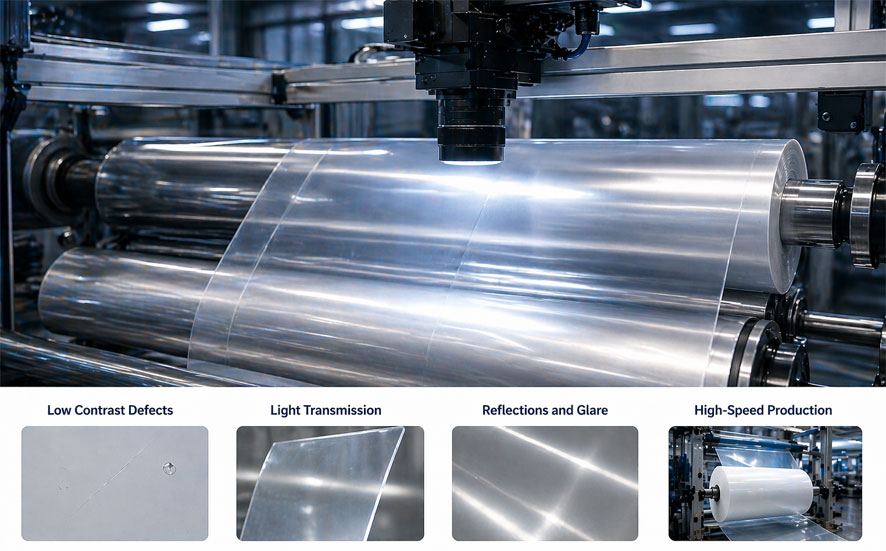
Low Contrast Defects
Defects such as scratches or bubbles may not produce strong visual contrast.
Light Transmission
Transparent materials allow light to pass through, making it difficult to highlight surface defects.
Reflections and Glare
Shiny surfaces create reflections that can obscure defects.
High-Speed Production
Many transparent materials are produced in continuous roll-to-roll or high-speed production lines, requiring fast inspection systems.
Machine vision systems address these challenges by combining specialized lighting geometries, industrial cameras, and AI algorithms.
Machine Vision Technologies for Transparent Material Inspection
Several lighting techniques are commonly used to inspect transparent materials.
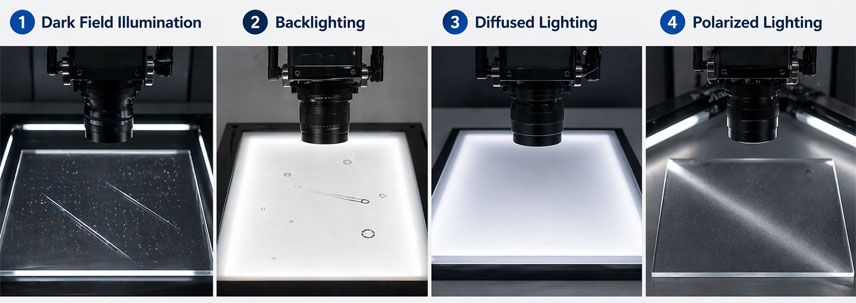
Dark Field Illumination
Low-angle lighting highlights surface defects such as scratches and cracks.
Backlighting
Light placed behind the material reveals shape variations and internal defects.
Diffused Lighting
Soft, uniform lighting reduces reflections and glare.
Polarized Lighting
Polarizing filters help reduce reflections from shiny surfaces.
The choice of lighting depends on the material type and defect characteristics.
Role of AI in Transparent Material Inspection
AI-based machine vision systems significantly improve defect detection accuracy.
AI algorithms can:
- detect subtle surface defects
- Differentiate between acceptable variations and real defects
- adapt to different material types
- reduce false defect detection
Deep learning models are trained using large datasets of defect images, allowing the system to recognize complex defect patterns.
Inspection Workflow
Automated inspection systems follow a structured workflow.
Step 1 — Material Handling
Transparent materials move through the inspection station using conveyors or rollers.
Step 2 — Lighting Setup
Specialized lighting highlights defects on the material surface.
Step 3 — Image Capture
Industrial cameras capture high-resolution images of the material.
Step 4 — AI Image Analysis
AI algorithms analyze images to detect defects.
Step 5 — Defect Classification
Detected defects are categorized based on severity.
Step 6 — Quality Decision
Defective materials are rejected automatically.
Common Defects in Transparent Materials
Machine vision systems can detect various types of defects.
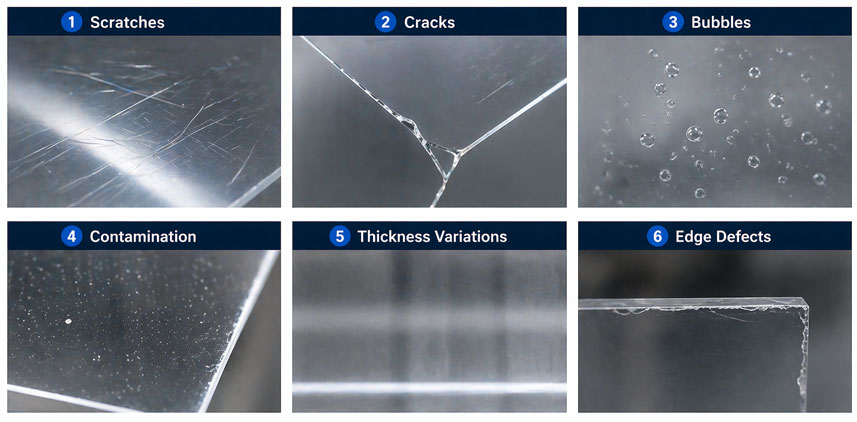
Scratches
Surface scratches caused by handling or processing.
Cracks
Structural cracks that weaken the material.
Bubbles
Air bubbles trapped inside glass or plastic materials.
Contamination
Dust or foreign particles on the surface.
Thickness Variations
Inconsistent thickness across sheets or films.
Edge Defects
Irregularities along material edges.
Industries Using Transparent Material Inspection
Automotive Industry
Inspection of windshields and automotive glass.
Consumer Electronics
Inspection of smartphone and tablet glass screens.
Packaging Industry
Inspection of transparent plastic films and containers.
Solar Panel Manufacturing
Inspection of glass used in photovoltaic panels.
Optical Manufacturing
Inspection of lenses and optical components.
Benefits of Automated Transparent Material Inspection
High Detection Accuracy
Detect small defects that are difficult to see manually.
High-Speed Inspection
Inspection systems operate at production line speed without slowing down manufacturing.
100% Inspection Coverage
Every material piece can be inspected automatically.
Reduced Human Error
Automated inspection eliminates subjective judgments.
Improved Product Quality
Early detection prevents defective products from reaching customers.
Intelgic’s Transparent Material Inspection Solutions
Intelgic develops AI-powered machine vision inspection systems designed for challenging materials such as transparent glass and plastic.
These systems allow manufacturers to detect defects with high reliability while maintaining production efficiency.
Future Trends in Transparent Material Inspection
Advances in machine vision and AI are enabling more powerful inspection systems.
Future developments include:
ultra-high-resolution imaging systems
3D surface inspection technologies
AI models capable of detecting microscopic defects
integration with smart factory systems
These technologies will enable fully automated quality inspection for transparent materials in next-generation manufacturing environments.
Automated inspection of transparent materials using machine vision systems provides an effective solution for detecting defects in challenging materials such as glass and plastic.
By combining specialized lighting techniques, high-resolution cameras, AI-based analysis, and automated inspection systems, manufacturers can maintain high product quality while improving production efficiency.
As manufacturing continues to adopt automation and smart factory technologies, machine vision inspection systems will become increasingly important for transparent material quality control.