Automating the Palletizing of Bulk Bags of Wood Pellets
Palletizing 40-pound bags of wood pellets is a demanding material-handling application. The combination of heavy individual bags, high production rates, dusty operating environments, and the need to build stable, transport-ready pallet loads makes palletizing an excellent candidate for automation.
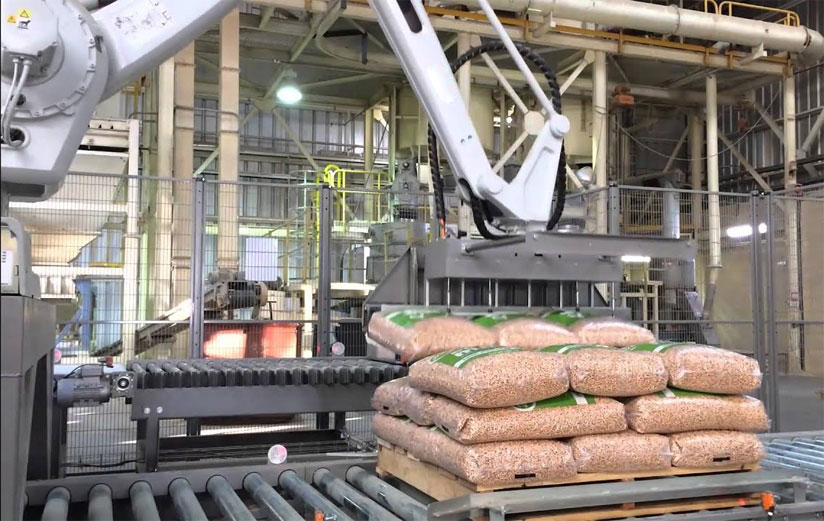
A 40-pound bag may not appear particularly heavy when handled occasionally, but the demands become significant when employees are required to lift and position hundreds or thousands of bags during a shift.
When these factors are properly addressed, robotic palletizing can transform the handling of 40-pound wood-pellet bags from a labor-intensive operation into a reliable, repeatable, and scalable automated process.
The Physical Demands of Manual Bag Handling
A worker handling 40-pound bags at a rate of only 10 bags per minute would be moving approximately 400 pounds of product every minute. Over an eight-hour production period, that can represent a substantial amount of repetitive lifting and handling.
The physical demands become even greater when bags must be repeatedly:
Automating this process can significantly reduce repetitive lifting and improve ergonomics.
Why Robotic Palletizing Is Well Suited to Wood Pellets
Robotic palletizers are particularly effective for products that are repetitive, relatively consistent in size and weight, and produced at a predictable rate.
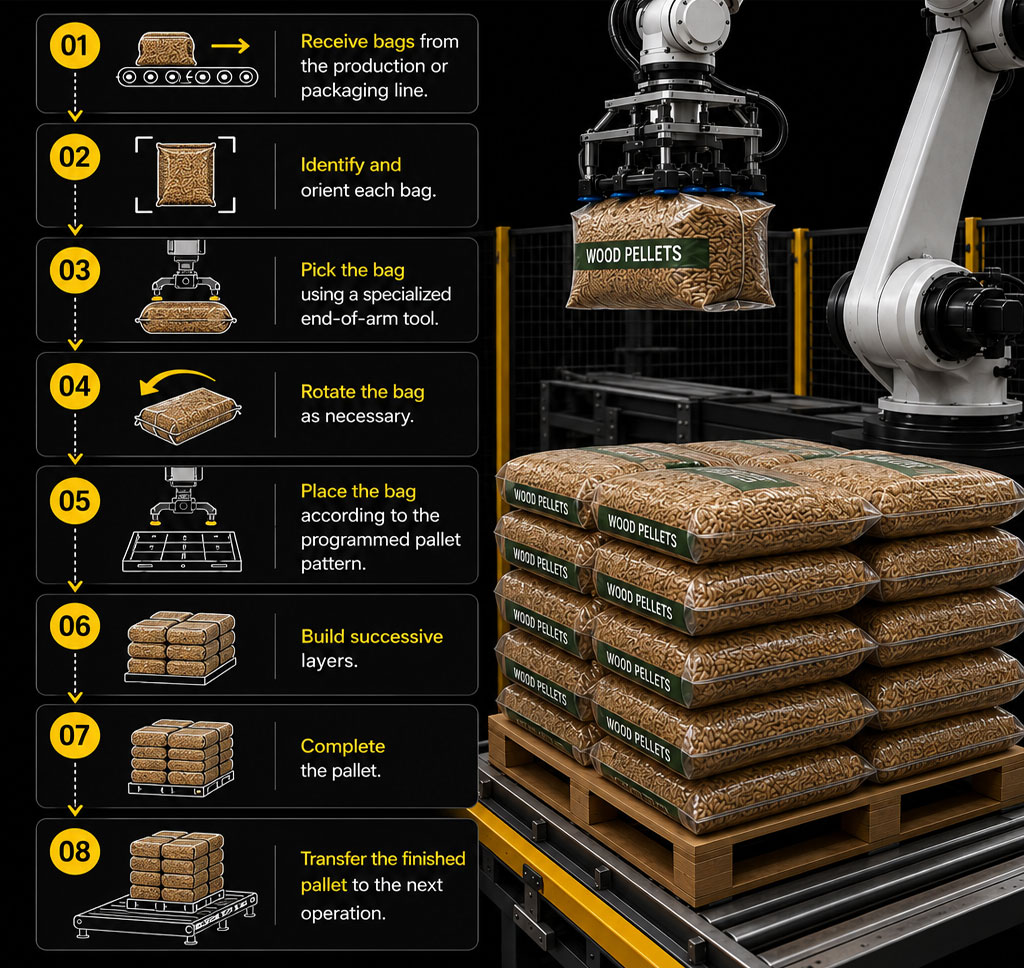
Wood-pellet bags generally fit these characteristics.
A robotic palletizing system can automatically:
Receive bags from the production or packaging line.
Identify and orient each bag.
Pick the bag using a specialized end-of-arm tool.
Rotate the bag as necessary.
Place the bag according to the programmed pallet pattern.
Build successive layers.
Complete the pallet.
Transfer the finished pallet to the next operation.
This allows the palletizing process to operate continuously while reducing manual handling.
Designing the Right End-of-Arm Tool
One of the most important components of a robotic bag palletizing system is the end-of-arm tooling (EOAT).
A 40-pound wood-pellet bag is not a rigid box. The bag can deform, shift, compress, or change shape depending on the amount of product inside.
The gripping system therefore needs to be designed specifically for the bag.
The correct solution depends on the bag material, surface texture, bag dimensions, pellet density, bag construction, and production rate.
A properly engineered gripper must also account for the consequences of a loss of grip. A dropped 40-pound bag can create a personnel hazard as well as product damage.
Pallet Pattern and Load Stability
Palletizing bags is different from palletizing rigid cartons.
A box maintains its shape and provides predictable support. A bag can deform around adjacent bags, creating a more complicated load structure.
The pallet pattern therefore has a major influence on finished pallet stability.
A well-designed pattern should create a stable load while maximizing the number of bags per pallet.
Pallet stability is particularly important with wood-pellet bags because the product can shift during transportation.
For this reason, palletizing should be considered part of the overall packaging system rather than simply the final robot operation.
Production Rate and the Wood-Pellet Environment
The required palletizing rate should be established before selecting the robot.
A well-designed system should provide sufficient capacity so that the robot is not continuously operating at its absolute maximum capability.
Wood-pellet production can create a dusty environment, which is an important consideration when designing automation.
The specific facility should be evaluated for applicable combustible-dust hazards and requirements. Equipment should be selected and installed based on the actual dust characteristics and environmental conditions.
Safety Considerations
A 40-pound bag palletizing operation contains several potentially serious hazards.
The robot itself is only one part of the safety assessment.
A complete robotic palletizing cell should be evaluated as an integrated machine system. Depending on the application, safeguarding can include:
The final safeguarding approach should be established through a formal machine risk assessment based on the actual equipment and operating conditions.
This can create a safer and more sustainable work environment.
Labor Utilization
A robotic palletizer can allow manufacturers to use employees more efficiently.
Instead of dedicating personnel exclusively to repetitive palletizing, one employee may be able to oversee several processes, depending on the facility's layout and operating requirements.
Automation can therefore provide benefits beyond simply reducing labor hours.
It can help manufacturers address staffing shortages while allowing existing employees to focus on tasks requiring greater skill and judgment.
Integrating the processes reduces manual handling and helps maintain consistent finished-pallet quality.
The stretch-wrapper recipe can also be selected based on pallet height, number of bags, and product requirements.
Return on Investment
The financial justification for robotic palletizing should include more than direct labor savings.
Potential benefits include:
The return on investment should be calculated using the actual production rate, labor cost, operating hours, pallet configuration, and equipment cost.
Designing the Complete System
The most effective robotic palletizing systems are designed around the entire production process rather than simply selecting a robot and attaching a gripper.
A complete system may include:
Each component must work together to create a reliable production system.
A properly engineered system can provide significant benefits in productivity, ergonomics, consistency, labor utilization, and overall production efficiency.
A Customized Palletizing Solution
The key to a successful installation is designing the complete system around the actual bag, production rate, pallet configuration, and operating environment. Special attention should be given to the end-of-arm tooling, pallet pattern, load stability, dust environment, safety system, and downstream stretch-wrapping operation.
Intelgic develops application-specific palletizing systems that may combine:
The complete cell is engineered around the actual bag, production rate, pallet configuration, and operating environment.
Transform Bag Palletizing with Intelgic
Manual palletizing of 40-pound wood-pellet bags can limit production speed, expose employees to repetitive lifting, and consume skilled labor that could be applied elsewhere.
Intelgic combines industrial robots, application-specific EOAT, pallet-pattern programming, safety-rated controls, and downstream stretch-wrapping to automate the entire process — from bag receipt through finished-pallet transfer.
When these factors are properly addressed, robotic palletizing can transform the handling of 40-pound wood-pellet bags from a labor-intensive operation into a reliable, repeatable, and scalable automated process.