Palletizing 90-lb. bags of concrete is one of the most physically demanding applications in the building-materials industry. The weight, repetitive handling, and pace of production can place significant strain on employees while also creating challenges for maintaining consistent pallet quality.
Robotic palletizing provides an efficient solution by automating the heavy lifting and repetitive stacking process while improving safety, productivity, and product consistency.
Intelgic engineers complete robotic palletizing cells for 90-lb. concrete bags — from bag gripper and stacking pattern to conveyors, safety systems, and dust-tolerant controls.
System Overview
How a Robotic Concrete Bag Palletizer Works
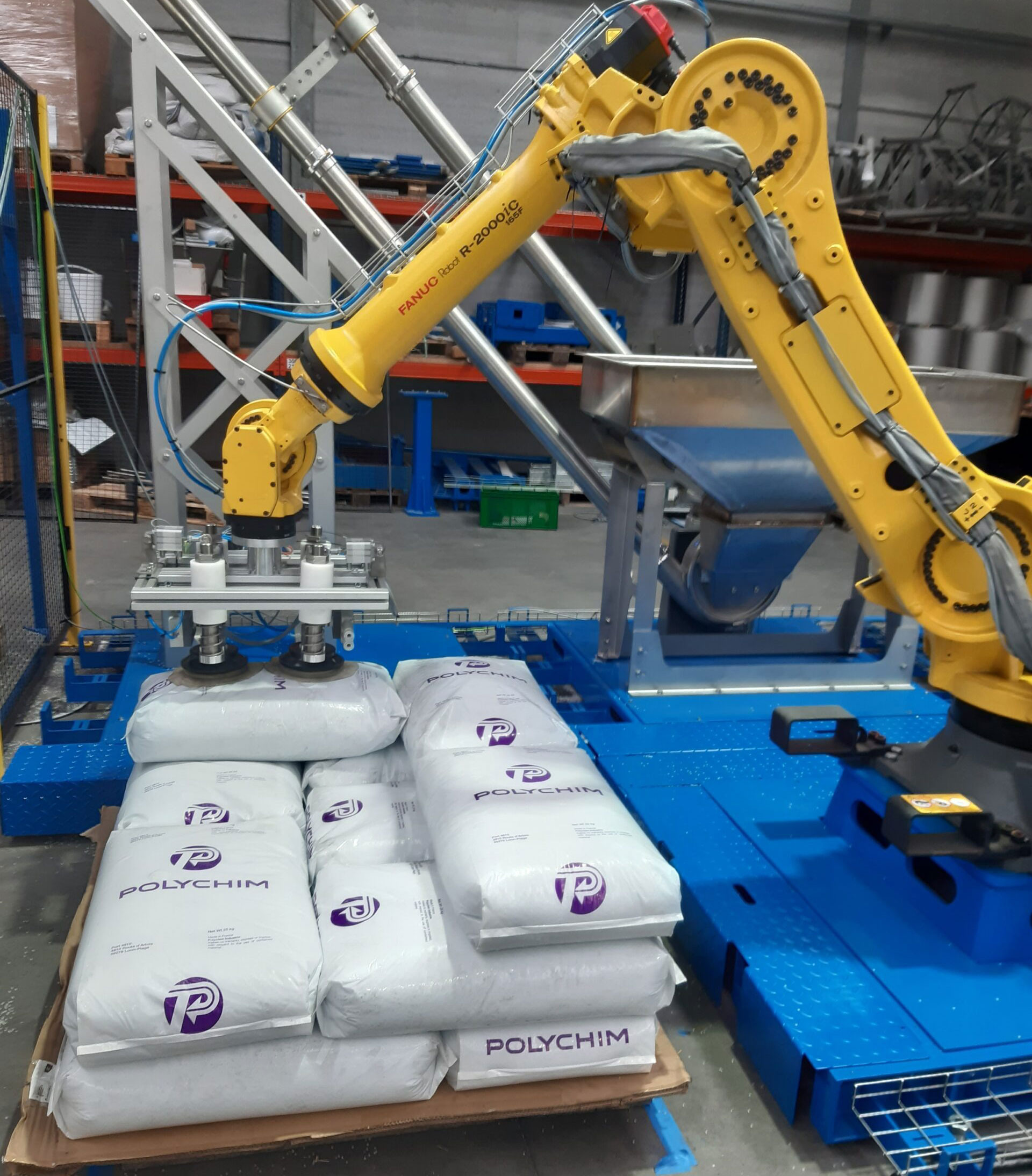
A typical robotic concrete bag palletizing system receives filled 90-lb. bags from a bagging or conveying system and automatically transfers them onto pallets according to a programmed stacking pattern.
The robot uses a specially designed bag gripper capable of securely handling the heavy, flexible bags without damaging the packaging.
Bag Gripper Options
Depending on the application, the end-of-arm tooling may use mechanical clamps, vacuum technology, or a combination of gripping methods.
Each option is selected to secure the heavy, flexible bag without damaging the packaging — matched to bag material, fill density, and required cycle time.
Eliminating Repetitive Heavy Lifting
One of the primary advantages of robotic palletizing is the elimination of repetitive heavy lifting. Handling 90-lb. bags throughout an entire shift can expose workers to significant ergonomic stresses, particularly involving the back, shoulders, and arms.
By assigning the lifting and stacking operation to a robot, employees can be moved into supervisory, material-handling, quality-control, or other less physically demanding positions.
Highly Consistent Pallet Patterns
Robotic systems also provide highly consistent pallet patterns. Concrete bags can be stacked in interlocking configurations designed to improve pallet stability and maximize the number of bags per pallet.
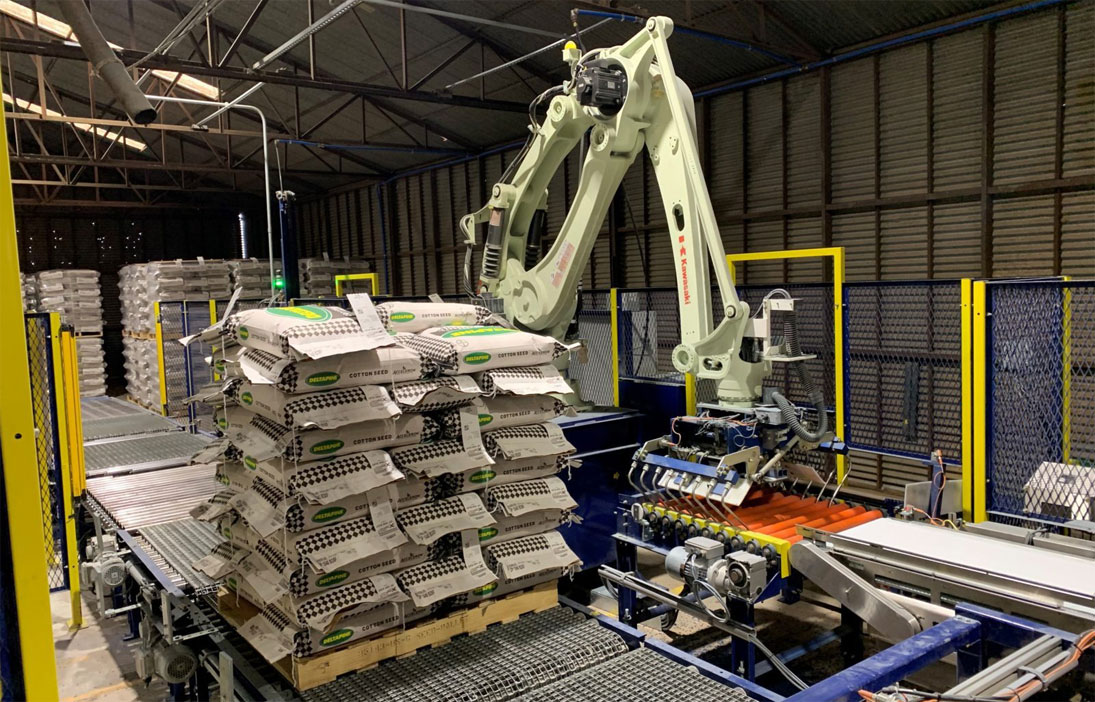
The robot can accurately repeat the programmed pattern from pallet to pallet, reducing leaning, shifting, and uneven stacking.
Multiple pallet patterns can also be programmed to accommodate different bag sizes, products, or customer requirements.
Dual-Robot Palletizing
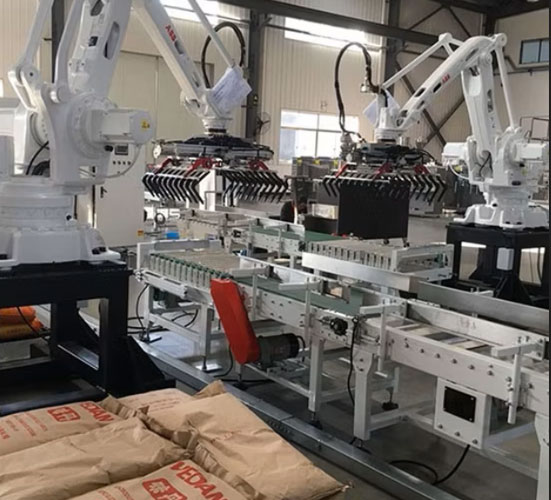
For high-throughput facilities, a dual-robot configuration can provide additional capacity and flexibility. Two robots can share the palletizing workload, operate on separate pallet positions, or work together on demanding stacking patterns.
This approach can increase production rates while providing system redundancy and allowing the palletizing process to continue efficiently during certain maintenance activities.
More Than Just the Robots
A complete robotic palletizing cell typically includes more than the robots themselves.
Bag Infeed
Conveyors transport bags into the robotic work area, while pallet dispensers automatically supply empty pallets.
Finished Pallet Transfer
Full pallets can be transferred out of the cell using powered conveyors, pallet carts, or forklifts.
Personnel Safeguarding
Safety fencing, guarding, interlocked access doors, light curtains, scanners, and emergency-stop systems are incorporated to protect personnel working around the equipment.
Sensors & Controls
A Continuous Process from Filling to Finished Pallet
The system can also incorporate sensors and controls to monitor bag position, pallet location, robot operation, and production counts.
Automated controls can coordinate the bag conveyor, robots, pallet handling equipment, and upstream packaging machinery. This creates a continuous process from bag filling through completed pallet production.
Designed for Concrete-Dust Environments
Another important consideration is the harsh environment commonly found in concrete and building-material plants. Concrete dust can be abrasive and can accumulate on equipment, sensors, and mechanical components.
Robotic palletizing systems should therefore be designed with appropriate guarding, component protection, dust management, and maintenance access.
Reliable in Demanding Conditions
Proper system design can help ensure reliable operation in demanding industrial conditions.
A Practical Answer to Concrete-Bagging's Toughest Task
Ultimately, robotic palletizing of 90-lb. concrete bags offers manufacturers a practical way to address labor shortages, improve employee safety, increase production consistency, and reduce the physical demands associated with manual palletizing.
With properly engineered gripping equipment, pallet patterns, conveyors, controls, and safety systems, a robotic palletizing cell can provide reliable, repeatable operation while handling one of the most physically demanding tasks in the concrete-bagging process.
Contact Intelgic to discuss your bag, production rate, pallet configuration, and plant environment.