Automating Quality Inspection of Large Automotive Parts
Inspecting large automotive components is one of the most challenging applications of machine vision. Typical parts include:
These components have large surface areas, complex curves, edges, corners, and reflective finishes. Small defects can be difficult to detect consistently through conventional manual inspection:
A single camera cannot capture an entire large component at the high resolution and viewing angles required for reliable defect detection.
Industrial cameras are moved across the part, capturing multiple high-resolution images from strategically selected positions, each analyzed by Machine Vision AI.
By combining robotic precision, specialized lighting, and AI-powered defect detection, Intelgic enables highly accurate, repeatable, and automated inspection of complex automotive surfaces.
Why Large Automotive Parts Are Difficult to Inspect
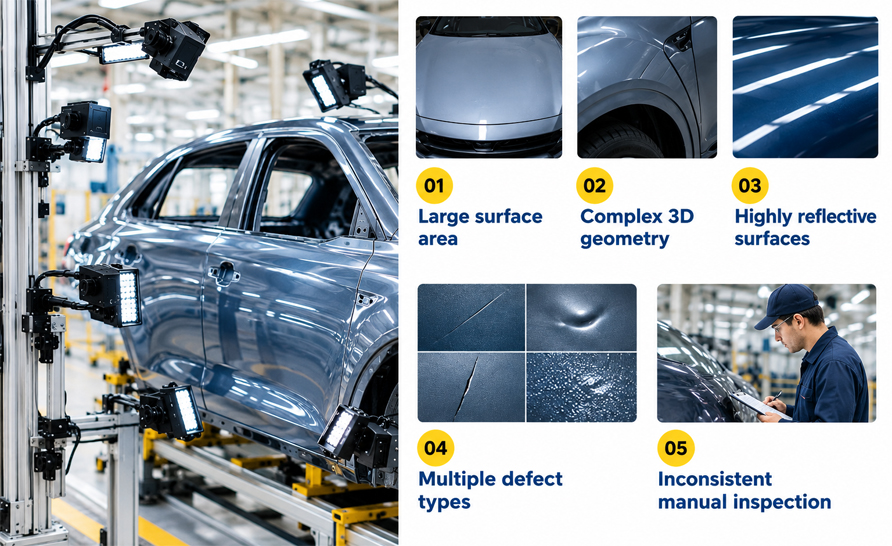
Large automotive components introduce several challenges for conventional inspection systems.
A single image may not provide enough resolution to identify small defects across a door, roof, or hood.
Curves, bends, edges, and recessed regions require different camera angles.
Glossy paint and polished metal can create reflections that hide defects or produce false detections.
Scratches, shallow dents, cracks, coating defects, and surface irregularities require different imaging conditions.
Human inspection results can vary depending on lighting, viewing angle, fatigue, and operator experience.
To overcome these challenges, the imaging system must move around the component instead of relying on a fixed viewing position.
How Intelgic’s Robotic Automotive Inspection System Works
Intelgic uses a programmable robotic arm equipped with industrial cameras, precision lenses, and specialized lighting.
The robot moves the imaging system across the component, positioning the camera at multiple locations and orientations. At each position, the system captures high-resolution images of a specific inspection region. Intelgic’s AI analyzes the captured images to identify, classify, and locate defects.
Identify component and load the inspection recipe
Move camera and lighting to strategic inspection positions
Capture detailed images of every required surface region
Identify scratches, dents, cracks, coating defects, and anomalies
Generate defect maps, inspection results, and traceability records
Robotic Movement, Surface Coverage, and Lighting
Intelligent Robotic Camera Movement
The inspection system divides a large automotive component into multiple predefined inspection regions. For each region, the robotic arm positions the camera at an appropriate:
This approach allows the system to capture high-quality images even on curved, angled, and recessed surfaces. The robot follows a repeatable inspection path, maintaining consistent imaging conditions across production cycles.
Multiple High-Resolution Images for Complete Surface Coverage
Large components cannot always be inspected accurately using a single wide-angle image. Intelgic uses a region-by-region imaging approach. The robot moves across the part and captures multiple images with appropriate overlap to cover the required inspection surfaces.
Each region can have its own camera position and lighting settings.
The result is high-resolution inspection coverage across the component without sacrificing the image detail needed to identify small defects.
Specialized Lighting for Reflective and Curved Surfaces
Automotive surfaces, particularly painted metal panels, create complex reflections. A small dent may be visible from one angle but disappear from another. Similarly, light reflections may resemble scratches or other defects.
Intelgic addresses this challenge using specialized lighting configurations, including:
The robot can move the camera and lighting together to optimize the imaging conditions for each inspection region.
Multiple images under different lighting conditions can help AI distinguish actual defects from normal surface reflections. This approach is also described in Intelgic’s published automotive surface inspection methodology.
AI Defect Detection and Digital Quality Reports
AI-Based Surface Defect Detection
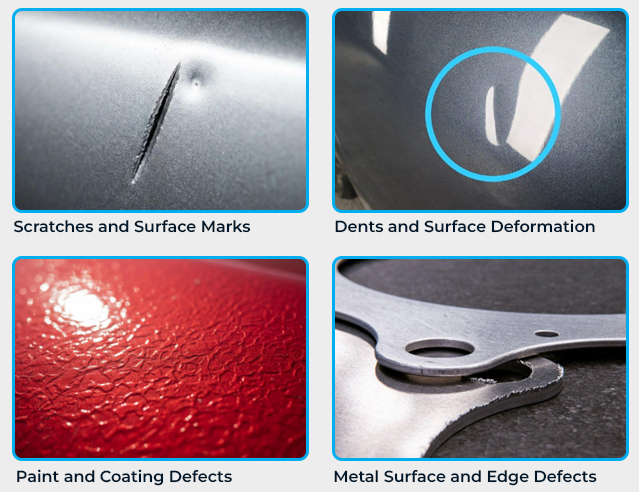
Once images are captured, Intelgic’s Machine Vision AI analyzes them to identify predefined defect categories. The system can be configured to detect:
Fine scratches, scuff marks, abrasion, and other visible surface damage.
Small dents, surface waviness, and abnormal variations in panel geometry.
Pinholes, paint runs, orange peel, foreign particles, uneven coating, and other visible finish defects.
Visible cracks, pits, burrs, stamping marks, and edge irregularities.
Defect detection capabilities and minimum detectable sizes depend on surface finish, lighting, image resolution, component geometry, and application-specific AI validation.
Automated Defect Mapping and Digital Quality Reports
Intelgic’s system can map detected defects to their corresponding locations on the automotive component. Each inspected part can have a digital quality record containing:
These reports help quality teams identify recurring manufacturing problems and take corrective action before defects progress further in the production process.
Automotive Components That Can Be Inspected
Inspection of outer and inner panels, stamped contours, edges, scratches, dents, and painted surface defects.
Inspection of large curved surfaces for dents, waves, scratches, and coating imperfections.
Inspection of broad reflective surfaces, formed edges, surface irregularities, and paint defects.
Multi-angle inspection of curved profiles, bends, edges, and complex geometries.
Inspection of scratches, molding defects, surface irregularities, and painted finishes.
Inspection Before and After Painting
Intelgic’s robotic inspection approach can be adapted for different stages of automotive manufacturing.
- ◆Stamping marks
- ◆Scratches and dents
- ◆Surface deformation
- ◆Visible cracks and pits
- ◆Edge irregularities
- ◆Surface waviness
- ◆Paint runs
- ◆Pinholes
- ◆Foreign particles
- ◆Orange peel
- ◆Coating inconsistencies
- ◆Scratches and finish defects
Bare metal, primer-coated, and painted surfaces require different inspection recipes and lighting conditions.
Detecting defects before painting can prevent unnecessary downstream processing, while post-paint inspection helps ensure that finished automotive panels meet defined visual quality standards.
What Makes Intelgic’s Robotic Inspection System Different?
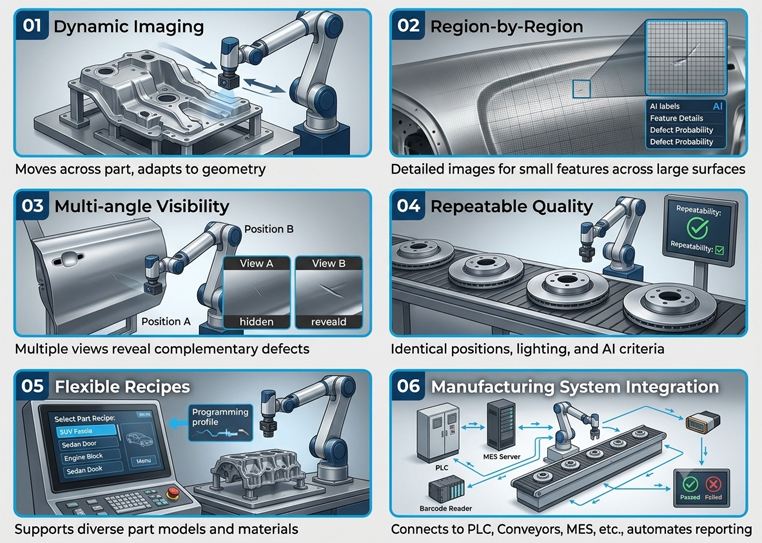
Fixed cameras have limited viewing positions. Intelgic’s robotic imaging system moves across the part and adapts camera positions to the component’s geometry.
Capturing multiple detailed images allows the AI to inspect small features across large surfaces without relying on a single low-detail overview image.
Some defects only become visible under specific viewing angles or lighting conditions. Robotic positioning allows the system to capture these complementary views.
Every component can be inspected using the same programmed camera positions, lighting conditions, and AI acceptance criteria.
The system can support different automotive part models, dimensions, materials, and finishes using configurable inspection recipes.
Intelgic can integrate robotic inspection with existing PLCs, conveyors, robots, barcode readers, MES, and quality management systems to automate part identification, inspection triggering, and result reporting.
Business Benefits for Automotive Manufacturers
For production environments, the following should be validated against the customer’s quality requirements:
Intelgic’s Turnkey Robotic Inspection Solution
Intelgic provides an integrated approach to automotive inspection automation, combining:
Bringing Precision and Intelligence to Large Automotive Parts Inspection
Large automotive components require more than a conventional fixed-camera inspection system. Their size, reflective surfaces, and complex geometries demand an imaging approach that can adapt to the shape of each component while maintaining the resolution required for small defect detection.
Intelgic combines robotic movement, strategic camera positioning, multi-image acquisition, specialized lighting, and advanced Machine Vision AI to automate large automotive parts inspection.
The result is an intelligent, repeatable, and scalable quality inspection approach designed to reduce missed defects, improve manufacturing consistency, and provide digital visibility into product quality.
Frequently Asked Questions
What is a robotic automotive inspection system? +
A robotic automotive inspection system uses industrial robots, cameras, lighting, and AI software to inspect automotive components automatically. The robot moves the imaging system to predefined locations, captures images, and enables AI to identify surface defects.
Why are robots used for inspecting large automotive parts? +
Large components contain extensive surfaces, curves, edges, and complex geometries. Robotic movement allows cameras to capture these surfaces from multiple positions and angles while maintaining appropriate resolution and lighting.
Can robotic inspection detect small scratches and dents? +
Yes. With suitable image resolution, lighting, camera positions, and trained AI models, the system can detect small visible scratches, dents, and other surface imperfections. Minimum defect size and detection performance must be established during application validation.
Can Intelgic inspect automotive doors, roofs, and hoods? +
Yes. Intelgic’s robotic inspection architecture can be configured for large automotive panels, including doors, roof panels, hoods, fenders, and other body components.
How does AI inspect reflective painted automotive surfaces? +
The system uses controlled lighting and strategic viewing angles. Capturing multiple images under different conditions helps AI distinguish genuine surface defects from reflections and glare.
Can one robotic inspection system inspect multiple automotive models? +
Yes. Different components can have separate inspection recipes defining robot trajectories, camera settings, lighting conditions, and AI defect detection criteria.
Can the system inspect both painted and unpainted components? +
Yes. Robotic inspection can be configured for bare metal, primer-coated, and painted surfaces, with appropriate imaging settings for each material and finish.
How does the system ensure coverage of a large automotive part? +
The part is divided into inspection regions, and the robot follows predefined imaging positions. Overlapping images and coverage validation help ensure that all specified inspectable areas are captured.
Can Intelgic’s system integrate with an existing automotive production line? +
Yes. Integration with conveyors, PLCs, robots, barcode systems, MES, and quality management software can support automated inspection and reporting.
Does the system generate inspection reports? +
Yes. The system can generate part-specific inspection reports with defect images, classification, location, timestamps, and pass/fail results.
Is robotic inspection more accurate than manual inspection? +
Robotic inspection can provide more consistent imaging and repeatable defect evaluation than manual inspection. Actual comparative accuracy depends on the defect types, surface conditions, inspection requirements, and validated system performance.
Can the system perform dimensional measurements as well as surface inspection? +
Yes. Where dimensional measurement is required, calibrated imaging or suitable 3D measurement sensors can be integrated with the robotic inspection system.