Why Assembly Errors Still Happen
Even in well-trained teams, human errors such as wrong-part selection, skipped steps, incorrect tool usage, or out-of-sequence assembly can still occur. These small deviations often lead to defects, rework, scrap, production delays, and customer complaints.
This is where Intelgic’s AI agents fundamentally change the assembly process.
Using Intelgic’s Certainty platform, manufacturers can quickly create, train, and deploy AI agents directly on the assembly line. These agents monitor every critical action in real time and ensure operators execute each step correctly—eliminating errors before they become defects.
"With Intelgic AI agents, assembly lines move closer to true zero-defect manufacturing."
What Is an Intelgic AI Agent for Assembly Operations?
An Intelgic AI agent is an intelligent, real-time system deployed on the shop floor to understand what is happening at each workstation, compare it with approved work instructions, and actively guide operators to the correct action.
Built on the Certainty platform, these agents can be configured and deployed rapidly without long development cycles.
By combining all these inputs, the AI agent builds a live understanding of the assembly process and ensures every step is executed correctly.
How Intelgic AI Agents Prevent Human Errors in Assembly
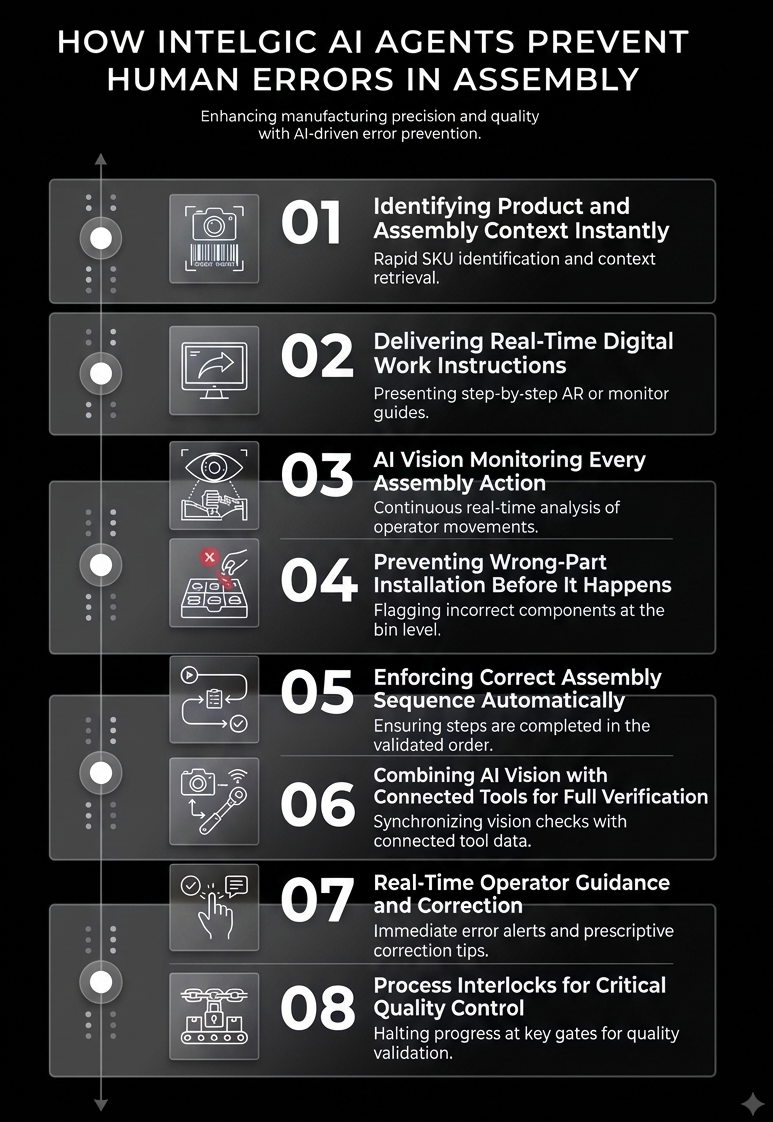
Identifying Product and Assembly Context Instantly
The AI agent first identifies the product, model, or work order being assembled. This ensures the correct:
- Bill of materials
- Assembly sequence
- Tool settings
- Quality checkpoints
are automatically loaded.
In high-mix manufacturing environments, this eliminates the risk of operators following the wrong instructions for a similar product variant.
With Intelgic’s Certainty platform, this context recognition is configured once and deployed across multiple stations quickly.
Delivering Real-Time Digital Work Instructions
Instead of relying on memory or printed manuals, operators receive step-by-step instructions directly from the AI agent.
These instructions include:
The AI agent ensures the operator only sees the current step, reducing confusion and cognitive overload.
AI Vision Monitoring Every Assembly Action
Intelgic AI agents use computer vision to continuously observe the workstation.
The system can detect:
The AI agent compares live actions with the approved process. If everything is correct, it advances the workflow automatically. If not, it intervenes instantly.
This is AI assembly error prevention in action—at the point of work.
Preventing Wrong-Part Installation Before It Happens
One of the most common assembly failures is selecting the wrong component.
Intelgic AI agents prevent this by verifying:
- Shape and geometry
- Color and markings
- Labels and identifiers
- Connector layout
- Hole patterns and orientation
When needed, barcode, QR, or RFID validation adds an additional layer of certainty.
If a wrong part is detected, the AI agent immediately stops the process and instructs the operator to correct it before installation.
Enforcing Correct Assembly Sequence Automatically
Assembly errors often occur when steps are skipped or performed out of order.
If an operator attempts to proceed incorrectly, the system intervenes with:
- On-screen warnings
- Highlighted missing steps
- Required corrective actions
- Controlled workflow blocking (if needed)
This ensures structural integrity of the assembly process.
Combining AI Vision with Connected Tools for Full Verification
Vision alone confirms actions—but Intelgic AI agents go further by integrating connected tools and sensors.
They validate:
For example, the AI agent confirms the correct fastener visually and verifies torque compliance through a connected smart tool.
This dual-layer verification ensures true manufacturing quality control.
Real-Time Operator Guidance and Correction
When a deviation occurs, Intelgic AI agents don’t just detect it—they guide the operator to fix it immediately.
Guidance is delivered through:
Examples of real-time instructions:
“Incorrect connector detected. Use Connector B for this product.”
“Fastener missing. Install before proceeding.”
This immediate feedback prevents defects from moving downstream.
Process Interlocks for Critical Quality Control
For high-risk or safety-critical steps, Intelgic AI agents can enforce process interlocks.
The system prevents progression until conditions are met, such as:
These interlocks are configured through the Certainty platform and can be tailored per workstation or product line.
Assembly Errors Intelgic AI Agents Help Eliminate
With Intelgic AI assembly error prevention, manufacturers can eliminate:
- Wrong-part installation
- Missing components
- Skipped or out-of-sequence steps
- Incorrect tool usage
- Improper fastener tightening
- Misaligned assemblies
- Incorrect labeling
- Failed inspections being missed
- Unapproved process deviations
- Defective products moving forward
Full Traceability Built Into Every Assembly
Every action monitored by the AI agent is recorded automatically, including:
This creates complete traceability for audits, compliance, and continuous improvement.
Empowering Operators, Not Replacing Them
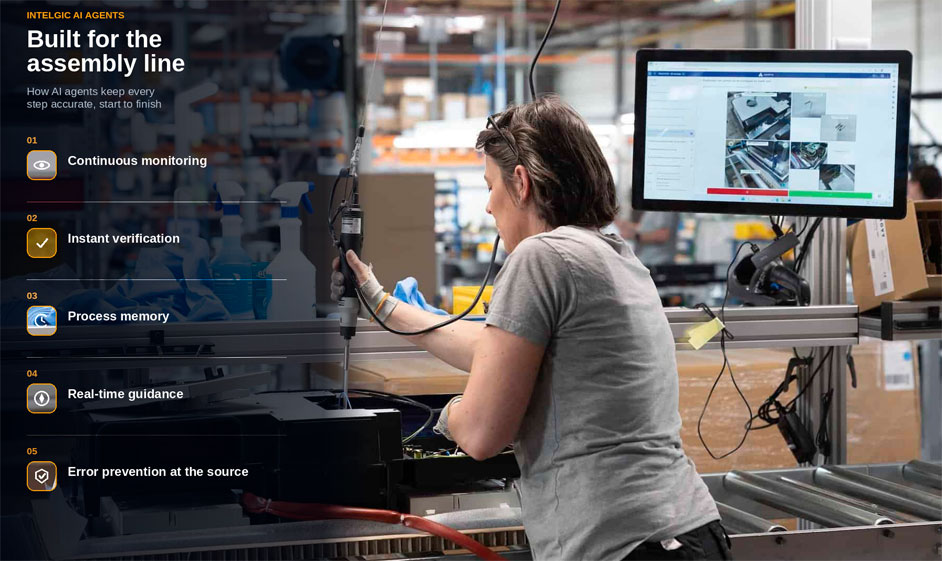
Intelgic AI agents are designed to support operators—not replace them.
Operators bring skill, judgment, and experience. The AI agent adds:
Together, they create a highly reliable, human-centered assembly system.
Rapid Deployment with Intelgic Certainty Platform
A key advantage of Intelgic’s approach is speed.
- ◆Create AI agents quickly
- ◆Train them on real assembly data
- ◆Deploy them across workstations in days or weeks
- ◆Scale across multiple lines easily
A typical deployment includes:
This makes AI-driven error prevention practical and fast to implement.
Moving Toward Zero-Defect Assembly with Intelgic
While no system can eliminate every human error, Intelgic AI agents significantly reduce assembly mistakes by ensuring:
By combining AI vision, sensors, connected tools, and real-time guidance, Intelgic enables manufacturers to move toward consistent, scalable zero-defect production.
"With Intelgic’s Certainty platform, this transformation is no longer complex or slow—it is fast, practical, and production-ready."