What is Poka‑Yoke 2.0? How Intelgic Uses AI to Prevent Shopfloor Errors
Manufacturers have always tried to design processes that make mistakes difficult—or ideally impossible—to commit. This principle is known as Poka‑Yoke.
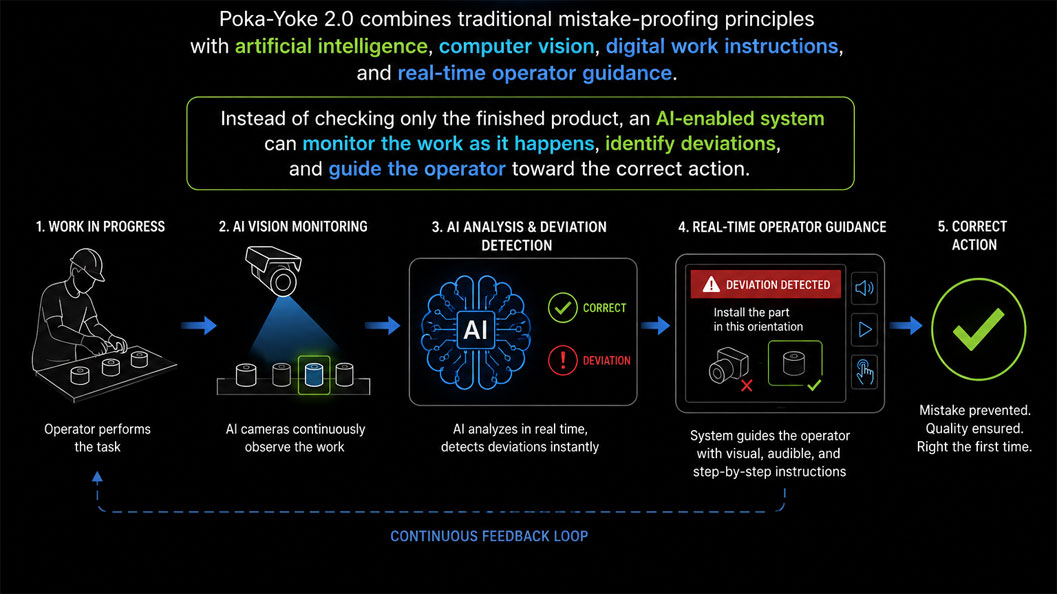
Traditional Poka‑Yoke solutions use fixtures, sensors, interlocks, guide pins, barcode scanners, limit switches, and other mechanisms to prevent an incorrect action. These methods remain extremely valuable, but modern manufacturing introduces challenges they cannot always address efficiently.
Operators may need to perform many steps, handle visually similar components, switch frequently between product variants, or follow changing work instructions. A fixed mechanical device may prevent one specific error, but it cannot necessarily understand the complete operation.
This is where Poka‑Yoke 2.0 comes in.
Poka‑Yoke 2.0 combines traditional mistake-proofing principles with artificial intelligence, computer vision, digital work instructions, and real-time operator guidance. Instead of checking only the finished product, an AI-enabled system can monitor the work as it happens, identify deviations, and guide the operator toward the correct action.
Intelgic brings this approach to the manufacturing shopfloor through camera-based AI monitoring and assistance.
What Is Poka‑Yoke?
Poka‑Yoke is a Japanese term commonly translated as “mistake-proofing” or “error-proofing.” It refers to a method or device that either prevents an error or makes the error immediately visible. The American Society for Quality defines mistake-proofing as using an automatic device or method that makes an error impossible or immediately obvious. It is especially useful when manufacturing quality depends heavily on human attention, experience, or memory. (ASQ) Common examples include:
- ◆A fixture that accepts a component in only the correct orientation
- ◆A connector designed so it cannot be inserted incorrectly
- ◆A sensor that confirms whether a part is present
- ◆A torque tool that verifies that a fastener has been tightened
- ◆A barcode scanner that checks whether the correct material was selected
- ◆An interlock that prevents the next cycle from starting until a condition is satisfied
The purpose is not to blame an operator for making a mistake. It is to improve the process so that normal human slips do not become defects, rework, safety incidents, or customer complaints.
What Is Poka‑Yoke 2.0?
Poka‑Yoke 2.0 is an AI-enabled extension of traditional mistake-proofing. It adds visual understanding, process awareness, live guidance, and digital traceability to the established Poka‑Yoke philosophy. Unlike a conventional sensor that checks a single condition, an AI vision system can potentially evaluate several aspects of an operation:
- ◆Was the correct component selected?
- ◆Was it placed in the correct position?
- ◆Were all required steps completed?
- ◆Was the prescribed sequence followed?
- ◆Was the correct tool used?
- ◆Was a safety or quality check skipped?
- ◆Is the operator waiting for guidance?
- ◆Is the process taking significantly longer than expected?
Research has demonstrated that deep learning and computer vision can extend Poka‑Yoke from fixed mistake-proofing devices into systems that also assist assembly-line operators. (University of Modena and Reggio Emilia research) The term “Poka‑Yoke 2.0” is not a formal manufacturing standard. It is a useful way to describe the evolution from static error-proofing toward intelligent, software-driven process assistance.
Traditional Poka‑Yoke vs. Poka‑Yoke 2.0
| Traditional Poka‑Yoke | AI-Powered Poka‑Yoke 2.0 |
|---|---|
| Usually checks one predefined condition | Can observe multiple visual and process conditions |
| Often depends on a dedicated sensor or fixture | Uses cameras, AI models, and workflow rules |
| Normally fixed to one product or operation | Can support multiple products and variants |
| Prevents or signals a specific known error | Can identify several types of process deviation |
| May require physical equipment modifications | Can often be added around an existing workstation |
| Provides limited process data | Can create event records and performance insights |
| Mainly detects or blocks errors | Can detect, alert, guide, and document |
Mechanical Poka‑Yoke should not automatically be replaced by AI. When a simple physical fixture can make a dangerous error impossible, it may remain the best solution. AI becomes especially useful when operations are variable, manual, sequence-dependent, difficult to instrument, or reliant on visual judgment. In many applications, the strongest solution combines AI monitoring with conventional sensors, tools, PLC controls, or interlocks.
Why Manufacturers Need AI-Powered Error Proofing
A written SOP explains how work should be performed. It does not confirm that every step was followed correctly. On a busy shopfloor, deviations can occur because of:
- ◆Incomplete operator training
- ◆Similar-looking components
- ◆Complex assembly sequences
- ◆Product-variant changes
- ◆Frequent workforce rotation
- ◆Language or literacy barriers
- ◆Fatigue and distraction
- ◆Outdated or inaccessible instructions
- ◆Dependence on experienced supervisors
- ◆Pressure to maintain production speed
Traditional inspections may find the resulting defect only after additional value has been added. The later a problem is discovered, the more rework, investigation, handling, and disruption it can create. AI-powered Poka‑Yoke moves quality control closer to the moment of action. It can help identify a deviation before the operation is completed or before the product moves downstream.
How Intelgic Implements Poka‑Yoke 2.0
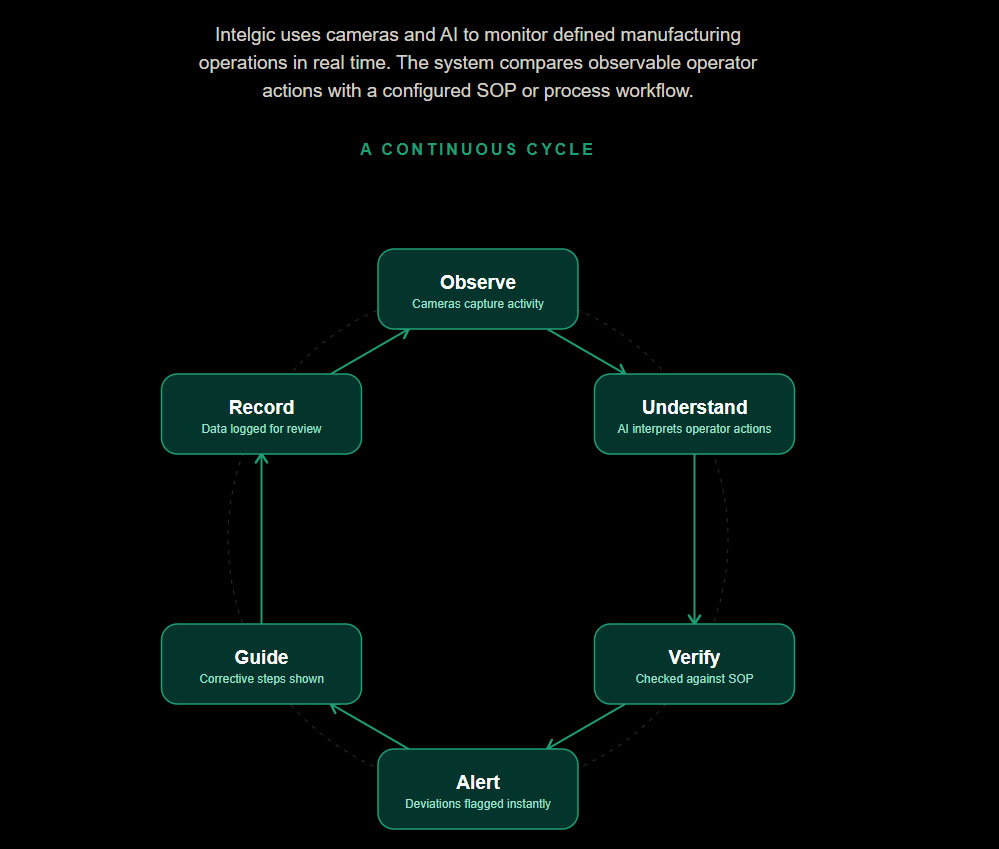
Intelgic uses cameras and AI to monitor defined manufacturing operations in real time. The system compares observable operator actions with a configured SOP or process workflow. Intelgic’s approach can be understood as a continuous cycle: Observe → Understand → Verify → Alert → Guide → Record
1. The manufacturing process is mapped
The first step is to understand the operation and convert it into defined, observable stages. For example, a manual assembly process might contain these steps:
- 01Pick the correct base component.
- 02Position the component in the fixture.
- 03Select the required subassembly.
- 04Insert it in the specified orientation.
- 05Tighten two fasteners.
- 06Perform a visual confirmation.
- 07Place the completed unit in the output area.
The implementation team identifies which errors should be detected, which steps require verification, and which events should trigger guidance or escalation.
2. Existing SOPs become trackable workflows
Written instructions are translated into digital process rules. The system may be configured to recognize:
- ◆Expected steps
- ◆Step sequence
- ◆Component presence or absence
- ◆Component position
- ◆Tool interaction
- ◆Relevant workstation zones
- ◆Completion conditions
- ◆Process timing
- ◆Defined exceptions
This creates the digital reference against which the actual operation can be monitored.
3. Cameras observe the workstation
One or more cameras are positioned to capture the relevant work area. Depending on the application, this may include the operator’s hands, components, tools, bins, fixtures, or completed assembly. The objective is not simply to record video. The camera provides visual input that the AI interprets in relation to the configured process. Proper camera placement, lighting, visibility, and handling of occlusion are essential for reliable performance.
4. AI recognizes actions and process events
Intelgic’s AI analyzes the camera input to identify relevant objects, actions, and workflow states. For example, the system may determine that:
- ◆A component has been picked
- ◆An item has entered a defined workstation zone
- ◆A required assembly step has been completed
- ◆A component is missing
- ◆Steps are being performed in the wrong sequence
- ◆The operator has moved ahead without completing a required action
Intelgic describes its solution as a camera-based system that verifies SOP steps in real time. (Intelgic SOP Monitoring)
5. The operation is verified against the SOP
As the work progresses, observed events are matched against the expected workflow. When the operator completes a step correctly, the system advances to the next stage. When it identifies a deviation, it can generate a response based on the configured business rules. Possible deviations include:
- ◆Missed step
- ◆Incorrect sequence
- ◆Wrong component
- ◆Missing component
- ◆Incorrect placement
- ◆Incomplete operation
- ◆Unexpected action
- ◆Excessive process delay
The exact capabilities depend on the use case, camera visibility, model training, and required integrations.
6. The operator receives immediate guidance
A Poka‑Yoke 2.0 system should do more than create a record of an error. It should help the operator recover while the work is still in progress. Guidance can be presented through a screen, light, sound, message, or another connected interface. It might tell the operator to:
- ◆Complete a missed step
- ◆Check the selected component
- ◆Repeat an operation
- ◆Correct the component position
- ◆Return to the required sequence
- ◆Request supervisor assistance
- ◆Review a visual work instruction
This is where AI becomes an operator assistant—not merely a monitoring system. An average operator does not need to remember every detail that an experienced specialist has learned over many years. The system makes relevant process knowledge available at the moment it is needed.
7. Events are recorded for traceability and improvement
Verified steps and detected deviations can create a digital process record. Depending on configuration and integration, manufacturers may use these records to understand:
- ◆Frequently missed steps
- ◆Recurring process bottlenecks
- ◆Error patterns by operation
- ◆Training opportunities
- ◆Workstation design problems
- ◆SOP stages that cause confusion
- ◆Process-cycle variations
- ◆Areas requiring additional error-proofing
This converts isolated shopfloor incidents into structured information for continuous improvement.
Example: AI-Guided Manual Assembly
Consider an operator assembling a product with four visually similar components. Without AI assistance, the operator must identify the correct part, remember the sequence, install each component correctly, and complete the final check. A conventional inspection may detect a mistake only after the product reaches another station. With Intelgic’s AI-powered approach:
- 01The camera observes the workstation.
- 02The AI recognizes the product variant.
- 03The system tracks each expected assembly stage.
- 04The operator selects a component.
- 05The AI verifies whether the selection and placement match the configured process.
- 06If a step is missed or performed out of sequence, the operator receives an alert.
- 07The system guides the operator back to the appropriate step.
- 08The completed workflow is recorded.
Instead of relying entirely on memory and experience, the operator receives contextual assistance throughout the operation.
How Poka‑Yoke 2.0 Helps an Average Operator Perform Like an Expert
An expert operator develops pattern recognition through experience. Experts know what to inspect, where mistakes normally occur, and how to recover when something is not right. AI-guided workstations help distribute some of that knowledge across the workforce. They can provide:
- ◆Step-by-step assistance for new operators
- ◆Immediate reminders during complex processes
- ◆Consistent interpretation of standard work
- ◆Visual support for different product variants
- ◆Earlier detection of incorrect actions
- ◆Less dependence on memory
- ◆Faster escalation when human judgment is required
The goal is not to remove human expertise. It is to capture and scale good operating practices so that every worker has access to expert-level support.
Benefits of Intelgic’s AI-Powered Poka‑Yoke
Fewer process errors
Real-time verification helps detect missed, incorrect, or out-of-sequence actions before they create downstream problems.
Better first-time-right quality
Correcting a deviation at the point of work can reduce the likelihood of defective assemblies moving to later operations.
Faster operator training
New operators can receive contextual guidance while performing actual work instead of relying only on classroom training or printed documents.
Consistent SOP execution
The same digital workflow can be applied across operators, shifts, lines, and sites, subject to the relevant process configuration.
Reduced supervisor dependency
Supervisors can focus on exceptions and improvement activities instead of continuously watching every routine operation.
Improved traceability
Digital process records can support root-cause analysis, internal reviews, and continuous improvement.
Greater process visibility
Manufacturing teams can see where deviations occur instead of discovering only the final defect.
Where Can AI-Powered Poka‑Yoke Be Used?
Potential applications include:
- ◆Manual assembly
- ◆Component selection and placement
- ◆Kitting and material picking
- ◆Packaging and labeling
- ◆Product changeovers
- ◆Quality-check procedures
- ◆Tool-use verification
- ◆Maintenance operations
- ◆Safety-procedure monitoring
- ◆Pre-dispatch checks
- ◆Electronics assembly
- ◆Automotive component manufacturing
- ◆Appliance and equipment assembly
- ◆Pharmaceutical and medical-device processes
The best initial use cases usually have a clearly defined workflow, visible actions, recurring human errors, and a measurable quality or productivity impact.
Important Implementation Considerations
AI-powered error-proofing requires thoughtful implementation. Manufacturers should evaluate:
- ◆Camera coverage and lighting
- ◆Visual similarity between components
- ◆Operator or tool occlusion
- ◆Process variability
- ◆Acceptable false-alert rates
- ◆Response time
- ◆Data retention and privacy
- ◆System availability
- ◆Model validation
- ◆Integration with MES, PLC, ERP, or quality systems
- ◆Procedures for uncertain AI results
- ◆Human review and escalation
A visual AI alert is not automatically equivalent to a safety-rated machine interlock. Safety-critical controls should continue to use appropriate engineered protections and applicable safety standards. Successful implementation also requires operator involvement. Workers should understand what the system observes, why it is being introduced, and how it helps them perform their work.
How to Start a Poka‑Yoke 2.0 Pilot
Manufacturers can begin with a focused workstation rather than attempting to transform an entire plant at once.
Step 1: Select a high-value operation
Choose an operation with recurring errors, costly rework, complex instructions, or significant dependence on operator experience.
Step 2: Define the expected process
Document the required steps, acceptable variations, error conditions, and escalation rules.
Step 3: Establish measurable objectives
Track indicators such as:
- ◆Process deviations
- ◆First-pass yield
- ◆Rework frequency
- ◆Scrap
- ◆Training time
- ◆Cycle time
- ◆False-alert rate
- ◆Operator response time
Step 4: Validate visibility
Confirm that the camera can reliably see the relevant components, actions, and workstation zones.
Step 5: Run in observation mode
Initially, monitor the process without interrupting production. Compare AI events with human-reviewed outcomes.
Step 6: Introduce operator guidance
After validation, enable appropriate alerts and instructions.
Step 7: Measure and improve
Review performance, operator feedback, exceptions, and model accuracy before expanding the system.
The Future of Mistake-Proof Manufacturing
Traditional Poka‑Yoke changed manufacturing by designing errors out of physical processes. Poka‑Yoke 2.0 extends the same philosophy into manual, variable, and knowledge-intensive operations. With AI and computer vision, the workstation can become an active participant in quality. It can observe the process, verify important steps, warn about deviations, guide the operator, and create information for continuous improvement. Intelgic’s approach brings SOPs off the page and into the live manufacturing environment. Instead of expecting every worker to remember every instruction under every condition, manufacturers can provide real-time assistance that helps ordinary operators achieve more consistent, expert-like performance. The result is not a shopfloor without people. It is a shopfloor where people are supported by systems designed to help them succeed.
Frequently Asked Questions About Poka‑Yoke 2.0
What is Poka‑Yoke in manufacturing?
Poka‑Yoke is a mistake-proofing method that prevents an error or makes it immediately apparent. Examples include fixtures, sensors, interlocks, barcode checks, and connectors that fit in only one direction.
What does Poka‑Yoke 2.0 mean?
Poka‑Yoke 2.0 describes the use of AI, computer vision, digital workflows, and real-time guidance to extend traditional error-proofing. It is a descriptive concept rather than a formal manufacturing standard.
How is AI used for Poka‑Yoke?
AI can analyze camera input to recognize components, actions, tools, and process stages. It can compare observed activity with a defined SOP and alert the operator when it detects a missed step, incorrect sequence, or other deviation.
How does Intelgic monitor SOP compliance?
Intelgic uses cameras and AI to observe manufacturing operations and compare detectable actions with a configured SOP workflow. The system can identify defined process deviations and provide real-time alerts or operator guidance.
Can computer vision prevent manufacturing defects?
Computer vision can help prevent defects by detecting process deviations while work is being performed. Its effectiveness depends on camera visibility, model performance, process design, response rules, and how well the system is integrated into the operation.
Does AI-powered Poka‑Yoke replace operators?
No. Its primary purpose is to assist operators by providing timely guidance, verifying important steps, and reducing dependence on memory. Human expertise remains essential for judgment, problem-solving, and handling exceptions.
Does AI Poka‑Yoke replace physical error-proofing?
Not necessarily. Physical fixtures and interlocks are often the most reliable option when an error can be mechanically prevented. AI is especially valuable for visual, variable, sequence-based, or manual operations. The two approaches can be used together.
Can AI-powered SOP monitoring work with different product variants?
Yes, provided that each relevant variant and workflow is configured and validated. The system may use product or job information to apply the appropriate sequence and verification rules.
What manufacturing errors can visual AI identify?
Depending on the application, visual AI may identify missing components, wrong selections, incorrect positioning, skipped steps, sequence violations, incomplete operations, and unusual process delays.
How should manufacturers evaluate an AI Poka‑Yoke system?
Manufacturers should evaluate detection accuracy, false-alert rates, response time, camera coverage, process variability, integration requirements, operator usability, privacy, traceability, and measurable effects on quality and rework.
Talk to Intelgic
Would you like to find out whether AI-powered Poka‑Yoke can support your manufacturing process? Intelgic can help assess your operation, identify visually trackable SOP steps, and design a pilot for real-time process monitoring and operator guidance. Schedule a consultation with Intelgic to explore an AI-enabled Poka‑Yoke solution for your shopfloor.
Schedule a consultationBring SOP guidance into the live workstation.
Intelgic can assess a manufacturing operation, identify visually trackable process steps, and design a focused pilot for real-time monitoring, verification, and operator guidance.
Talk to Intelgic