AI-Powered Motorcycle Fuel Tank Inspection
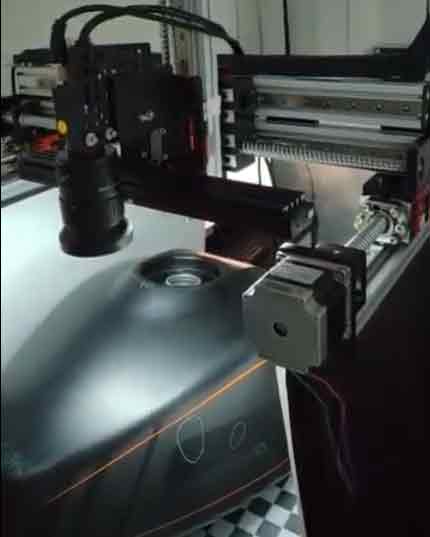
Motorcycle fuel tanks are challenging components to inspect because of their curved, non-planar surfaces, complex geometries, reflective finishes, and multiple design variants.
Small defects such as dents, pinholes, scratches, cut marks, paint defects, and surface irregularities may only become visible when the fuel tank is observed from a particular angle under the correct lighting geometry.
Intelgic’s AI-powered motorcycle fuel tank inspection system combines robotic motion, specialized machine vision cameras, controlled lighting, and advanced AI defect detection to automate this complex inspection process.
A robotic arm moves the camera and lighting system around the fuel tank, capturing high-resolution images from multiple optimized angles. Intelgic’s Machine Vision AI analyzes these images to identify defects and determine whether the fuel tank meets defined quality requirements.
Why Is Motorcycle Fuel Tank Inspection Difficult?
Unlike a flat metal sheet or panel, a motorcycle fuel tank has a continuously changing surface geometry.
Its curved shape means that the relationship between the camera, surface, and illumination changes across different areas of the tank. This becomes particularly challenging when inspecting painted, glossy, metallic, or reflective surfaces.
A shallow dent or fine scratch, for example, might be almost invisible from one direction but become clearly visible when light reflects across the surface from another angle.
Successful fuel tank surface inspection requires more than simply placing a camera above the product.
The inspection system needs to control
Intelgic addresses these challenges using robotic machine vision inspection.
Challenges of Manual Fuel Tank Inspection
Traditional motorcycle fuel tank inspection is often performed manually.
An experienced quality inspector visually examines the tank while changing either the viewing position, the tank orientation, or the lighting angle to expose subtle surface imperfections.
The inspector is essentially searching for the correct reflection that makes a defect visible.
While experienced inspectors can perform this process effectively, maintaining exactly the same inspection procedure across hundreds or thousands of parts is difficult. Manual inspection can be affected by:
Repetitive visual inspection can reduce concentration over long production shifts.
Certain defects are visible only from specific viewing directions.
Changes in ambient or inspection lighting can significantly affect defect visibility.
Different inspectors may interpret borderline defects differently.
Curved areas, transitions, and edges can be difficult to inspect consistently.
Different fuel tank designs may require different inspection positions and criteria.
Automated machine vision provides a repeatable method for controlling these variables.
Intelgic Robotic Machine Vision Fuel Tank Inspection System
Intelgic uses a robot-mounted machine vision system to inspect motorcycle fuel tanks with complex geometries. The robotic arm carries a specialized industrial camera and controlled lighting assembly.
Instead of observing the fuel tank from a single fixed position, the robot follows a programmed inspection trajectory around the component. At each inspection location, the system positions the camera and lighting at the required geometry and automatically triggers image acquisition.
The inspection process
This creates a repeatable inspection process for every fuel tank.
Robotic Imaging for Complex Curved Surfaces
The key advantage of robotic inspection is the ability to control the camera and lighting geometry relative to the fuel tank surface.
Intelgic can define multiple inspection positions around the tank. For example, separate imaging positions may be created for the:
At each position, the robot can maintain the camera orientation and lighting geometry required to expose defects within that inspection region. The camera captures multiple high-resolution images until the required surface areas have been covered.
This allows the system to inspect complex three-dimensional surfaces that would be difficult to cover reliably with a single fixed camera.
AI Defect Detection for Motorcycle Fuel Tanks
After image acquisition, Intelgic’s Machine Vision AI analyzes the captured images for defects. The AI models can be trained using actual production images representing acceptable products and different defect conditions.
Depending on the manufacturing process, inspection requirements, imaging resolution, and available training data, the system can detect and classify defects such as:
Shallow or localized surface deformation that can be difficult to recognize under uniform illumination.
Small surface or coating imperfections that may appear only under optimized imaging conditions.
Fine or larger scratches across painted, coated, or metallic surfaces.
Surface damage caused during manufacturing, material handling, assembly, or transportation.
Visible abnormalities in the painted or coated surface.
Unexpected changes in surface appearance, texture, or geometry.
Particles, contamination, or unwanted material present on the tank surface.
Other visible imperfections that do not meet defined appearance standards.
The exact defect classes and detection thresholds can be configured according to the manufacturer’s quality requirements.
Multi-Angle Imaging and Controlled Lighting
For complex surface inspection, AI performance depends heavily on image quality.
A defect cannot reliably be identified by AI if the imaging system cannot make the defect visually distinguishable.
Intelgic therefore designs the complete imaging environment rather than relying only on the AI model. The system can combine:
Different inspection areas can use different camera settings or lighting conditions.
A lighting geometry that makes fine linear marks stand out across the painted surface.
A different geometry that reveals subtle deformation through changes in surface reflection.
By combining multiple images and lighting conditions, the system creates better visual information for AI-based defect detection.
Recipe-Based Inspection for Multiple Fuel Tank Variants
Motorcycle production lines frequently manufacture multiple models and fuel tank designs.
Intelgic supports recipe-based machine vision inspection so that each fuel tank variant can have its own inspection configuration.
What a recipe can define
Automatic recipe selection
The appropriate recipe can be automatically selected using information from:
This enables one robotic inspection station to support multiple product variants.
Digital Quality Records and Traceability
Automated fuel tank inspection can provide more than a simple pass/fail signal. Intelgic can create a digital inspection record for each inspected component.
Depending on the required integration, the inspection record can include:
Inspection information can be stored locally or integrated with plant-level systems for reporting, analytics, and traceability.
This gives quality teams visibility into recurring defects and production trends that are difficult to obtain from purely manual inspection.
Benefits of AI-Powered Fuel Tank Inspection
Automating motorcycle fuel tank inspection can help manufacturers achieve:
Every fuel tank follows the same programmed inspection sequence.
Robotic positioning helps create the camera and lighting geometry required to expose difficult surface defects.
Inspection becomes less dependent on individual operator experience and concentration.
Recipe-based inspection enables different tank models to be inspected within the same system.
Inspection images, results, and defect information can be recorded for each product.
Automated inspection can be integrated directly into manufacturing and final-quality processes.
From Manual Visual Inspection to Robotic AI Inspection
Inspecting a motorcycle fuel tank is fundamentally different from inspecting a flat component. Its curved geometry means that defect visibility continuously changes depending on the relationship between the surface, camera, and light.
Intelgic solves this challenge by combining robotics with Machine Vision AI.
Together, these technologies enable manufacturers to transform a difficult and subjective visual inspection process into a repeatable, automated, and digitally traceable quality inspection system.
Frequently Asked Questions
Can machine vision inspect curved motorcycle fuel tanks? +
Yes. Complex curved surfaces can be inspected using multiple imaging positions rather than relying on a single fixed camera. Intelgic uses robotic positioning to move the camera and lighting around the fuel tank and capture different surface regions from optimized viewing angles.
What defects can AI detect on a motorcycle fuel tank? +
Depending on the imaging setup, required defect size, surface finish, and training data, Machine Vision AI can be configured to detect defects such as dents, pinholes, scratches, cut marks, paint defects, surface irregularities, contamination, and other cosmetic imperfections.
Why use a robot for fuel tank inspection? +
Many defects on curved surfaces become visible only from particular camera and lighting angles. A robotic arm allows the inspection system to repeatedly position the camera and lighting at predefined locations and orientations around the fuel tank.
Can one inspection system handle different motorcycle fuel tank models? +
Yes. Intelgic can use recipe-based inspection for different tank variants. Each recipe can contain different robot trajectories, imaging positions, lighting settings, AI models, inspection regions, and acceptance criteria.
Can the system detect small dents and scratches? +
The achievable detection capability depends on defect size, surface material, paint characteristics, camera resolution, optics, lighting, working distance, and production conditions. Intelgic designs the imaging configuration around the specific defects and acceptance criteria required by the manufacturer.
How does AI inspect reflective or glossy fuel tanks? +
Controlled illumination and camera positioning are particularly important for reflective surfaces. The system can capture images under carefully selected lighting and viewing geometries so that subtle changes in surface reflection caused by scratches, dents, or other imperfections become visible to the vision system.
Can fuel tank inspection be integrated into an existing production line? +
Yes. The inspection station can be integrated with factory automation systems such as PLCs, conveyors, barcode or QR readers, MES platforms, and production databases. Inspection results can also be used for pass/fail signaling, reporting, traceability, and downstream automation.
Does the system save images of detected defects? +
Yes. The system can retain defect images and associate them with information such as product ID, tank variant, defect type, defect location, inspection time, and pass/fail status to provide digital quality traceability.
Can AI completely replace manual fuel tank inspection? +
The objective is to automate repeatable visual inspection tasks where defects can be reliably represented through machine vision. Final automation capability depends on the manufacturer’s defect specifications, surface characteristics, required resolution, cycle time, and production environment. A feasibility study can be used to validate difficult defects before full production deployment.
Automate Motorcycle Fuel Tank Inspection with Intelgic
Intelgic develops AI-powered machine vision and robotic inspection systems for automotive components and other products with complex surfaces.
For motorcycle fuel tanks, Intelgic combines the following to create a complete automated inspection solution:
If your fuel tank inspection process currently depends on operators manually searching for dents, scratches, pinholes, paint defects, or other difficult-to-see surface imperfections, Intelgic can evaluate your components and develop an automated inspection approach for your production environment.
Contact Intelgic to discuss your motorcycle fuel tank inspection application or schedule a feasibility evaluation.
Schedule a Feasibility Evaluation →