Laser Triangulation Sensors Explained (Complete Industrial Guide)
Published on: Apr 08, 2026

Written by:Content team, Intelgic
Laser triangulation sensors are widely used in modern manufacturing for high-precision dimensional measurement and surface profile inspection. These sensors enable fast, accurate, and non-contact measurement, making them ideal for automated inspection systems in production environments.
Industries such as automotive, electronics, packaging, metal fabrication, and construction materials rely on laser triangulation sensors to ensure components meet strict dimensional specifications.
This guide explains how laser triangulation sensors work, their advantages, industrial applications, and how they are used in automated inspection systems.
What is a Laser Triangulation Sensor?
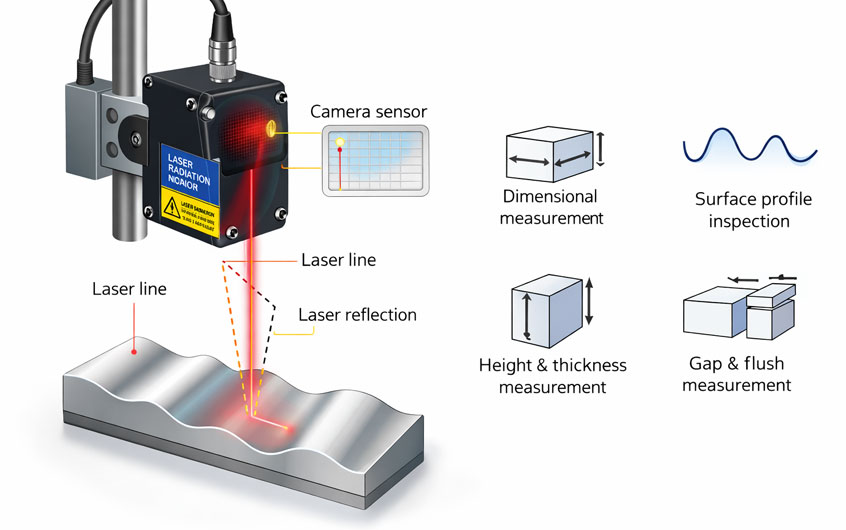
A laser triangulation sensor is a measurement device that determines the shape or distance of an object using a projected laser beam and a camera sensor.
The sensor projects a laser point or laser line onto an object, and a camera observes how the laser reflection changes based on the object's surface shape. By analyzing the geometry of the reflected laser beam, the sensor calculates the exact position and profile of the object.
- Dimensional measurement
- Surface profile inspection
- Height and thickness measurement
- Gap and flush measurement
The Principle of Laser Triangulation
Laser triangulation is based on a geometric principle involving three key components: Laser source, Camera sensor, and Measured object.
Step-by-Step Process
Step 1 — Laser Projection
The sensor projects a thin laser beam or laser line onto the surface of the object.
Step 2 — Reflection Capture
A camera inside the sensor observes the reflected laser light.
Step 3 — Position Calculation
If the object moves closer or farther from the sensor, the position of the reflected laser changes on the camera sensor.
Step 4 — Profile Extraction
Using triangulation geometry, the system calculates the exact height or profile of the object surface.
This process allows the sensor to generate precise 2D profiles or full 3D surface measurements.
Types of Laser Triangulation Sensors
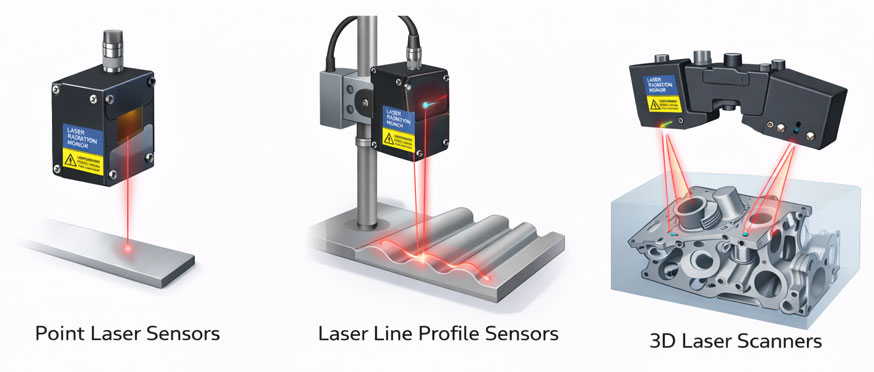
Point Laser Sensors
Measure a single point distance from the sensor to the object.
Laser Line Profile Sensors
Project a laser line across the object to capture a cross-sectional profile.
3D Laser Scanners
Combine multiple profiles captured during motion to generate complete 3D models of objects.
Key Measurement Capabilities
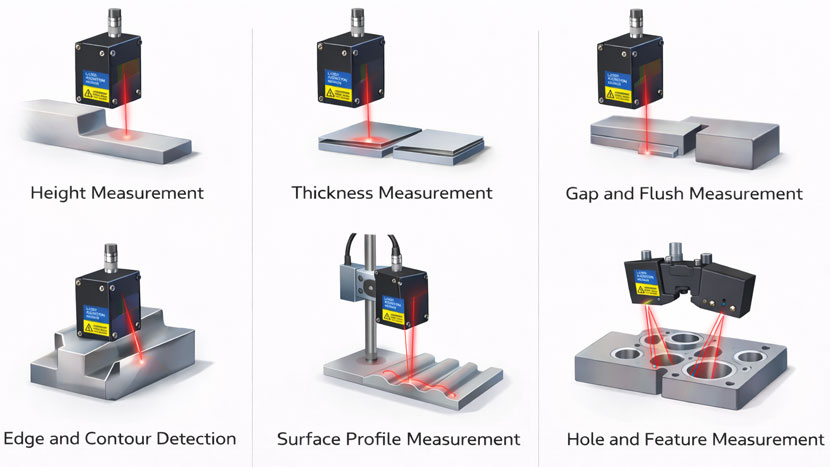
Height Measurement
Measure surface height with high accuracy.
Thickness Measurement
Measure thickness of materials such as sheets or films.
Gap and Flush Measurement
Measure alignment between surfaces.
Edge and Contour Detection
Detect edges and shapes of objects.
Surface Profile Measurement
Capture detailed surface geometry.
Hole and Feature Measurement
Measure hole diameter, position, and geometry.
Advantages of Laser Triangulation Sensors
Non-Contact Measurement
Objects can be measured without touching them, preventing damage to delicate parts.
High Accuracy
Laser triangulation sensors can achieve micron-level precision.
High-Speed Measurement
Sensors can capture thousands of measurements per second.
Real-Time Inspection
Measurements can be performed directly on production lines.
Easy Integration: Laser sensors can be integrated with robotic systems, conveyors, and industrial automation platforms.
Industrial Applications
Automotive Manufacturing
- Measurement of stamped parts
- Gap and flush inspection
- Gear profile inspection
Metal and Steel Industry
- Sheet thickness measurement
- Weld seam inspection
- Plate flatness measurement
Electronics Manufacturing
- PCB component height measurement
- Connector alignment verification
Packaging Industry
- Bottle height measurement
- Cap position inspection
Construction Materials
Laser Triangulation vs Other Measurement Technologies
| Technology | Advantages | Limitations |
|---|---|---|
| Laser Triangulation | High accuracy, fast, non-contact | Sensitive to reflective surfaces |
| CMM Machines | Extremely accurate | Slow and not suitable for production lines |
| Vision Cameras | Good for surface inspection | Limited dimensional measurement |
| Ultrasonic Sensors | Good for distance measurement | Lower accuracy |
Laser triangulation sensors provide the best balance between speed, accuracy, and automation compatibility.
Integration with Machine Vision and AI
Modern inspection systems combine laser triangulation sensors with machine vision cameras and AI software. Companies like Intelgic develop integrated inspection systems combining laser sensors, cameras, AI, and industrial automation.
Laser Sensors
Measure dimensional features
Vision Cameras
Detect surface defects
AI Algorithms
Analyze data for anomaly detection
Future Trends in Laser Triangulation Technology
Advances in sensing and computing technologies are expanding the capabilities of laser triangulation systems.
These innovations will enable fully automated dimensional inspection in smart factories.
Laser triangulation sensors are powerful tools for high-precision dimensional measurement and surface profile inspection in manufacturing.
By providing fast, accurate, and non-contact measurement, these sensors allow manufacturers to perform automated inspection directly on production lines.
As industrial automation and smart manufacturing continue to evolve, laser triangulation sensors will play an increasingly important role in advanced quality inspection systems.