Industrial Automation Using AI and Vision Systems
Published on: Mar 25, 2026

Written by:Content team, Intelgic
Industrial automation is transforming manufacturing across the world. As factories strive to increase productivity, improve quality, and reduce operational costs, technologies such as Artificial Intelligence (AI) and machine vision systems are becoming essential components of modern manufacturing environments.
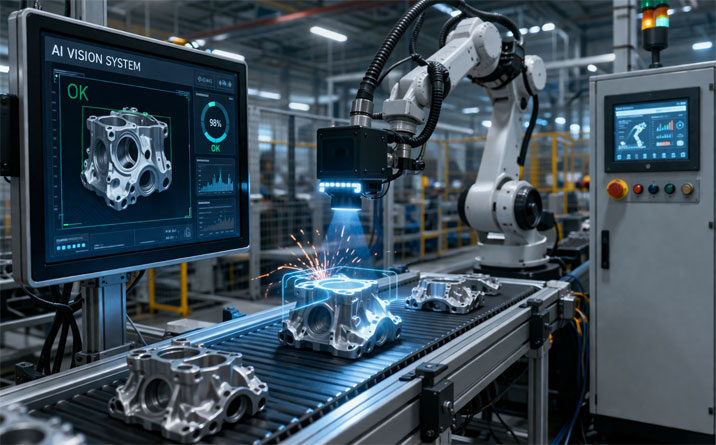
AI-powered vision systems enable machines to see, analyze, and make decisions in real time, allowing factories to automate tasks that previously required human judgment. These technologies are helping manufacturers build smart factories capable of autonomous inspection, monitoring, and process control.
Companies like Intelgic develop advanced automation solutions combining machine vision, AI algorithms, robotics, and industrial control systems to solve complex manufacturing challenges.
What is Industrial Automation?What is Industrial Automation?
Industrial automation refers to the use of control systems, robotics, sensors, and software to operate manufacturing processes with minimal human intervention.
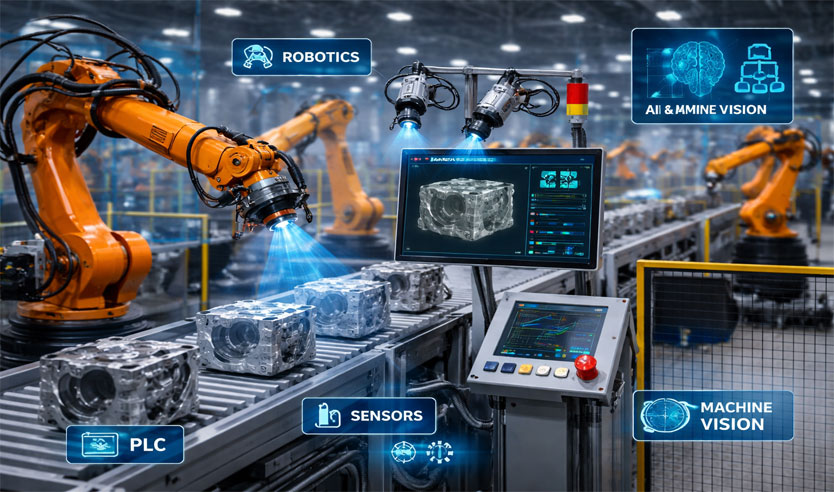
Automation technologies include:
Robotics and automated machinery
Programmable logic controllers (PLCs)
Industrial sensors and actuators
Machine vision systems
Artificial intelligence and analytics
The goal of automation is to increase efficiency, improve product quality, and reduce human error.
Role of Machine Vision in Industrial Automation
Machine vision systems act as the “eyes” of automated manufacturing systems. These systems use industrial cameras and image processing software to analyze products and make decisions.
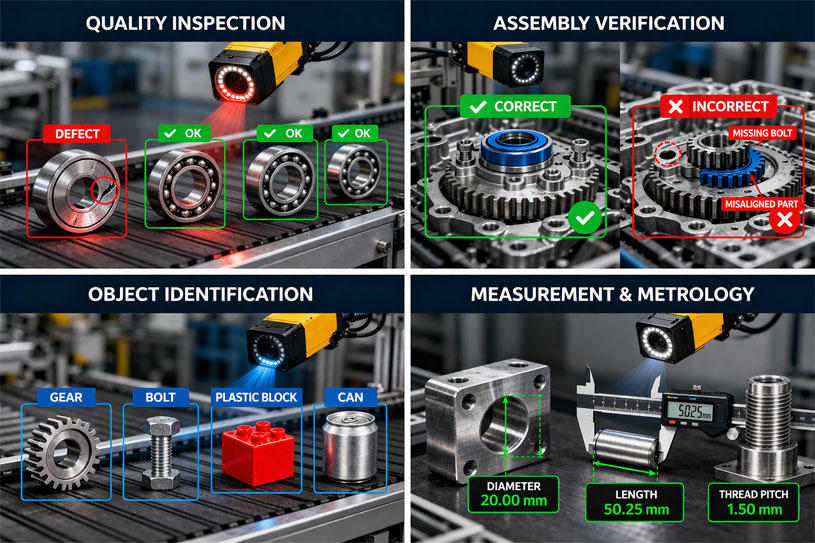
Machine vision can perform several automated tasks:
Quality Inspection
Vision systems inspect products for defects such as scratches, cracks, contamination, or missing components.
Assembly Verification
Ensure that components are assembled correctly before the product moves to the next stage.
Object Identification
Identify parts and components using pattern recognition and AI algorithms.
Measurement and Metrology
Perform accurate dimensional measurements without physical contact.
AI-Powered Vision Systems
Traditional machine vision systems relied on rule-based algorithms, which were limited in their ability to detect complex defects. Modern systems use deep learning and AI algorithms, which allow computers to learn patterns from large datasets.
AI-powered vision systems can:
- Detect subtle defects
- Identify complex patterns
- Adapt to variations in products
- Improve accuracy over time
These capabilities enable highly reliable automated inspection systems.
Key Components of AI Vision Automation Systems
AI-based automation systems integrate several components to function effectively.
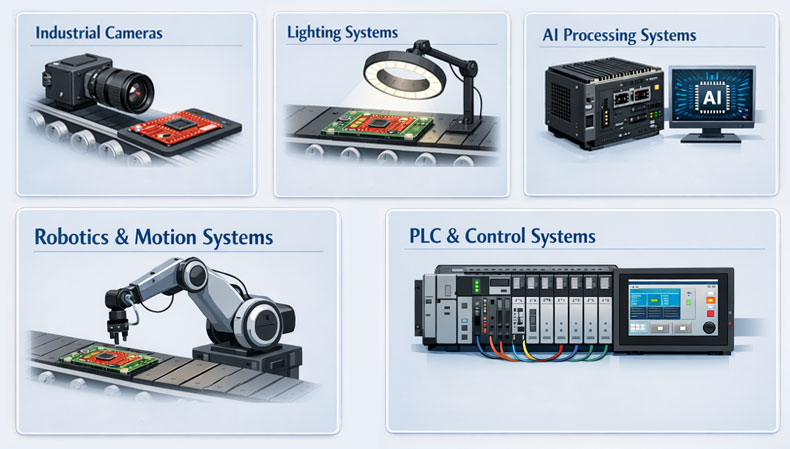
Industrial Cameras
Capture high-resolution images of products during manufacturing.
Lighting Systems
Provide consistent illumination to highlight defects and features.
AI Processing Systems
Industrial computers or GPU systems process images and run AI models.
Robotics and Motion Systems
Robots or automated mechanisms move products for inspection or assembly.
PLC and Control Systems
Coordinate the automation workflow and integrate with factory equipment.
Applications of AI and Vision Systems in Manufacturing
AI-powered automation systems are used across many industries.
Automotive Manufacturing
Inspect engine components, tires, and body panels.
Electronics Manufacturing
Verify PCB assembly and detect micro defects.
Textile Industry
Inspect fabrics for defects and monitor printing quality.
Packaging Industry
Verify labels, barcodes, and product packaging.
Metal and Steel Industry
Detect surface defects and measure dimensions.
Glass and Ceramic Manufacturing
Identify cracks, bubbles, and surface defects.
Benefits of AI-Based Industrial Automation
Increased Productivity
Automated systems can operate continuously without fatigue.
Improved Quality Control
Vision systems ensure consistent inspection accuracy.
Reduced Labor Costs
Automation reduces reliance on manual inspection.
Faster Decision-Making
AI systems analyze images and make decisions instantly.
Data-Driven Manufacturing
Inspection data provides insights into production processes.
Industrial Automation and Smart Factories
AI and machine vision are essential technologies in Industry 4.0, which focuses on building connected and intelligent factories.
In a smart factory:
Machines communicate with each other
Production data is analyzed in real time
AI systems monitor product quality
Automation systems optimize manufacturing processes
This results in higher efficiency, improved quality, and reduced operational costs.
Intelgic’s AI Automation Solutions
Intelgic develops custom industrial automation solutions powered by AI and machine vision systems.
These systems integrate:
Industrial cameras and optics
Specialized lighting systems
AI-based inspection software
Robotic automation
GPU-based processing systems
Intelgic solutions can automate complex tasks such as:
These technologies help manufacturers achieve higher production efficiency and better product quality.
The Future of AI and Vision-Based Automation
Industrial automation continues to evolve with advancements in:
Deep learning algorithms
Edge AI processing
3D vision systems
Collaborative robotics
Predictive manufacturing analytics
Future factories will increasingly rely on AI-powered vision systems to enable autonomous manufacturing processes.
AI and machine vision systems are revolutionizing industrial automation by enabling machines to inspect, analyze, and make decisions in real time.
By integrating cameras, AI algorithms, robotics, and control systems, manufacturers can automate complex processes, improve product quality, and increase production efficiency.
As industries move toward smart factories and Industry 4.0, AI-powered automation systems will play a central role in the future of manufacturing.