Home Appliances Quality Inspection Automation Using AI, Cameras, and Robots
Published on: Apr 21, 2026

Written by:Content team, Intelgic
Home appliance manufacturing demands high quality, high throughput, and consistent performance. Products such as washing machines, refrigerators, air conditioners, microwaves, dishwashers, mixer grinders, induction cooktops, and other consumer appliances contain multiple parts, complex assemblies, cosmetic surfaces, labels, and electrical components that must all meet strict quality standards.
Manual inspection alone is no longer enough for modern appliance production lines. As product variety increases and production speeds rise, manufacturers need automated systems that can inspect every part, every assembly, and every finished product with accuracy and repeatability.
This is where Intelgic's AI-powered quality inspection automation solution creates value.
Intelgic provides complete inspection automation systems using industrial cameras, machine vision, AI software, robots, motion systems, lighting, and controls to inspect home appliances and appliance components with speed and precision. From cosmetic surface inspection to assembly verification and robotic handling, Intelgic delivers the full solution as one integrated system.
Why Quality Inspection Is Critical in Home Appliance Manufacturing
Home appliances are customer-facing products. Even a small defect can affect appearance, function, durability, or brand perception. Manufacturers must therefore inspect for both visual defects and assembly correctness.
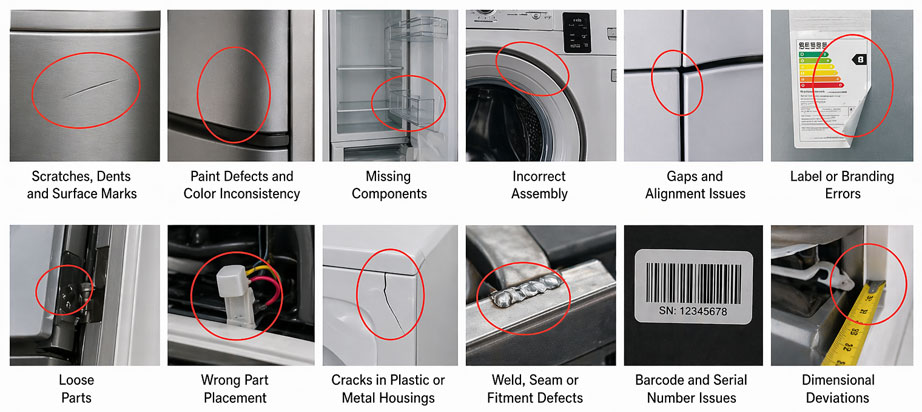
Common Quality Issues in Home Appliances
- Scratches, dents, and surface marks
- Paint defects and color inconsistency
- Missing components
- Incorrect assembly
- Gaps and alignment issues
- Label or branding errors
- Loose parts
- Wrong part placement
- Cracks in plastic or metal housings
- Barcode and serial number issues
- Dimensional deviations
Because many appliances have complex geometry and multiple visible surfaces, inspection often requires more than a single camera view. This is why automated imaging combined with robotic movement is especially powerful in appliance manufacturing.
What Intelgic Provides
Intelgic does not just provide a camera or AI software. Intelgic delivers a complete industrial inspection automation solution that can include:
- High-resolution industrial cameras
- Line scan cameras or area scan cameras
- Specialized lighting systems
- AI-based defect detection software
- Industrial GPU processing systems
- Robotic part handling or camera movement
- Conveyor and mechanical automation
- Fixtures and enclosures
- PLC and HMI integration
- Defect reporting and analytics software
This turnkey approach helps appliance manufacturers implement inspection faster, with a single integrated architecture.
How AI, Cameras, and Robots Work Together
Industrial Cameras Capture High-Quality Images
The inspection process starts with industrial imaging. Depending on the product and line configuration, Intelgic uses:
- Area scan cameras for stationary or indexed inspection
- Line scan cameras for continuous moving products or sheet-like surfaces
- Multi-camera systems for capturing several views at the same time
- 3D sensors or laser profilers for dimensional and profile inspection where needed
The camera system is selected based on part size, speed, defect type, surface finish, and resolution requirement.
Specialized Lighting Reveals Defects Clearly
Lighting is one of the most important parts of machine vision. Home appliances often contain glossy metal, coated surfaces, reflective plastic, textured components, glass panels, and printed labels. Each surface behaves differently under light.
Intelgic designs the lighting setup to highlight the defects that matter, such as:
Proper lighting ensures that the camera sees the defect reliably and the AI receives strong image data for analysis.
AI Software Detects Defects and Quality Deviations
Once the images are captured, Intelgic's AI-based inspection software processes them in real time. The AI can be trained to detect:
The AI learns to identify real defects while tolerating acceptable manufacturing variation, helping reduce false rejections and improving inspection reliability.
Robots Handle Complex Product Geometry
Home appliances and their subassemblies often have multiple sides, corners, curves, and hidden surfaces. A single top-view image is usually not enough.
Intelgic uses robots in two common ways:
Camera Movement
Robot moves the camera around the appliance to capture images from multiple angles
Part Positioning
Robot moves the product into different positions for inspection
This robotic imaging approach is especially useful for:
By combining robotics with AI vision, Intelgic can inspect complex geometry parts much more effectively than fixed manual inspection.
Automated Pass/Fail Decision and Rejection
After inspection, the system generates a pass/fail result. If a defect is detected, the part can be:
This creates a closed-loop automated inspection process that supports high-volume manufacturing.
Typical Home Appliance Inspection Applications
Intelgic's AI inspection automation can be used across many appliance manufacturing applications.
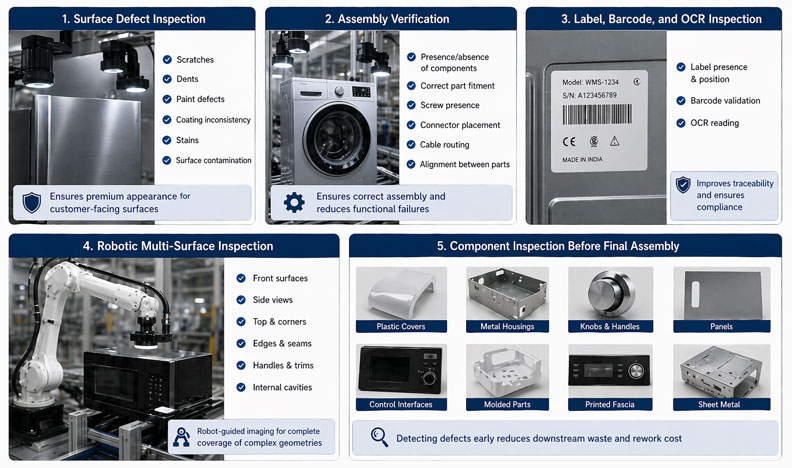
Surface Defect Inspection
Home appliance exteriors must look clean and premium. Intelgic's system can inspect for:
Especially useful for visible customer-facing panels.
Assembly Verification
In appliance assembly lines, Intelgic's vision systems can verify:
- Presence/absence of components
- Correct part fitment
- Screw presence
- Connector placement
- Cable routing
- Alignment between parts
Label, Barcode, and OCR Inspection
Appliances often require labels, serial numbers, compliance markings, and barcode verification. Intelgic can inspect:
Label presence & position
Barcode validation
OCR reading
This improves traceability and compliance.
Robotic Multi-Surface Inspection
For products with complex shapes, Intelgic can use a robot-guided camera system to inspect:
Ideal for both large and compact appliance products.
Component Inspection Before Final Assembly
Intelgic's systems can also inspect parts before final assembly, such as:
Detecting defects early reduces downstream waste and rework cost.
Why Robots Matter in Appliance Inspection
Robots add major value to quality inspection automation, especially in appliance manufacturing.
Better Coverage
Capture images from multiple angles and inspect surfaces that fixed cameras cannot see properly.
Higher Consistency
The robot follows the same path every time, ensuring repeatable imaging quality.
Faster Cycles
Inspect multiple surfaces in a structured sequence without manual repositioning.
Flexible Variants
Recipe-based robotic inspection allows the system to adapt to different models.
Reduced Handling
Minimize human touchpoints, lowering the risk of damage and variability.
Benefits of Home Appliances Quality Inspection Automation
Improved Product Quality
Automated systems detect defects consistently before products reach packaging or shipment.
Reduced Human Error
Unlike manual inspection, AI vision systems do not suffer from fatigue, inconsistency, or subjective judgment.
Higher Throughput
Inspection can keep pace with high-speed production lines without bottlenecks.
Better Traceability
Inspection results, images, serial numbers, and defect records can be stored digitally.
Lower Rework & Scrap
Defects are identified earlier in the process, reducing downstream cost.
Multiple Product Variants
Recipe-based inspection makes it easier to switch between product models.
Stronger Brand Protection
Consistent quality improves customer satisfaction and reduces field complaints and warranty claims.
Challenges in Home Appliance Inspection That AI Solves
Traditional rule-based vision systems can struggle when appliance products show natural variation in texture, color, gloss, or geometry. AI improves inspection by handling more complex patterns and defect types.
AI is especially valuable when:
Intelgic combines AI with industrial imaging and automation so the system works reliably in real production environments.
Complete Turnkey Automation by Intelgic
One of Intelgic's biggest strengths is providing the full integrated solution rather than isolated hardware or software.
Intelgic can design and supply:
Inspection concept
Imaging hardware
Lighting system
Robotic setup
Fixture & mechanical design
Conveyor mechanism
GPU processing
AI software
PLC & HMI integration
Reporting dashboard
On-site deployment and support
This makes implementation simpler for appliance manufacturers and ensures all parts of the system are built to work together.
Future of Home Appliance Manufacturing Inspection
Home appliance manufacturing is moving toward smarter, data-driven production. Quality inspection is no longer just about detecting defects. It is also about collecting insights that improve the process over time.
With AI, cameras, and robots, manufacturers can move from manual checking to intelligent quality control that supports:
This is the future of quality assurance in appliance manufacturing.
Home appliances quality inspection automation using AI, cameras, and robots is becoming essential for manufacturers that want higher quality, better consistency, and faster production. Manual inspection cannot reliably keep up with today’s product complexity and throughput demands.
Intelgic provides complete turnkey inspection automation systems for home appliances, combining machine vision cameras, advanced lighting, AI software, robotic automation, and industrial controls into one integrated solution. Whether the need is cosmetic inspection, assembly verification, label inspection, or multi-surface robotic imaging, Intelgic helps manufacturers build smarter and more reliable quality inspection processes.