Detecting Barcode and QR Code Printing Defects on High-Speed Production Lines
Barcodes and QR codes connect physical products with digital information. They support product identification, inventory management, regulatory compliance, authentication and end-to-end traceability.
However, a code is valuable only when it is correct and reliably readable. Smudging, missing bars, poor contrast, distorted modules or incorrect encoded data can cause scanning failures later in production, distribution or retail. On a high-speed line, these defects may affect thousands of products before an operator notices the problem.
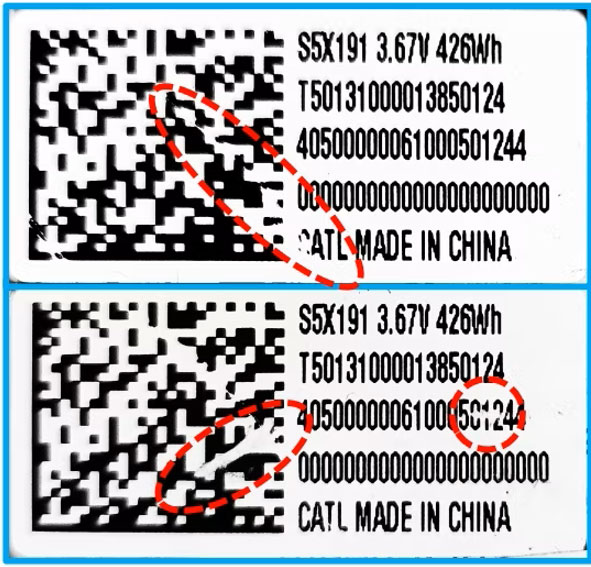
Intelgic’s machine-vision imaging system captures and inspects every barcode, QR code and label while products remain in motion.
Intelgic’s machine-vision imaging system addresses this challenge by capturing and inspecting every barcode, QR code and label while products remain in motion. It identifies printing defects, verifies encoded information and enables defective products to be rejected automatically—without slowing production.
Why Barcode Readability Alone Is Not Enough
A conventional barcode reader answers a basic question: “Can this code be decoded right now?”
A complete vision inspection system goes further. It determines whether:
This distinction is important. A partially damaged QR code may still decode because of error correction, but its remaining quality margin could be too low for dependable scanning throughout the supply chain.
Common Barcode and QR Code Printing Defects
Printing quality can change because of worn printheads, low ink levels, incorrect printer settings, substrate variation, vibration, contamination or web-tension problems. Typical defects include:
Low contrast or faded printing
Insufficient ink, ribbon or laser power can reduce the difference between the code and its background. The code may read under ideal conditions but fail when scanned with another device or under different lighting.
Smudging and print spread
Excess ink, improper drying or movement during printing can make bars wider and QR modules merge together. This changes the intended geometry of the symbol.
Missing bars or modules
Blocked printhead elements, dirt and material damage can leave gaps in linear barcodes or missing cells in QR codes.
Voids and broken printing
Small unprinted areas inside a bar or module reduce uniformity and may interrupt the decoding pattern.
Distortion and non-uniform scaling
Stretching of the label material, incorrect web tension or printing at an angle can distort the code. In QR codes, this may produce uneven module spacing or grid deformation.
Quiet-zone violations
Barcodes and QR codes require a clear area around the symbol. Text, graphics, label edges or other printed elements inside this area can interfere with code detection.
Damaged finder patterns
The three prominent corner patterns of a QR code help a reader locate and orient the symbol. Damage, obstruction or poor printing in these regions can make the entire code difficult to detect.
Incorrect or duplicate data
A visually perfect code can still contain the wrong product number, batch ID, serial number or URL. Duplicate serial numbers can also compromise traceability.
Label-level defects
The code may be correct while the label itself is missing, folded, skewed, upside down, applied to the wrong product or positioned outside the permitted tolerance.
How Intelgic Images a High-Speed Production Line
Capturing a sharp image of a fast-moving label is different from taking an ordinary photograph. If the camera, lens, lighting and exposure are not selected correctly, motion blur can make a good code appear defective—or hide a real printing problem.
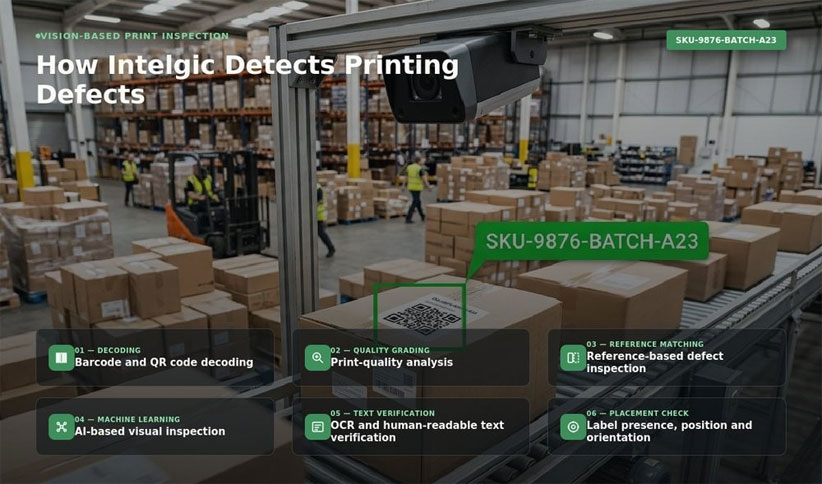
Intelgic engineers the imaging arrangement around the line speed, product size, field of view, smallest code feature and available inspection distance.
1. Product detection and precise triggering
A sensor detects each approaching product and sends a trigger to the vision system. Where product speed or position varies, an encoder can synchronize image capture with conveyor movement.
This ensures that the camera captures the label at the correct location for every product.
2. Short-exposure image capture
An industrial camera uses a short exposure to freeze the moving barcode or label. A global-shutter camera can capture the entire frame at one instant, avoiding the geometric distortion that fast motion may create with unsuitable imaging methods.
The required camera resolution is calculated from the inspection area and the size of the smallest bar, space or QR module that must be evaluated.
3. Synchronized industrial lighting
A precisely timed light pulse provides strong illumination during the short exposure. Depending on the product and label material, the system may use diffuse, directional, polarized or backlighting.
This is particularly important for glossy labels, curved containers, metallic packaging and transparent films, where reflections can hide parts of a code.
4. Optical and geometric control
The lens and camera position are selected to minimize perspective error and keep the complete inspection region in focus. Mechanical mounting, protective enclosures and controlled illumination help maintain stable images despite changes in ambient factory lighting.
5. Multi-camera inspection when required
One camera may be sufficient for a consistently positioned flat label. Cylindrical containers, large cartons or products with labels on multiple sides may require several cameras. Their results are combined into one inspection decision.
How Intelgic Detects Printing Defects
After capturing the image, Intelgic’s vision software locates the label and performs several inspections in parallel.
Barcode and QR code decoding
The system detects and decodes common 1D and 2D symbols, including Code 128, EAN, UPC, Data Matrix and QR codes. The decoded value can be compared with:
This helps detect incorrect, unexpected and duplicate data—not only unreadable codes.
Print-quality analysis
The software examines the structure of the symbol rather than relying only on a successful decode.
For linear barcodes, relevant checks can include contrast, bar and space consistency, edge definition, defects and quiet-zone availability. ISO/IEC 15416 defines an internationally recognized methodology for assessing the print quality of linear barcode symbols. ISO/IEC 15416 overview
For QR codes and other two-dimensional symbols, the system can evaluate characteristics such as:
ISO/IEC 15415 provides the established print-quality methodology for two-dimensional symbols such as QR Code and Data Matrix. GS1 DataMatrix quality guidance
Where formal standards compliance is required, the inspection configuration and validation method must be defined for that application. An inline vision inspection system and a calibrated standards-compliant barcode verifier serve related but not always identical purposes.
Reference-based defect inspection
The captured label can be aligned with an approved reference image. Vision algorithms then detect unexpected differences such as:
Image alignment allows inspection to remain reliable even when the label shifts or rotates slightly within acceptable production tolerances.
AI-based visual inspection
Rule-based vision is effective for well-defined measurements and code structures. AI-based inspection adds value when acceptable labels contain natural variations or when defects have irregular shapes.
Intelgic can combine conventional machine vision with AI to distinguish genuine printing defects from harmless variations in the substrate, artwork or label placement. This helps improve defect detection while reducing unnecessary false rejections.
OCR and human-readable text verification
Information printed next to the code—such as a batch number, manufacturing date, expiry date or serial number—can be read using optical character recognition.
The system can compare this text with the decoded barcode or QR data. For example, it can verify that the serial number printed in human-readable form matches the serial number encoded in the symbol.
Label presence, position and orientation
Intelgic’s inspection system can also confirm that the correct label is present and measure its position and angle. Missing, skewed, folded, rotated or incorrectly applied labels can therefore be rejected even when their codes remain readable.
Real-Time Decisions and Automatic Rejection
Once all inspections are complete, the software produces a pass-or-fail result within the available production cycle.
For a failed product, the system can:
Correct synchronization between inspection and rejection ensures that the defective product—not the product before or after it—is removed.
Traceability and Process Improvement
Every inspection can generate a digital record containing the captured image, timestamp, decoded value, defect category, product recipe and final decision.
These records support audits and investigations, but they also help manufacturers improve the printing process. A gradual increase in low-contrast results, for example, may indicate ribbon depletion, printhead wear or ink-system instability before codes become completely unreadable.
Trend analysis can reveal:
The vision system therefore becomes both a quality gate and a source of actionable production intelligence.
Applications
High-speed barcode, QR code and label inspection is valuable in:
Building a Reliable Inspection Solution
A successful high-speed inspection system is not created by selecting a camera alone. It requires coordinated design of image resolution, optics, lighting, triggering, software, automation interfaces and rejection control.
Intelgic provides an end-to-end approach that can include:
From Occasional Scanning to 100% Inline Inspection
Manual sampling cannot reliably protect a high-speed production line, and a successful decode alone does not prove that a code has been printed correctly.
Intelgic’s machine-vision system captures every product at production speed and evaluates the code, printed label and encoded information as one complete quality check. Manufacturers can detect defects close to their source, prevent incorrect products from leaving the line and maintain dependable traceability without compromising throughput.
Need to inspect barcodes, QR codes or labels on a high-speed line?
Contact Intelgic to evaluate your products, printing process, line speed and traceability requirements.
Frequently Asked Questions
1. What barcode and QR code defects can Intelgic’s vision system detect?
The system can detect unreadable or incorrectly encoded codes, low contrast, faded printing, smudging, missing bars or modules, print growth, damaged QR finder patterns, quiet-zone violations and distorted symbols. It can also identify missing, skewed, folded, rotated or incorrectly positioned labels.
2. Can the system inspect codes without stopping the production line?
Yes. Industrial cameras, synchronized lighting and precise triggering allow images to be captured while products are moving. Inspection takes place within the production cycle, enabling real-time pass-or-fail decisions without interrupting normal line operation.
3. Can Intelgic inspect every product on a high-speed line?
Yes. The system is designed for 100% inline inspection. The final achievable speed depends on factors such as product spacing, code size, conveyor speed, field of view, camera resolution and the number of inspections performed on each product.
4. What types of barcodes can the system read?
Depending on the application, Intelgic’s system can read common 1D and 2D codes, including Code 128, Code 39, EAN, UPC, Data Matrix and QR codes. Additional symbologies can be supported after an application assessment.
5. Can the system detect a wrong barcode even when it is readable?
Yes. The decoded information can be compared with the active product recipe, SKU, batch record, serial-number rule or data received from a PLC, MES, ERP system or database. This allows the system to identify readable but incorrect codes.
6. Can it detect duplicate serial numbers?
Yes. Each decoded serial number can be checked against previously inspected products or a connected production database. Duplicate, missing or incorrectly formatted serial numbers can be flagged according to the configured traceability rules.
7. Can the printed text be compared with the barcode or QR code?
Yes. Intelgic can use OCR to read human-readable information such as batch numbers, dates and serial numbers. The OCR result can then be compared with the information encoded in the barcode or QR code.
8. Can the system inspect glossy, curved or reflective labels?
Yes, subject to feasibility testing. Intelgic selects suitable lenses, camera positions and lighting techniques—including diffuse or polarized illumination—to reduce glare and reveal code features on challenging surfaces. Curved containers may require multiple cameras or a specialized imaging arrangement.
9. What happens when a defective code or label is detected?
The system produces an immediate fail result and can send a signal to the PLC. The affected product can then be removed using an air jet, pusher, diverter or another reject mechanism. The failed image, decoded data, timestamp and defect category can also be stored for traceability.
10. Does an inline inspection system replace a barcode verifier?
Not necessarily. Inline machine vision provides continuous inspection, decoding and process control at production speed. A calibrated verifier evaluates barcode quality under defined conditions according to applicable standards. Where formal verification is required, Intelgic can help define an inspection strategy that distinguishes inline quality monitoring from standards-based verification.
11. Can the system be integrated with an existing production line?
Yes. Intelgic’s inspection solution can be integrated with existing conveyors, printers, labellers, PLCs and rejection mechanisms. It can also exchange information with MES, ERP and production databases when the required interfaces are available.
12. What information is needed to evaluate an application?
An initial assessment normally requires the line speed, product dimensions, code type, smallest code or module size, label material, inspection distance, product spacing, defect examples and integration requirements. Sample products and defective labels help Intelgic conduct feasibility testing and select the appropriate imaging configuration.
Talk to an Intelgic Machine-Vision Expert
A reliable barcode and QR code inspection solution begins with a detailed understanding of the product, printing process and production environment.
Contact Intelgic to discuss your line speed, code dimensions, label material, known printing defects and traceability requirements. Our team can evaluate the application and recommend an imaging, inspection and automation solution designed for your production line.
Request a Demo