What Is First-Time-Right Production (FTR)? How Visual AI Improves Manufacturing Quality
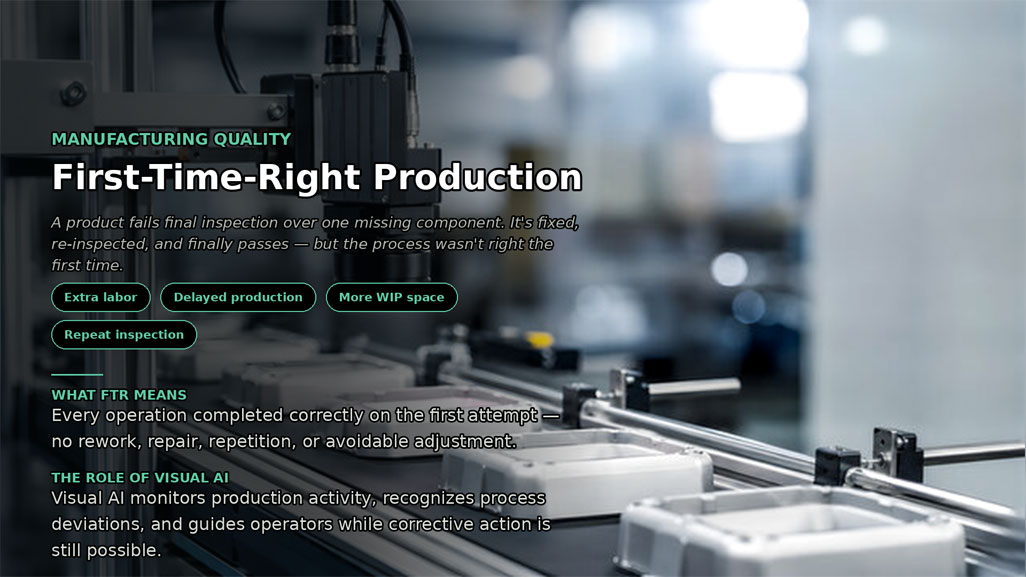
A product reaches final inspection and fails because one component is missing. The component is added, the product is inspected again and it finally passes.
The finished product may now meet the specification, but the process was not performed correctly the first time.
What is First-Time-Right production?
First-Time-Right production measures whether a product or process is completed correctly during its first pass. A unit is normally considered First-Time-Right when it:
- Meets the defined quality requirements;
- Follows the approved manufacturing process;
- Passes the required inspections;
- Does not require rework or repair;
- Does not need to repeat a process step;
- Does not require an unplanned adjustment to become acceptable.
The exact definition should be established by each manufacturer. For example, an approved in-process adjustment may be considered part of the normal process in one factory but counted as a failure in another. The definition must be consistent if FTR is to be a useful performance indicator.
How is First-Time-Right calculated?
A common FTR formula is: FTR rate = (Number of units completed correctly the first time ÷ Total units processed) × 100 For example, a production line processes 1,000 units during a shift:
- 940 units meet all requirements on the first attempt;
- 40 units require rework;
- 15 units are scrapped;
- 5 units require the operation to be repeated.
The FTR rate is: FTR = (940 ÷ 1,000) × 100 = 94% The units that were repaired and eventually accepted do not become First-Time-Right units. FTR measures the original execution, not only the final result.
First-Time-Right versus First-Pass Yield
First-Time-Right and First-Pass Yield are often used interchangeably. In some organizations, they mean the same thing. In others, they are defined differently. A practical distinction is:
- First-Time-Right emphasizes completing the work correctly without error, rework or repetition.
- First-Pass Yield usually measures the percentage of units that pass a particular process or inspection without rework.
- Rolled Throughput Yield estimates the probability that a unit passes every stage of a multi-step process without a defect.
If a production process has several stages, each stage may report a high First-Pass Yield while the probability of a product passing the entire process without an issue is considerably lower. For example, suppose a product passes through five operations, each with a 98% First-Pass Yield: Rolled Throughput Yield = 0.98 × 0.98 × 0.98 × 0.98 × 0.98 The resulting yield is approximately 90.4%. Manufacturers should document which metric they use, how it is calculated and where rework is counted. A consistent definition is more important than the terminology selected.
Why First-Time-Right matters
FTR is more than a quality score. It reflects how reliably the overall production system converts materials, labor, equipment time and process knowledge into conforming products. A low FTR rate can create several hidden costs.
Rework consumes productive capacity
Every repaired unit uses labor and equipment time that could have been used to produce another product.
Defects increase lead time
Products may wait for inspection, diagnosis, repair and reinspection. These delays can affect schedules and customer commitments.
Scrap increases material costs
When a defect cannot be corrected, the materials and production effort invested in the product may be lost.
Quality problems create additional administration
Defects may require deviation reports, non-conformance records, root-cause investigations and corrective actions.
Operators and supervisors lose time
Supervisors may need to investigate issues, answer questions and approve corrections instead of concentrating on production improvement.
Undetected defects create customer risk
The most serious failures are not always the ones detected internally. A process that depends too heavily on final inspection may allow occasional defects to reach customers. Improving FTR means improving quality, cost, delivery performance and production stability at the same time.
What causes poor First-Time-Right performance?
Low FTR is rarely caused by a single factor. Common causes include:
- Incorrect component selection;
- Missing components;
- Steps performed in the wrong sequence;
- Skipped process or inspection steps;
- Incorrect component orientation;
- Improper tool selection;
- Incomplete fastening or assembly;
- Confusing work instructions;
- Frequent product changeovers;
- Similar-looking variants;
- Inconsistent training;
- Workstation-layout problems;
- Machine or tool abnormalities;
- Material-quality variation;
- Operators depending too heavily on memory;
- Process changes that are not reflected in instructions.
It is tempting to classify many of these problems as operator errors. However, recurring operator errors usually indicate that the process allows the error to occur or does not make it visible soon enough. The goal should be to strengthen the process around the operator.
Why traditional quality control may not be enough
Traditional quality control often verifies the finished product or checks the output after a production stage. This is necessary, but it has an important limitation: inspection typically detects the result of an error after the error has already happened. Suppose a component is installed incorrectly during the first operation but discovered only at the fifth operation. By that point:
- More components may have been added;
- Additional labor has been invested;
- The defect may be difficult to access;
- Rework may damage other parts;
- Several other units may contain the same error.
FTR improvement requires quality controls closer to the point where the work is performed. Visual AI provides a way to monitor observable process conditions and guide corrective action during production.
What is Visual AI in manufacturing?
Visual AI combines cameras, computer vision and artificial intelligence to interpret objects, activities and conditions within a manufacturing environment. Unlike a conventional camera used only for recording, a Visual AI system analyzes images or video to identify configured events. Depending on the process and deployment, it may determine:
- Whether the expected component is present;
- Whether a component is missing;
- Whether the correct product variant is being processed;
- Whether a part entered the correct work area;
- Whether the expected action was completed;
- Whether process steps occurred in the correct sequence;
- Whether a visual inspection step was performed;
- Whether the operation is ready to proceed.
Visual AI can therefore support both product inspection and process verification.
Product inspection versus process monitoring
These two Visual AI applications are related but different.
Visual product inspection
The AI examines the product for a visible quality condition, such as:
- Surface defects;
- Missing components;
- Incorrect labels;
- Wrong color or shape;
- Assembly completeness;
- Position or alignment problems.
This helps determine whether the product appears to meet specified criteria.
Visual process monitoring
The AI observes how the operation is performed, including:
- Component selection;
- Step completion;
- Process sequence;
- Tool interaction;
- Movement between defined work zones;
- Inspection activity;
- Abnormal delays.
This helps prevent a defect by identifying the process deviation that could cause it. For FTR improvement, manufacturers often benefit from combining both approaches: verify the process while work is performed and inspect the resulting condition where appropriate.
How Intelgic uses Visual AI to improve FTR
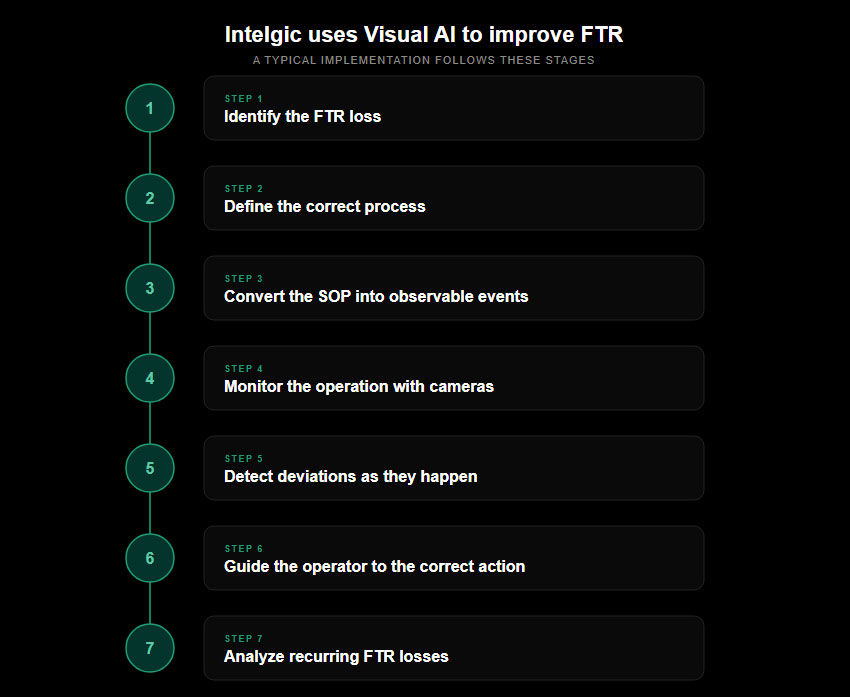
Intelgic provides a camera-based AI system for SOP monitoring and real-time operator guidance. The system observes configured manufacturing activities, compares them with the expected workflow and assists operators during the operation. A typical implementation follows these stages.
1. Identify the FTR loss
The manufacturer begins by selecting a process with measurable first-time quality losses. Examples include:
- Assemblies frequently missing a component;
- Products built using the wrong variant;
- Steps completed in the wrong sequence;
- Inspection activities occasionally skipped;
- Packaging containing the wrong quantity;
- Rework caused by incorrect part placement.
The current FTR rate and defect categories should be measured before deploying AI. Without a reliable baseline, improvement cannot be demonstrated objectively.
2. Define the correct process
The production team documents what must happen for the unit to be completed correctly the first time. This includes:
- Required components;
- Correct sequence;
- Approved tools;
- Critical-to-quality steps;
- Expected visual conditions;
- Permitted variations;
- Conditions requiring a warning;
- Conditions requiring escalation or a process stop.
Process engineers, quality teams, supervisors and experienced operators should participate in this exercise.
3. Convert the SOP into observable events
The SOP is divided into steps that cameras and connected production systems can verify. For example:
- Confirm the product variant;
- Select component A;
- Position component A;
- Add component B;
- Use the specified tool;
- Complete the quality check;
- Release the assembly.
Not every process requirement is visually observable. Torque, pressure, temperature or electrical measurements may require data from tools, sensors, PLCs or manufacturing systems. Visual AI should be part of the production-control architecture, not treated as a replacement for every other control.
4. Monitor the operation with cameras
Cameras are positioned to observe relevant objects and work areas. The field of view may include:
- Component bins;
- Assembly fixtures;
- Work-in-progress;
- Tools;
- Inspection areas;
- Packaging locations;
- Product labels or markings.
Camera position, lighting, visual obstructions and product variations must be evaluated under real production conditions.
5. Detect deviations as they happen
Intelgic’s Visual AI compares observed process events with the configured workflow. Depending on the application, it may identify:
- A required component that is not detected;
- Selection of an unexpected component;
- A skipped step;
- An incorrect sequence;
- Incomplete placement;
- A pending inspection;
- An abnormal dwell time;
- An attempt to advance before completion.
Detecting the deviation immediately gives the operator an opportunity to correct it before the product moves downstream.
6. Guide the operator to the correct action
The system can display contextual instructions based on the current process state. Examples include:
- “Select component B.”
- “Required component not detected.”
- “Complete Step 4 before continuing.”
- “Verify component orientation.”
- “Quality check is pending.”
- “This component does not match the selected variant.”
- “Supervisor assistance required.”
When the step is completed correctly, the system can confirm completion and present the next instruction. This turns the work instruction from a static reference into an active production assistant.
7. Analyze recurring FTR losses
Visual AI events can help manufacturing teams identify patterns behind repeated deviations. Teams may discover that:
- One product variant creates more errors;
- Instructions for a particular step are unclear;
- Similar components are stored too close together;
- Lighting makes parts difficult to distinguish;
- Errors increase during changeovers;
- One operation requires better physical mistake-proofing;
- New operators need additional support at specific steps.
These insights can drive improvements in workstation design, training, material presentation and SOP content.
Example: improving FTR at a manual assembly station
Consider an assembly containing four similar components. One component differs according to the product variant. Historically, some operators select the wrong component. The error is discovered during final inspection, requiring partial disassembly and replacement. With Intelgic’s Visual AI:
- The correct product variant is identified;
- The system loads the corresponding SOP;
- The operator receives the current instruction;
- The camera observes the component-selection area;
- AI checks whether the selected component matches the variant;
- An incorrect selection triggers an immediate alert;
- The correct selection allows the workflow to continue;
- The assembly sequence is monitored;
- Completion and exception events are recorded.
Instead of detecting the resulting defect during final inspection, the system addresses its likely cause at the point of execution. That is the central principle of First-Time-Right production.
How Visual AI supports operators
Visual AI should not be designed merely to identify mistakes. Its larger value is helping operators avoid them.
Contextual guidance
Operators see the instruction relevant to the current product and process step.
Reduced dependence on memory
The system can guide operators through different product variants and sequences.
Immediate feedback
Possible deviations are communicated while corrective action is still practical.
Faster onboarding
New operators can learn through guided production under appropriate supervision.
Consistent knowledge
Validated process instructions can be distributed across shifts and workstations.
Better access to expert practices
Knowledge from experienced operators can be incorporated into digital workflows. The purpose is not to turn people into machines. It is to give people better information at the moment they need it.
Business benefits of improving FTR with Visual AI
Potential benefits include:
- Higher first-pass yield;
- Reduced rework;
- Lower scrap;
- Earlier defect containment;
- Shorter production lead times;
- More consistent SOP execution;
- Faster operator training;
- Fewer avoidable supervisor interventions;
- Better process traceability;
- Improved visibility into recurring deviations;
- More stable production planning;
- Stronger progress toward zero-defect manufacturing.
Actual results depend on the process, baseline performance, system design and quality of deployment. Manufacturers should avoid assuming a fixed percentage improvement before conducting a validated pilot.
FTR metrics manufacturers should monitor
FTR should be evaluated together with supporting measures. Recommended metrics include:
- First-Time-Right rate;
- First-Pass Yield;
- Rolled Throughput Yield;
- Defects per unit;
- Rework rate;
- Scrap rate;
- Cost of poor quality;
- Deviation frequency by process step;
- Alert frequency;
- False-alert rate;
- Percentage of alerts corrected at the workstation;
- Cycle-time variation;
- Training time;
- Time required for new operators to work independently;
- Customer complaints and returns.
It is also useful to segment results by product, variant, line, workstation and shift. A plant-wide average can hide concentrated problems.
How to begin a Visual AI FTR pilot
Start with one process that has:
- A measurable FTR problem;
- Repeatable manual activity;
- Visually observable error conditions;
- A clearly documented SOP;
- Meaningful rework or quality costs;
- A practical camera view;
- Support from operators and process owners.
Before implementation:
- Establish the existing FTR rate;
- Define what qualifies as First-Time-Right;
- Identify the largest defect categories;
- Map the correct process;
- Decide which events Visual AI can verify;
- Define the operator response to each alert;
- Measure detection accuracy and false alerts;
- Compare pilot performance with the baseline;
- Gather operator feedback;
- Expand only after validating operational value.
Responsible use of Visual AI
Camera-based monitoring should be introduced transparently. Manufacturers should explain:
- Which work areas are monitored;
- What the AI is expected to detect;
- Whether video is retained;
- Which process events are recorded;
- Who can access the information;
- How long data is stored;
- How employee information will be used;
- How an operator can report an incorrect alert.
Where possible, the system should focus on the process, work zones and relevant objects rather than identifying individuals. Operators should participate in pilot design and testing. Their practical knowledge improves the workflow and helps ensure that guidance supports production instead of disrupting it.
Building quality into the process
Final inspection will continue to be important in many manufacturing environments. But inspection alone cannot create First-Time-Right production. FTR improves when manufacturers make the correct process easier to perform, detect deviations sooner and give operators the information required to take the correct action. Intelgic brings these capabilities together through Visual AI, camera-based SOP monitoring and real-time operator guidance. The result is a shopfloor where quality is not inspected only at the end. It is supported during every critical production step.
Improve First-Time-Right production with Intelgic
Are missing components, incorrect sequences, skipped steps or product-variant errors reducing your First-Time-Right rate? Intelgic can help evaluate whether Visual AI can monitor the relevant process and guide operators at the point of execution. Talk to an Intelgic expert about a Visual AI pilot for your manufacturing operation.
Frequently asked questions
What does First-Time-Right mean in manufacturing?
First-Time-Right means completing a product or process correctly during the first attempt without rework, repair, repetition or an unplanned correction.
How is the FTR rate calculated?
FTR is commonly calculated by dividing the number of units completed correctly the first time by the total number of units processed and multiplying the result by 100.
What is a good First-Time-Right percentage?
There is no universal target suitable for every process. The appropriate goal depends on product complexity, risk, industry requirements and the current baseline. Manufacturers should pursue continuous improvement while giving critical processes stricter targets.
Are First-Time-Right and First-Pass Yield the same?
Some organizations use the terms interchangeably. Others use FTR for overall correct execution and First-Pass Yield for passing a particular process or inspection without rework. The organization should document its definition.
How does Visual AI improve FTR?
Visual AI can monitor observable components, actions and sequences during production. It can identify configured deviations and guide the operator before the product advances, reducing the likelihood of downstream rework.
Can Visual AI detect missing assembly steps?
Yes, when the step creates an observable event and the system has been configured and validated to recognize it. Non-visual conditions may require data from tools, sensors or manufacturing systems.
Does Visual AI replace final inspection?
Not necessarily. Visual AI can strengthen quality at the source, but final inspection may remain necessary depending on process risk, customer requirements and regulations.
Can Visual AI guarantee zero defects?
No. Visual AI can reduce specific, detectable process errors and support zero-defect objectives, but it cannot guarantee that every possible defect will be eliminated.
How can Intelgic monitor SOP compliance?
Intelgic uses cameras and computer vision to observe configured manufacturing activities. Detected events are compared with the expected SOP so the system can track progress, identify deviations and provide operator guidance.
Which processes are suitable for Visual AI?
Potential applications include manual assembly, component picking, kitting, packaging, inspection, labeling, product changeovers and other repeatable processes involving visible objects or actions.
How should manufacturers start an FTR improvement project?
Define FTR consistently, measure the current baseline, identify the most frequent failure modes and begin with a controlled pilot focused on one measurable process.