Training and printed standard operating procedures (SOPs) are essential, but they cannot eliminate every mistake. Operators may forget a step, misunderstand an instruction, select the wrong component, or continue working after a process condition has changed.
Intelgic addresses this challenge with an AI-driven approach. Intelgic deploys AI agents at each workstation on the shop floor. These AI agents are trained on approved work instructions and use camera-based monitoring to observe operator actions in real time. When a deviation is detected, the system alerts the operator, provides corrective guidance, and helps ensure the correct procedure is followed before the process continues.
Intelgic’s AI agents combine vision, process intelligence, and real-time guidance to help manufacturers ensure operators follow work instructions consistently and accurately.
Intelgic Approach
Here is how Intelgic does this
Create Clear and Standardized Work Instructions
The foundation of operator error prevention is clear, consistent, and well-structured work instructions.
Effective work instructions should:
Instructions should be validated with the operators who perform the work. Their feedback helps identify unclear steps, missing details, or differences between documented procedures and real production conditions.
Replace Static Documents with Digital Work Instructions
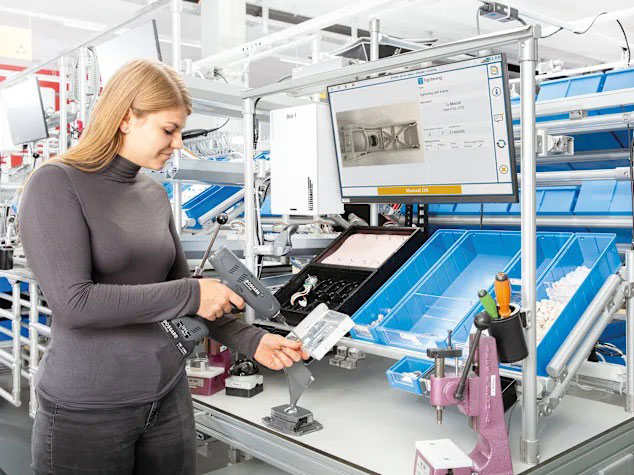
Intelgic’s AI agents are trained on digital work instructions and use them as the authoritative source of truth for each operation. Once trained, the AI can monitor execution and ensure operators do not proceed until each step is completed correctly.
Digital work instruction systems provide:
While digital instructions reduce ambiguity, they still rely on operator confirmation. For critical processes, additional automated verification is required to ensure full compliance.
Monitoring Operator Actions with Intelgic’s AI Agent
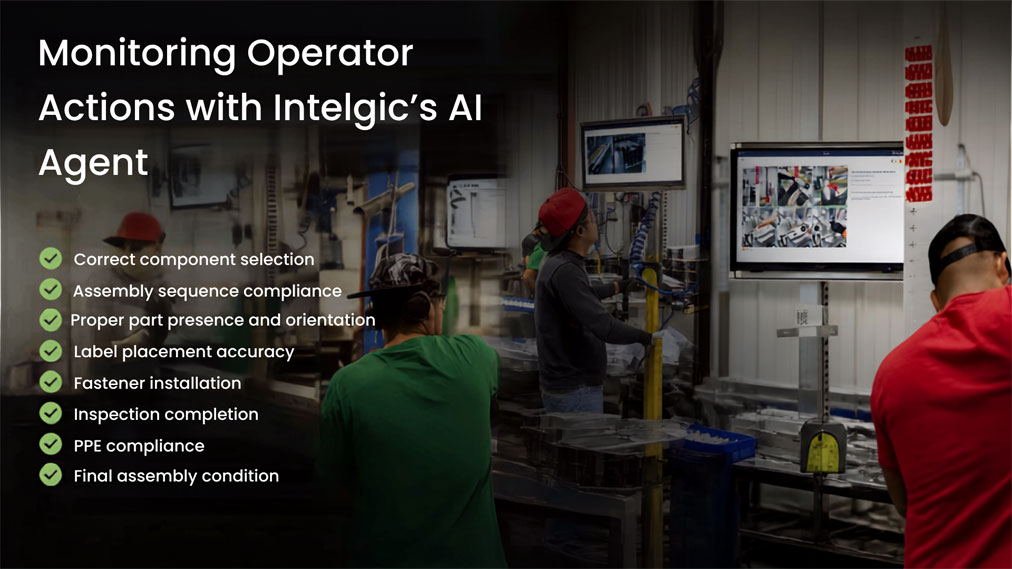
AI vision systems observe workstations through cameras and identify key actions, tools, components, and process conditions in real time.
Depending on the application, the system can verify:
Correct component selection
Proper part presence and orientation
Assembly sequence compliance
Label placement accuracy
Fastener installation
Inspection completion
PPE compliance
Final assembly condition
The AI compares observed actions with approved work instructions. If a mismatch is detected, it immediately alerts the operator so corrections can be made before the product moves forward.
Combine Camera Data with Sensors and Connected Tools
Not all process conditions can be verified visually. That is why Intelgic combines AI vision with sensors and connected tools for complete process validation.
Sensors and equipment can confirm:
For example, a camera may confirm the correct tool is used, while a connected torque system verifies that the required torque value is achieved.
Together, these systems provide stronger assurance than either method alone.
Guide Operators at the Right Time
Operators perform best when guidance is delivered at the exact moment it is needed.
Real-time guidance systems can present instructions through:
Guidance should be short, specific, and actionable. When an error occurs, the system should clearly explain the issue and the corrective action.
Example
“Incorrect component detected. Replace Part B with Part A before continuing.”
This is far more effective than generic warnings like “Process error.”
Add the Controls That Make Compliance Repeatable
Use Process Interlocks for Critical Operations
Some manufacturing steps require hard controls rather than warnings. Process interlocks prevent progression until required conditions are met.
Interlocks may be triggered when:
- A required step is skipped
- The wrong component is scanned
- A test fails
- A measurement is out of range
- A required tool is not used
- A safety condition is not met
- Supervisor approval is required
Interlocks must be carefully designed to avoid unnecessary production stoppages or operator workarounds. Clear rules should define when operators can correct issues and when escalation is required.
Apply Poka-Yoke Principles
Poka-yoke (mistake-proofing) reduces the possibility of human error by design.
Examples include:
Physical mistake-proofing combined with AI-based verification provides a powerful layered defense against errors.
Provide Role-Based Training and Competency Validation
Technology enhances operator performance, but it does not replace training.
Training should include:
- Purpose of each critical step
- Product and process risks
- Proper tool usage
- Quality acceptance criteria
- Common failure modes
- Response to alerts and exceptions
- Escalation procedures
- Safe operating practices
Competency should be validated through real-world performance, not just course completion. AI systems can also identify where operators frequently struggle, enabling targeted coaching and continuous improvement.
Control Work-Instruction Revisions
Operators cannot follow correct procedures if outdated instructions are still in use.
A strong revision control system ensures:
- Only approved instructions are accessible
- Obsolete versions are removed
- Changes are reviewed before release
- Training is updated when procedures change
- Instructions are correctly assigned to products
- Revision history is tracked for audits
Digital systems ensure operators always work with the latest approved version.
Capture Deviations and Improve the Process
Every deviation, alert, or correction provides valuable insight into process performance.
Manufacturers can analyze this data to identify:
The goal is not surveillance, but continuous process improvement and error reduction.
How an AI Agent Supports SOP Compliance
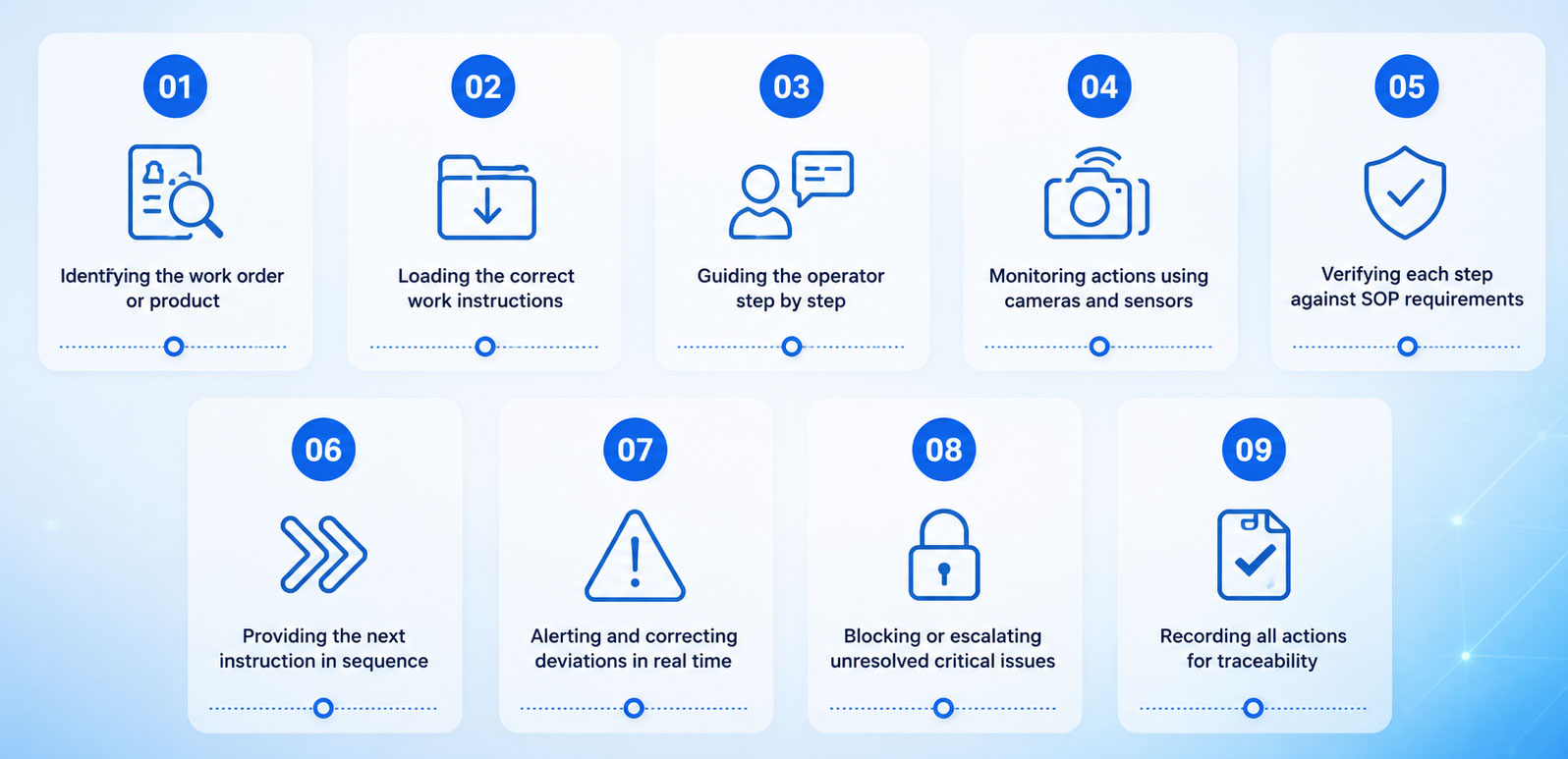
An AI agent integrates monitoring, verification, and guidance into a single closed-loop system.
A typical workflow includes:
This transforms work instructions from static documents into an active quality control system.
How to Measure the Results
Before implementing AI-based operator guidance, manufacturers should establish baseline metrics such as:
A successful system reduces errors while maintaining or improving productivity.
Deploying AI-Based Operator Guidance with Intelgic
Intelgic deploys AI agents that help manufacturers ensure operators follow work instructions through real-time monitoring and guidance.
A typical deployment starts with a high-impact process where errors are frequent, costly, or safety-critical.
Implementation steps include:
Human oversight remains essential. Supervisors and engineers validate system performance and manage exceptions for critical decisions.
Moving Toward Error-Free Manufacturing
No system can eliminate human error through training and documentation alone. The most effective manufacturing environments combine clear instructions, real-time verification, and intelligent process control.
By integrating standardized SOPs, digital work instructions, AI vision, sensors, connected tools, mistake-proofing, and real-time operator guidance, manufacturers can significantly reduce errors and improve consistency.
Intelgic’s AI agents bring intelligence directly to the point of work—helping operators perform the right action, at the right time, every time.
The result is improved quality, reduced defects, stronger traceability, and a measurable step toward zero-defect manufacturing.