Creating Digital Proof of SOP Compliance with AI
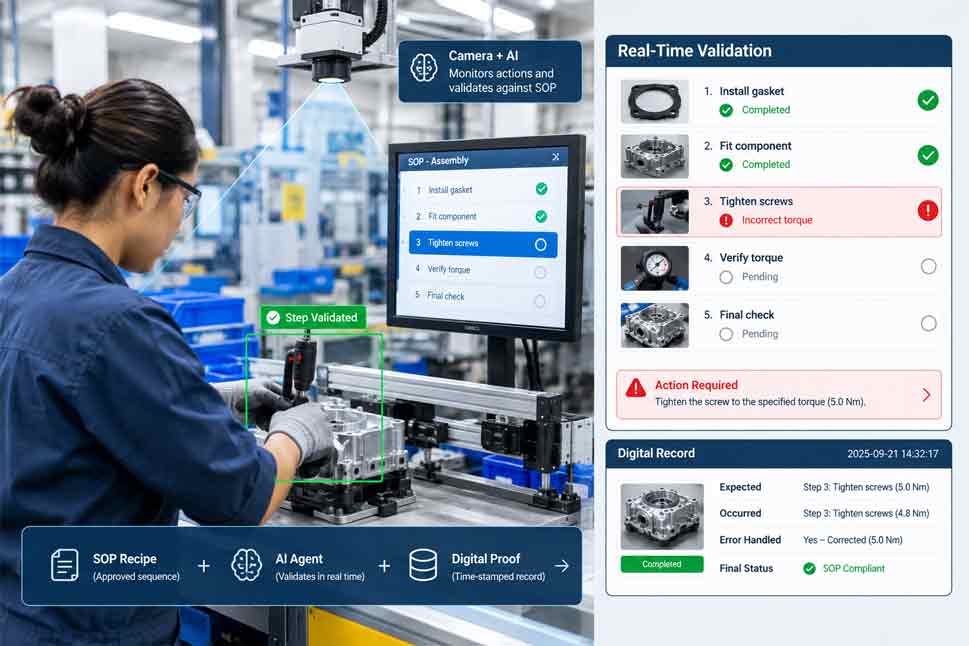
Standard operating procedures define how manufacturing tasks should be performed. However, a written SOP, training record, or operator confirmation does not prove that every required step was completed correctly for a specific product.
Intelgic’s Certainty platform creates digital proof of SOP compliance by monitoring industrial operations with cameras, AI, and connected process data. State-of-the-art AI models are trained using representative shop-floor data to create process intelligence for each operation.
During process execution, a Certainty AI agent follows and validates the approved sequence. It confirms visible actions, components, tools, product states, and process events against the active SOP recipe. When it detects a missed step, incorrect sequence, or process error, it flags the issue and guides the operator to perform the correct action at the appropriate time.
Certainty can then create a time-stamped digital record showing what was expected, what occurred, how an error was handled, and whether the product completed the approved process.
What Is Digital Proof of SOP Compliance?
Digital proof of SOP compliance is a structured record demonstrating that the required steps and conditions of a manufacturing procedure were verified during its execution.
Depending on the process, the record may include:
The goal is to replace unsupported assumptions with objective, traceable evidence.
Digital proof does not mean that AI independently certifies legal or regulatory compliance. It means that the system records evidence showing whether the defined and validated process requirements were followed.
From a Written SOP to Process Intelligence
An SOP is normally written for human interpretation. It may contain text, diagrams, photographs, tables, safety information, quality limits, and conditional instructions.
Before AI can monitor the SOP, its operational requirements must be converted into structured process intelligence.
Certainty can represent:
For example, the instruction “Install the seal before positioning the cover” can become a process sequence in which Certainty must first confirm the correct seal in the specified location and then detect placement of the cover.
What AI Can Verify
Camera-based AI can verify visible or optically measurable aspects of an SOP.
Depending on the application, Certainty may confirm:
AI can also combine this visual evidence with data from process equipment to verify requirements that a camera cannot measure directly.
Combining Camera Evidence with Process Data
A camera may confirm that a fastening tool visited the correct bolt. The fastening controller provides the actual torque and angle values.
Certainty can associate both results with the same:
The platform can combine camera evidence with data from:
This creates a more complete compliance record than either the camera or equipment data could provide independently.
How Certainty Validates SOP Execution
What the SOP recipe may define
Real-Time Operator Guidance
Digital proof is most valuable when it helps prevent noncompliance rather than merely documenting it afterward.
Certainty can provide real-time instructions such as:
The system can display the current step, required component, assembly location, error condition, and recovery instruction through an operator interface.
Once the correct action is completed, the AI agent validates the result and updates the compliance record.
Detecting Missed and Incorrect Steps
A missed step may be detected when:
An incorrect-sequence condition occurs when a required action is performed at the wrong point in the process.
For example, if an SOP requires surface cleaning before adhesive application, Certainty can identify a deviation when adhesive is applied before the cleaning step has been validated.
Managing Conditional SOPs
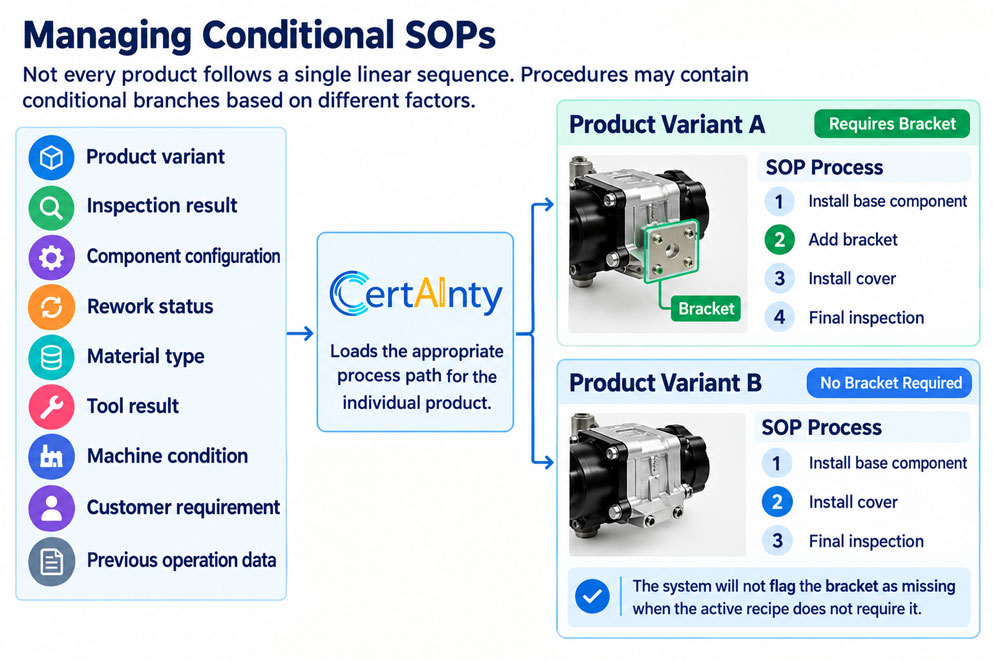
Not every product follows a single linear sequence. Procedures may contain conditional branches based on:
Certainty can load the appropriate process path for the individual product.
For example, one product variant may require an additional bracket, while another does not. The system should not flag the bracket as missing when the active recipe does not require it.
SOP Version Control
A digital compliance record must identify which procedure was active during production.
Certainty can associate each product with:
When a procedure changes, the revised recipe can be reviewed, tested, and released according to the manufacturer’s change-control process.
Older records remain connected to the procedure version used at the time of production.
Evidence Captured for Each Step
Different steps require different types of evidence.
Visual evidence
A camera can capture:
Machine evidence
Connected equipment can provide:
Time evidence
Certainty can record:
Human confirmation
When a condition cannot be automatically verified, the procedure may require an authorized operator, inspector, or supervisor to provide a controlled confirmation.
The record should distinguish an AI-validated result from a human-entered confirmation.
Creating an Evidence Package
Certainty can create a digital evidence package for every product, batch, or manufacturing operation.
The package may contain:
The manufacturer can define which information must be stored for successful cycles, error conditions, rework, or regulated processes.
Handling Deviations and Rework
A useful compliance system must record deviations—not hide them.
When a process error occurs, Certainty can document:
Some mistakes can be corrected within the standard process. Others may require a separate rework procedure, quality review, or product rejection.
Certainty can load the approved recovery workflow and validate each required rework step.
Pass, Fail and Review Results
Not every process event should produce an automatic pass or fail decision.
Certainty can use three result categories:
A review result is important when:
The system should not create false proof of compliance when the required evidence is missing.
Image-Quality Verification
Before an image is accepted as SOP evidence, Certainty can verify whether it is:
An invalid image can be captured again or assigned for review rather than being used as proof of a completed step.
Certainty AI Platform
Certainty manages the complete SOP-monitoring and compliance workflow.
It can coordinate:
The platform connects visual AI with the approved manufacturing process. This allows it to verify not only the final product but also the steps used to produce it.
Integration with Existing Systems
PLC integration
Certainty can exchange:
MES integration
MES connectivity can support:
ERP and quality-system integration
Certainty can also connect with:
Cloud-Based Compliance Analytics
SOP results can be transferred to a secure cloud analytics environment, subject to the manufacturer’s cybersecurity and data-governance policies.
- ✓Operations completed
- ✓SOP compliance rates
- ✓Missed steps
- ✓Incorrect sequences
- ✓Wrong-component selections
- ✓Process deviations
- ✓Error-recovery frequency
- ✓Rework rates
- ✓Step duration
- ✓Cycle time
- ✓Results by product variant
- ✓Results by station or line
- ✓Quality trends over time
- ✕Confusing work instructions
- ✕Frequently missed steps
- ✕Difficult assembly operations
- ✕Inadequate tooling
- ✕Similar-looking components
- ✕Station-design problems
- ✕Training opportunities
- ✕Process bottlenecks
- ✕Recurring equipment failures
Cloud data can be aggregated or de-identified where individual operator information is not required.
Digital Proof for Audits and Investigations
Digital SOP records can support internal audits, customer reviews, quality investigations, and root-cause analysis.
Authorized users can examine:
The record helps reconstruct the manufacturing history of a specific product without relying only on memory or handwritten documentation.
Whether a record satisfies a particular regulatory, legal, or contractual requirement depends on the applicable rules and the manufacturer’s validated quality system.
Protecting Worker Privacy
Digital process monitoring should focus on verifying the operation, not conducting unnecessary surveillance of workers.
A privacy-conscious system may use:
Operators should understand why the system is used, what information is collected, how long it is retained, and who can access it.
Important Limitations
AI can create digital evidence only for conditions that are visible, measurable by connected sensors, or confirmed by an authorized system or person.
Camera-based AI cannot directly prove:
Additional sensors and process equipment should be integrated when the SOP includes requirements that cannot be verified visually.
Digital evidence also proves only that the configured conditions were detected. The SOP logic, inspection method, AI models, equipment interfaces, and acceptance criteria must be correctly defined and validated.
Validating the System
Before the system is used to create compliance records, the manufacturer should validate:
Periodic verification should confirm that cameras, AI models, recipes, equipment interfaces, and reporting functions continue to operate within the validated conditions.
Digital SOP Compliance from Intelgic
Intelgic’s Certainty platform transforms an approved SOP into process intelligence that can be followed and validated during manufacturing.
Industrial cameras and AI recognize visible actions, components, tools, and product states. Connected equipment contributes process measurements and machine results. The Certainty AI agent compares this evidence with the active SOP, guides operators when mistakes occur, validates corrective actions, and creates a traceable digital record.
This allows manufacturers to move from assumed compliance to evidence-based process verification.
Looking to create digital proof of SOP compliance? Contact Intelgic to discuss an AI-powered process-monitoring and operator-guidance system built on the Certainty platform.
Frequently Asked Questions
What is digital proof of SOP compliance? +
It is a time-stamped record showing which procedure was active, which steps were detected, what evidence confirmed each step, whether deviations occurred, and how the process was completed.
Can AI prove that every SOP requirement was followed? +
AI can validate requirements that are visible, measurable through connected equipment, or confirmed by an authorized system or person. Requirements that cannot be observed or measured need another verification method.
How does Certainty detect a missed step? +
Certainty maintains the expected process state and checks for the required visual or equipment evidence before allowing the sequence to advance.
What happens if an operator makes a mistake? +
Certainty can flag the error, present the correct instruction, monitor the recovery action, and record both the original deviation and its resolution.
Can Certainty manage different SOPs for different products? +
Yes. It can store product-specific recipes containing different steps, sequences, components, tools, AI models, process limits, and evidence requirements.
Can camera data be combined with torque-tool results? +
Yes. Certainty can associate the visual evidence, fastener location, torque result, product identity, and process step within one traceability record.
Does digital evidence replace human quality review? +
Not in every situation. Certainty can produce a review-required result when the evidence is incomplete, uncertain, or outside the validated conditions.
Can Certainty track SOP revisions? +
Yes. Inspection records can include the SOP, recipe, and AI-model versions used during each manufacturing operation.
Can the platform integrate with PLC and MES systems? +
Yes. Certainty can exchange product identity, recipes, process states, results, alarms, rework instructions, and traceability data with existing manufacturing systems.
Can digital SOP records be used during audits? +
They can provide objective evidence for internal, customer, and quality audits. Whether they satisfy a specific legal, regulatory, or contractual requirement depends on the applicable rules and the manufacturer’s validated quality system.