Component Presence Detection in Electronics Assembly Lines
Published on: Apr 13, 2026

Written by:Content team, Intelgic
Electronics manufacturing involves assembling hundreds of small components onto printed circuit boards (PCBs) or electronic modules. Ensuring that every component is present and correctly placed is essential for product functionality and reliability.
Even a single missing or misplaced component can cause device failure, leading to product recalls, increased repair costs, and customer dissatisfaction.
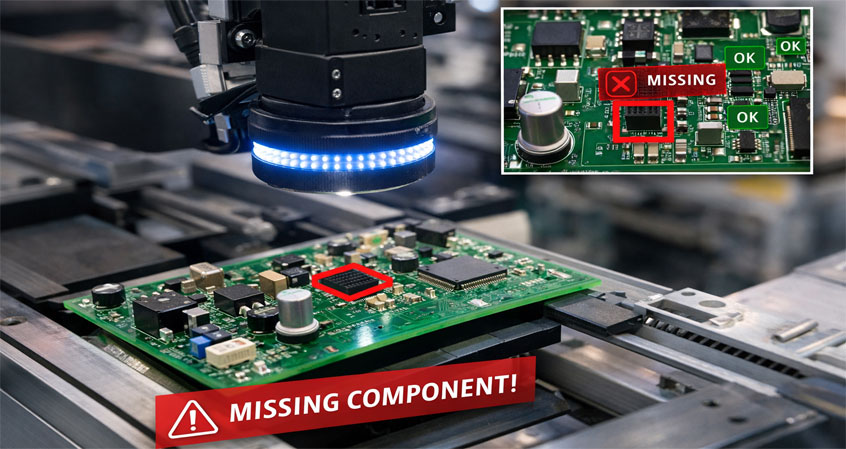
Traditional manual inspection methods are often slow, inconsistent, and unable to keep up with modern high-speed electronics production lines.
To solve this challenge, manufacturers are increasingly adopting machine vision systems powered by AI and industrial cameras to automate component presence detection in electronics assembly lines.
What is Component Presence Detection?
Component presence detection is an automated inspection process used to verify that all required components are present on an electronic assembly and correctly positioned.
Machine vision systems analyze images of assembled boards or modules and compare them with reference models to ensure that:
- All components are present
- Components are placed in the correct position
- Components are properly oriented
- No components are missing or misplaced
This process ensures consistent assembly quality and reliable product performance.
Why Component Presence Inspection Is Critical
Component presence inspection helps detect several types of assembly defects.
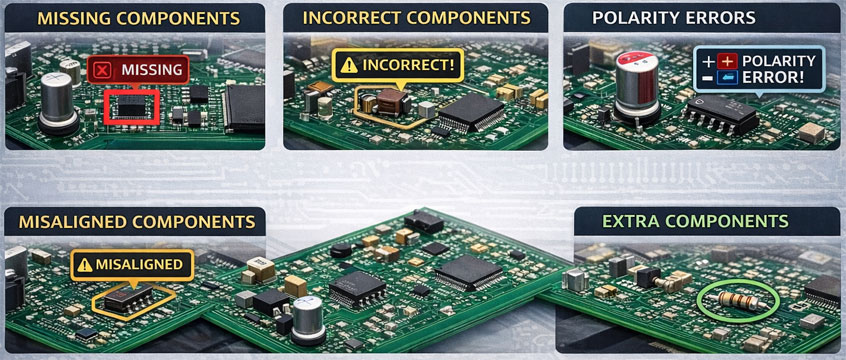
Missing Components
Components not placed during assembly.
Incorrect Components
Wrong component type placed on the PCB.
Misaligned Components
Components placed slightly off their intended position.
Polarity Errors
Components placed with incorrect orientation.
Extra Components
Unintended components placed on the board.
These defects can cause electrical malfunction, device failure, or performance issues.
How Machine Vision Detects Component Presence
Machine vision systems detect component presence using cameras and image processing software.
Step 1 — Image Capture
High-resolution industrial cameras capture images of the assembled PCB or module.
Step 2 — Lighting Optimization
Specialized lighting ensures components are clearly visible.
Step 3 — Image Processing
Software identifies component regions on the board.
Step 4 — Pattern Recognition
The system compares the captured image with reference data of the correct assembly.
Step 5 — Defect Detection
The system identifies missing or misplaced components.
Step 6 — Pass/Fail Classification
Boards with defects are flagged for rework or rejection.
AI-Based Component Detection
Traditional rule-based inspection systems sometimes struggle with variations in component appearance.
AI-based machine vision systems improve inspection accuracy by using deep learning models trained on large datasets of PCB images.
AI enables the system to:
Recognize different component types
Adapt to variations in lighting and positioning
Detect subtle assembly defects
Reduce false defect detection
This makes AI-based inspection particularly effective for complex and high-density electronic assemblies.
Technologies Used in Component Presence Detection
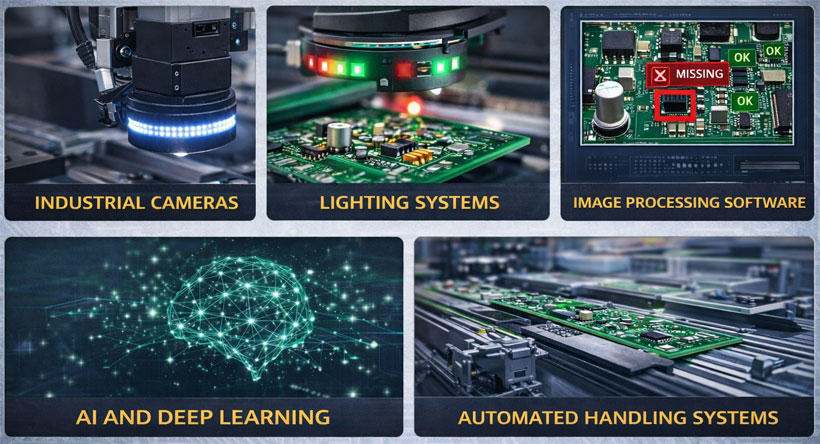
Industrial Cameras
High-resolution cameras capture detailed images of electronic assemblies.
Lighting Systems
Lighting highlights components and solder joints for clear imaging.
Image Processing Software
Algorithms analyze images to detect component presence.
AI and Deep Learning
AI models improve detection accuracy and adaptability.
Automated Handling Systems
Conveyors and robotic systems move boards through inspection stations.
Benefits of Automated Component Presence Detection
100% Inspection Coverage
Every assembly can be inspected automatically.
High-Speed Inspection
Inspection occurs at production line speed.
Reduced Human Error
Automation eliminates subjective manual inspection.
Improved Product Reliability
Defective assemblies are detected before reaching customers.
Data-Driven Quality Monitoring
Inspection data can be used for process improvement.
Applications in Electronics Manufacturing
Component presence detection systems are used in many electronics manufacturing processes.
PCB Assembly
Verify placement of surface-mount and through-hole components.
Automotive Electronics
Inspect electronic control units (ECUs).
Consumer Electronics
Inspect boards used in smartphones, computers, and appliances.
Industrial Electronics
Verify control modules and circuit boards.
Medical Electronics
Inspect electronic assemblies used in medical devices.
Integration with Smart Manufacturing
Machine vision inspection systems can integrate with factory automation systems such as:
This integration enables real-time monitoring and optimization of electronics assembly processes.
Intelgic’s Component Presence Inspection Solutions
Intelgic develops AI-powered machine vision inspection systems designed for complex electronics assembly environments.
Intelgic solutions include:
- High-resolution industrial imaging systems
- Optimized lighting configurations
- AI-based inspection algorithms
- Automated inspection software platforms
These systems help manufacturers ensure accurate component placement and reliable electronic assembly quality.
Future Trends in Electronics Inspection
As electronic devices become smaller and more complex, inspection systems will continue to evolve.
Future advancements include:
AI-driven defect detection
3D inspection of electronic assemblies
edge computing for real-time analysis
integration with fully automated smart factories
These innovations will enable fully autonomous electronics inspection systems.
Component presence detection using machine vision systems is essential for ensuring accurate and reliable electronics assembly.
By combining industrial cameras, specialized lighting, AI-based image analysis, and automated inspection systems, manufacturers can detect missing or misplaced components quickly and accurately.
As electronics manufacturing continues to adopt automation and Industry 4.0 technologies, machine vision inspection will remain a key technology for ensuring product quality and reliability.