How Camera-Based AI Detects Missed Steps and Incorrect Sequences
Many manufacturing and assembly operations must be completed in a defined order. A missed component, skipped fastening step, incorrect tool movement, or operation performed out of sequence can create quality problems that are difficult to detect during final inspection.
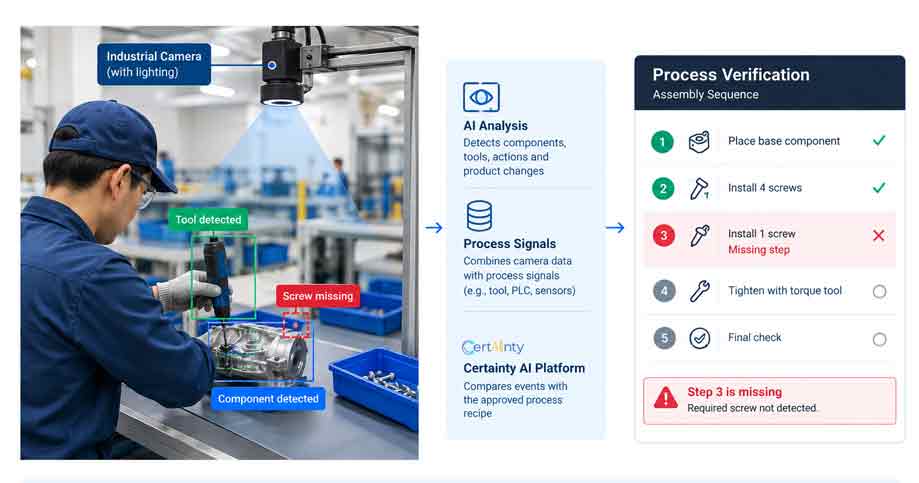
Intelgic uses industrial cameras, state-of-the-art AI, process signals, and the Certainty AI platform to verify manufacturing steps and assembly sequences. Cameras observe the defined work area, while AI identifies relevant components, tools, actions, and changes in the product.
Certainty compares the detected events with the approved process recipe. If a required step is missed, repeated, performed incorrectly, or completed in the wrong order, the system can notify the operator, stop the process, request a review, or send the result to the existing PLC and MES.
What Is Sequence Verification?
Sequence verification confirms that every required manufacturing step has been completed in the correct order.
For example, an assembly process may require an operator or machine to:
Camera-based AI observes the operation and converts the visible process into a series of events. Certainty then compares those events with the approved sequence.
The inspection is not limited to checking the finished product. It can verify how the product reached its final condition.
Why Final Inspection May Not Detect a Missed Step
Some process errors remain hidden after assembly.
A final image may show that a cover is present, but it may not reveal that:
By monitoring the operation as it happens, camera-based AI can verify visible intermediate conditions before they become covered or inaccessible.
Manufacturing Errors That Camera-Based AI Can Detect
A sequence-verification system can be configured to identify:
Actual capability depends on camera visibility, image quality, process design, required cycle time, and the validated inspection criteria.
How Camera-Based AI Understands a Manufacturing Step
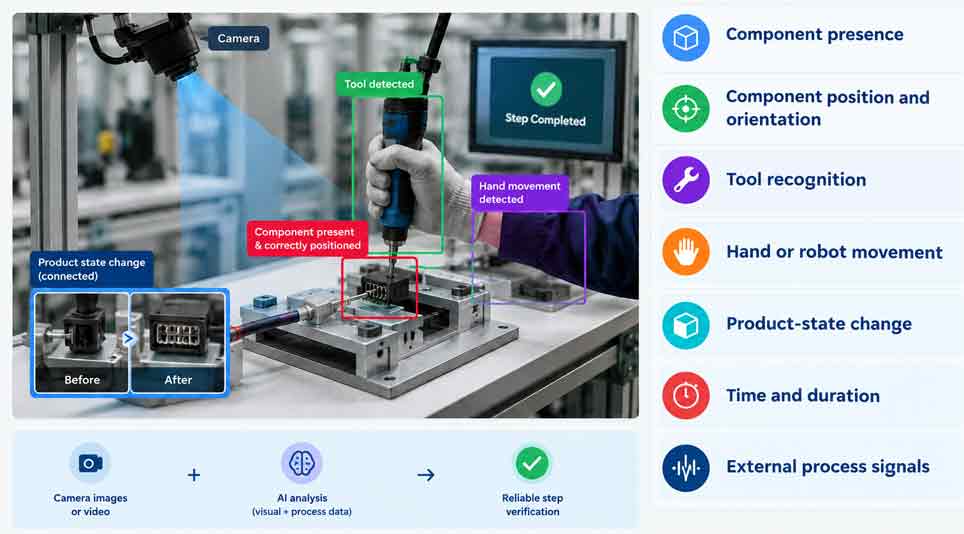
A camera records images or video, but the AI must determine which visual changes represent meaningful production events.
A step may be recognized using one or more types of information:
This combination provides more reliable verification than relying on camera images alone.
Detecting a Missed Step
Certainty maintains the expected process state throughout the operation.
If the recipe requires steps A, B, C, and D, the system expects evidence for each event before the assembly can be completed.
A missed-step condition may be generated when:
Depending on the application, Certainty can provide an operator instruction, activate an alarm, prevent the product from advancing, or mark the assembly for review.
Detecting an Incorrect Sequence
Some operations must be completed in a specific order. Performing every step is not enough if the order is incorrect.
For example, a process may require:
If the component is installed before the adhesive is applied, the system identifies a sequence violation even if both actions eventually occur.
Conditional sequences
Certainty can also manage conditional sequences. Different steps may be required based on:
The active recipe determines which sequence is valid for the specific product.
State-of-the-Art AI for Process Verification
Manufacturing actions can vary between operators, product variants, tools, and cycle conditions. Intelgic’s AI learns the relevant visual patterns from representative production images and video.
Depending on the application, the system may use:
Object detection
Identifies components, tools, hands, robots, fixtures, labels, and product features.
Object tracking
Follows an object across multiple video frames and determines where it moves.
Pose estimation
Estimates the position of an operator, robot, tool, or component when movement and orientation are relevant to the process.
Action recognition
Classifies a defined activity such as picking, placing, inserting, fastening, scanning, cleaning, dispensing, or removing.
Segmentation
Identifies the exact image area occupied by a component, material, or process feature.
Change detection
Compares product images before and after an operation to confirm that the expected visible change occurred.
Anomaly detection
Flags an activity or product state that differs from validated examples of the approved process.
Temporal analysis
Analyzes events across time rather than treating every video frame as an independent image. This allows the AI to distinguish a completed operation from a temporary or incomplete movement.
Combining Camera Evidence with Tool and Machine Data
Visual evidence becomes more useful when combined with production-equipment data.
For example, a camera may confirm that a fastening tool visited the correct bolt, while the tool controller provides the actual torque and angle result. Together, these records show where the tool was used and whether the fastening parameters were achieved.
Certainty can combine camera results with information from:
Camera-based AI should not be used to infer a process value that is more reliably measured by the process equipment itself. For example, an image may verify that a torque tool reached the correct joint, but it cannot directly measure the applied torque.
Correcting Errors Without Losing Traceability
A sequence-verification system should define how an operator can recover from an error.
If the wrong component is selected, Certainty may instruct the operator to return it and select the correct component. If a step is missed, the system may allow the operator to complete it before continuing, provided the approved process permits recovery.
The recovery workflow can record:
Some errors cannot be corrected simply by returning to a previous step. In those cases, the system can route the product for rework, engineering review, or rejection according to the manufacturer’s quality process.
Certainty AI Platform
Intelgic’s Certainty platform is designed and developed for industrial process monitoring and real-time operator guidance. Its state-of-the-art AI models are trained using representative shop-floor data to create process intelligence that defines the correct actions, sequence, timing, and operating conditions for each task.
During process execution, a Certainty AI agent follows and validates every defined step. When it detects a mistake, missed step, or incorrect sequence, it does more than flag the error—it guides the operator to perform the correct action at the appropriate time, helping prevent the error from moving to the next stage of production.
It can coordinate:
Certainty maintains the current state of the operation, allowing it to determine which steps are complete, which step should happen next, and whether the observed action is valid.
Operator-interface integration
Certainty can provide real-time visual instructions through an HMI or workstation display, including:
Cloud-Based Process and Quality Analytics
Sequence-verification results can be transferred to a secure cloud analytics environment, subject to the manufacturer’s cybersecurity and data-governance policies.
Process dashboards
Dashboards may display:
Process-improvement insights
These analytics can help manufacturers identify:
Where cloud storage is restricted, an on-premises or hybrid system can retain video and images locally while sharing approved process statistics.
Digital Process Records
For each product, Certainty can record:
Data-retention rules should be configured according to the manufacturer’s operational, cybersecurity, privacy, and quality requirements.
Privacy and Responsible Deployment
When cameras observe manual workstations, the system should be designed around process verification rather than unnecessary worker surveillance.
A responsible implementation should define:
In many applications, the system can focus on hands, tools, components, fixtures, and defined work zones without using facial recognition.
Important Limitations
Camera-based AI verifies actions and conditions that are visible or supported by connected process data.
It may not be able to confirm:
Additional sensors, process controllers, electrical tests, leak tests, dimensional gauges, or other inspection methods may be required.
The system should generate an invalid or review-required result when the available evidence is insufficient to confirm a step.
Camera-Based Process Verification from Intelgic
Intelgic combines industrial cameras, robots, specialized lighting, state-of-the-art AI, process data, and the Certainty AI platform to detect missed manufacturing steps and incorrect sequences.
Certainty identifies the active product recipe, tracks the current process state, confirms visible actions, combines camera evidence with tool and machine data, and communicates results to existing automation and manufacturing systems.
This enables manufacturers to detect process errors when they happen—before the product advances to the next station or a missed step becomes hidden inside the assembly.
Looking to automate assembly-sequence verification? Contact Intelgic to discuss a camera-based AI system powered by the Certainty platform.
Frequently Asked Questions
How does camera-based AI know that a step was completed? +
The AI identifies defined evidence such as component presence, tool movement, product-state changes, and visible actions. Certainty compares this evidence with the active process recipe and any required machine signals.
Can the system detect a step completed in the wrong order? +
Yes. Certainty maintains the expected process sequence and compares each detected event with the next valid step.
Can it detect missing components? +
Yes. AI can confirm that required components are present in the correct locations before the product advances.
Can camera-based AI confirm that a bolt reached the correct torque? +
No. A camera can confirm that the tool visited the correct fastener and inspect visible conditions. The actual torque result should come from the fastening controller and can be combined with the visual record in Certainty.
What happens if the operator’s hand blocks the camera? +
The system can use multiple cameras, wait for a clear view, compare images before and after the action, use process signals, or return a review-required result when there is insufficient evidence.
Can one station verify different product variants? +
Yes. Certainty can store separate component lists, sequences, camera views, AI models, tool requirements, and acceptance criteria for each product variant.
Can the system guide an operator through the assembly process? +
Yes. Certainty can display the current step, required component, tool, assembly location, detected errors, and approved recovery instructions.
Does the system need to identify individual employees? +
No. Sequence verification can focus on components, hands, tools, fixtures, and defined work zones without using facial recognition.
Can Certainty integrate with existing PLC and MES systems? +
Yes. Certainty can exchange product identity, recipes, process states, completion signals, alarms, results, rework instructions, and traceability information with existing systems.
Are sequence-verification results available through cloud dashboards? +
Yes. Subject to the manufacturer’s data policies, dashboards can display missed steps, sequence errors, cycle times, rework, station trends, and other process-quality metrics.