In modern manufacturing, product traceability and identification are critical for quality control, regulatory compliance, and supply chain management. Most products are labeled with barcodes, QR codes, or serial numbers that contain essential information such as batch numbers, production dates, and product identifiers.
Errors in barcode printing or serial number marking can disrupt logistics, cause product recalls, and lead to compliance issues. Manual verification of codes is inefficient and unreliable, especially in high-speed production environments.
Machine vision systems using industrial cameras and AI-powered decoding algorithms provide a reliable solution for automatically inspecting and verifying barcodes and serial numbers in real time.
Why Barcode and Serial Number Inspection Is Important
Barcode and serial number inspection ensures that products are correctly labeled and traceable throughout the supply chain.
Key reasons for automated inspection include:
Product Traceability
Manufacturers must track products throughout production and distribution.
Regulatory Compliance
Industries such as pharmaceuticals, automotive, and electronics require strict labeling standards.
Quality Control
Incorrect or unreadable codes can lead to rejected products and supply chain disruptions.
Counterfeit Prevention
Unique serial numbers help prevent counterfeit products from entering the market.
Machine vision systems enable manufacturers to verify codes automatically during production.
Types of Codes Used in Manufacturing
Different types of codes are commonly used for product identification.
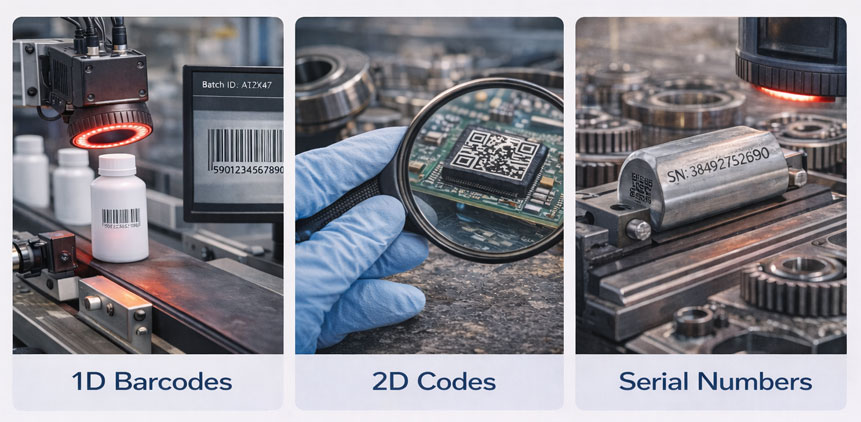
1D Barcodes
Traditional linear barcodes used in packaging and logistics.
2D Codes
Two-dimensional codes capable of storing larger amounts of information.
Serial Numbers
Unique alphanumeric identifiers printed, engraved, or stamped on products.
How Machine Vision Barcode Inspection Works
Machine vision systems automatically inspect barcodes and serial numbers using cameras and software.
Step 1 — Image Capture
Industrial cameras capture high-resolution images of the barcode or serial number.
Step 2 — Lighting Optimization
Specialized lighting ensures the code is clearly visible.
Step 3 — Image Processing
The system isolates the barcode or text region from the captured image.
Step 4 — Code Decoding
Software algorithms decode the barcode or extract characters using OCR.
Step 5 — Verification
The decoded data is compared with expected values stored in the system.
Step 6 — Pass/Fail Decision
Products with unreadable or incorrect codes are rejected.
Common Barcode and Serial Number Defects
Machine vision inspection systems detect various labeling defects.
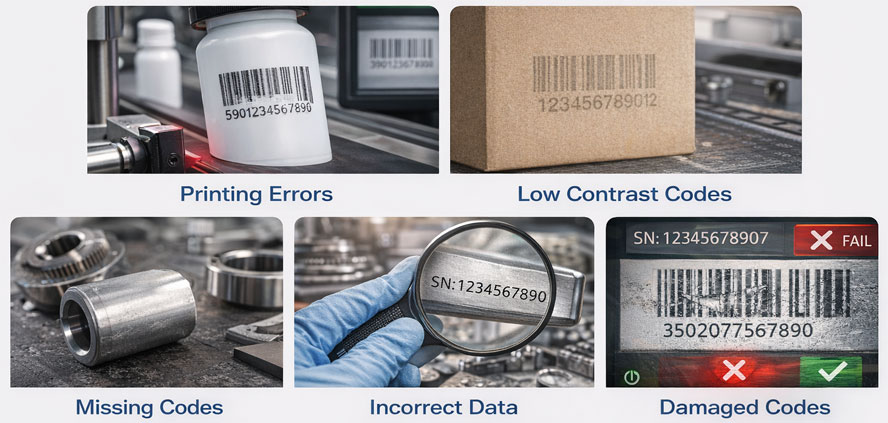
Printing Errors
Blurred or incomplete barcodes.
Low Contrast Codes
Poor contrast between barcode and background.
Missing Codes
Codes not printed or applied correctly.
Incorrect Data
Wrong serial numbers or product codes.
Damaged Codes
Scratched or distorted codes that cannot be read.
Challenges in Code Inspection
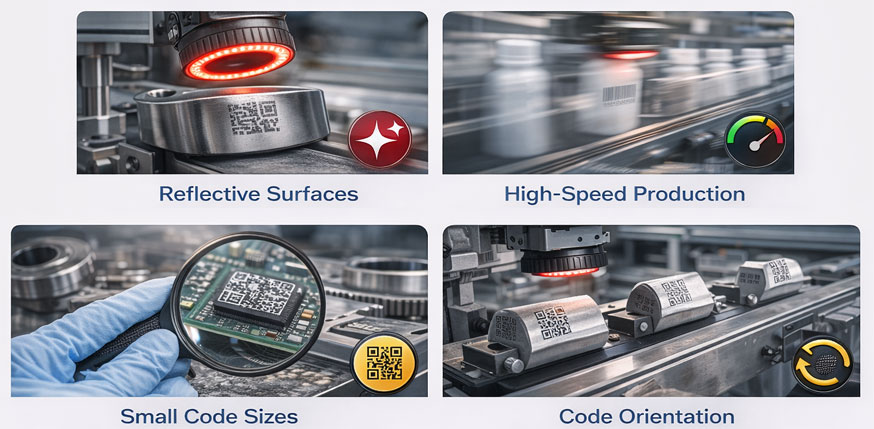
Barcode and serial number inspection can be challenging due to several factors:
-
Reflective Surfaces: Shiny materials such as metal may cause glare.
-
High-Speed Production: Inspection must occur at production line speeds.
-
Small Code Sizes: Micro codes require high-resolution cameras.
-
Code Orientation: Codes may appear rotated or tilted.
AI-based vision systems can handle these challenges by using advanced image processing and deep learning algorithms.
Benefits of Machine Vision Code Inspection
100% Product Verification
Every product can be inspected automatically.
High-Speed Operation
Inspection occurs in real time without slowing production.
Improved Traceability
Digital records of codes can be stored for tracking.
Reduced Human Error
Automated inspection eliminates manual verification errors.
Compliance with Industry Standards
Ensures labeling accuracy in regulated industries.
Industrial Applications
Machine vision barcode inspection systems are widely used in manufacturing.
Automotive Manufacturing
Reading serial numbers stamped on engine components.
Electronics Manufacturing
Reading PCB identification codes.
Pharmaceutical Industry
Verifying drug packaging codes and batch numbers.
Food and Beverage Industry
Reading expiration date codes and packaging labels.
Logistics and Warehousing
Scanning product barcodes for tracking.
Integration with Manufacturing Systems
Machine vision inspection systems can integrate with factory automation systems such as:
This integration enables real-time product tracking and digital traceability across production lines.
Intelgic’s Barcode and Serial Number Inspection Solutions
Intelgic develops AI-powered barcode and serial number inspection systems using industrial cameras and machine vision technology.
Intelgic solutions include:
- High-resolution imaging systems
- Advanced lighting design
- AI-based OCR algorithms
- Automated inspection software
These systems can read codes from:
Intelgic solutions enable manufacturers to achieve accurate product identification and full traceability.
Future of Code Inspection in Smart Manufacturing
Advances in machine vision and AI are enabling more powerful code inspection systems.
Future developments include:
- AI-based decoding for damaged codes
- Multi-code inspection systems
- Cloud-based product traceability
- Integration with digital manufacturing systems
These technologies will support fully automated product identification and tracking systems in smart factories.
Barcode and serial number inspection using machine vision systems enables fast, reliable, and automated product identification in manufacturing.
By combining industrial cameras, advanced lighting systems, AI-based OCR algorithms, and automated inspection software, manufacturers can ensure accurate labeling, maintain product traceability, and prevent costly errors.
As manufacturing continues to adopt automation and Industry 4.0 technologies, machine vision code inspection systems will become essential for modern production environments.