Automated Package Seal Inspection Using Machine Vision and Intelgic IG5 AI
Package sealing is a critical stage in food, pharmaceutical, medical-device, consumer-product, and industrial manufacturing. Sealed packages can vary widely in material, shape, transparency, surface texture, and sealing method. These differences make seal inspection a highly application-specific machine vision task.
Intelgic provides an end-to-end automated seal inspection solution that combines industrial cameras, specialized lenses, engineered lighting, mechanical handling, the IG5 AI model, production-line controls, automated rejection, and digital inspection records.
Machine vision cameras are installed at strategic locations to capture the complete seal area under controlled conditions.
Intelgic’s IG5 AI analyzes the images in real time to detect visible seal defects such as wrinkles, channels, incomplete seals, contamination, trapped product, and seal-width irregularities.
Suspect packages can be flagged, diverted, or automatically rejected. Inspection images and results can also be retained for quality review, process analysis, validation, and traceability.
What Is Automated Seal Inspection?
Automated seal inspection is the process of imaging a package’s sealing region and using machine vision or AI to determine whether its visible characteristics meet defined quality requirements.
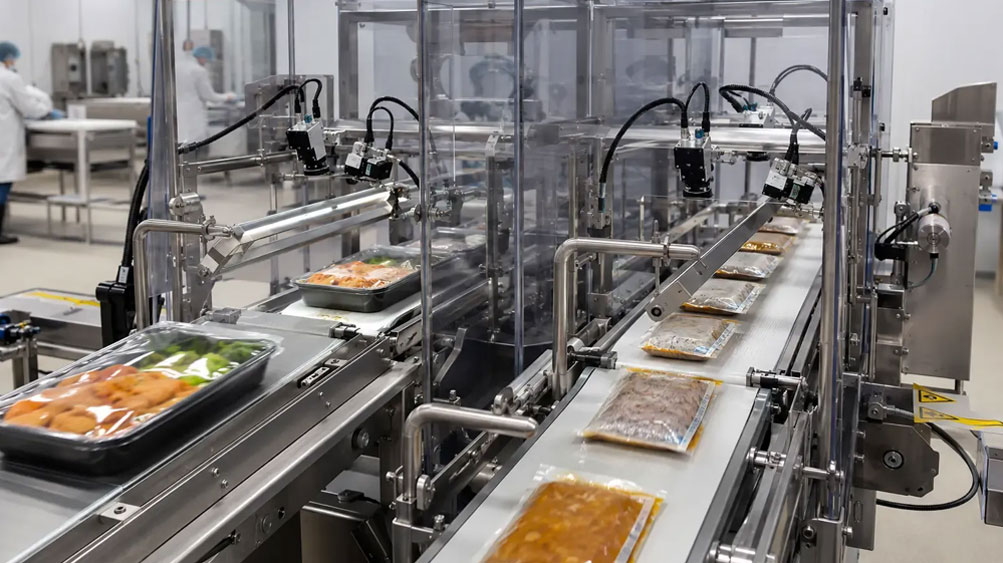
Inspection can be performed in-line at production speed or at a dedicated offline station.
Packages and Seals That Can Be Inspected
Intelgic can develop inspection systems for flexible pouches, sachets, form-fill-seal packages, vacuum packages, thermoformed trays, lidded trays, cups and containers, medical-device pouches, pharmaceutical packages, blister-related sealing areas, foil-sealed containers, paper-plastic packages, plastic-film seals, heat-sealed bags, food packages, industrial component packaging, and sterile barrier packages.
The inspection architecture depends on the seal geometry, package material, seal location, line speed, and defect requirements.
Visible Seal Defects IG5 Can Be Trained to Identify
Intelgic’s IG5 AI can be trained to identify application-specific visible defects in the sealing area.
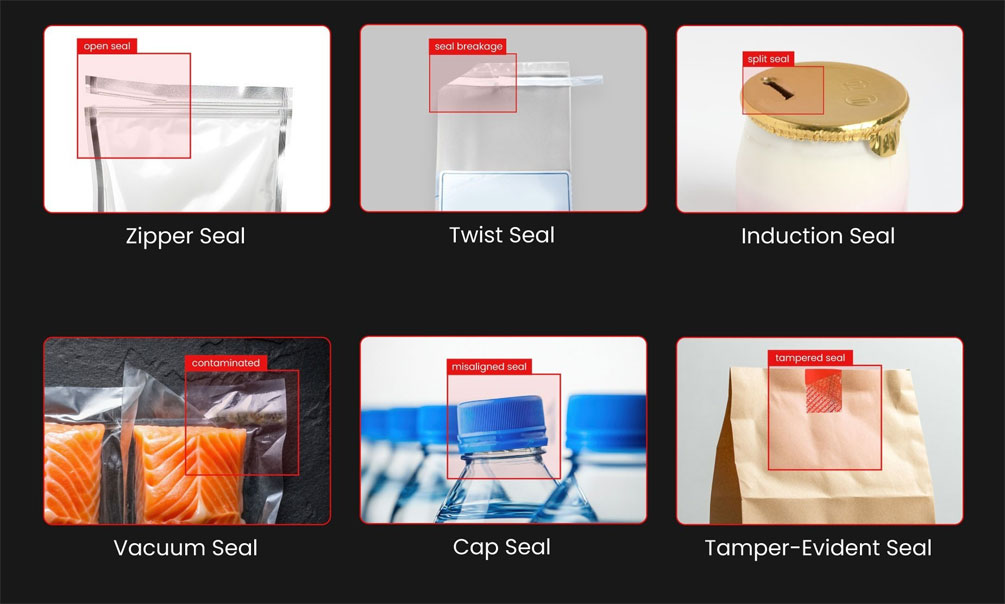
Wrinkles occur when the film or sealing material folds, creases, or does not remain flat during sealing. A wrinkle may remain outside the functional seal, enter the seal area, cross the entire seal width, create an irregular seal boundary, or produce a visible channel.
The inspection system can evaluate the wrinkle’s location, length, orientation, and relationship to the required seal region.
A channel is a visible path or discontinuity extending through or across the seal area. Channels may appear as narrow open paths, lines crossing the seal, unbonded sections, creases extending through the seal, or local interruptions in seal texture. Detection depends on whether the channel creates a visible difference under the selected lighting and image resolution.
An incomplete seal occurs when part of the required sealing path is missing or visibly under-formed. The system can identify missing seal sections, interrupted seal paths, unsealed corners, partial perimeter sealing, seal areas with insufficient visible coverage, unexpected gaps, and localized seal discontinuity. The captured seal can be compared with a product-specific region or reference pattern.
Particles, fibers, packaging fragments, dust, labels, or other foreign material can become trapped between sealing surfaces. IG5 can analyze foreign material according to size, shape, contrast, location, number, relationship to the seal, and configured severity. The lighting system is selected to make relevant contamination visible against the package and seal material.
The AI is trained to distinguish relevant product contamination from acceptable package printing, surface patterns, and normal seal appearance.
The system can inspect minimum visible seal width, maximum seal width, local narrowing, local widening, uneven seal boundaries, changes around corners, seal position relative to the package edge, and missing width in selected zones. Calibrated machine vision can convert image measurements into physical dimensions when quantitative seal-width inspection is required.
The system can compare the seal path with the expected region, seal edge with the package edge, top and bottom seal boundaries, seal position around corners, seal location relative to printed features, and lid position relative to a tray or container. It can also flag visible folds, discoloration, scorching, melting, deformation, unusual texture, tears, punctures, cuts, abrasions, edge damage, delamination, peeling, or local separation. Multiple camera angles may be needed when damage can occur on different faces or edges.
Seal Contamination Versus Package Printing
Printed packaging can contain text, graphics, barcodes, variable data, and color variation near the seal. Intelgic configures the imaging and AI model to distinguish between approved package design, normal print variation, seal texture, product contamination, foreign material, and true seal defects. Product-specific inspection recipes can be used when several package designs share the same production line.
The seal may be shifted, angled, or incorrectly positioned relative to the package. The system can compare the seal path with the expected region, seal edge with the package edge, top and bottom seal boundaries, seal position around corners, seal location relative to printed features, and lid position relative to a tray or container.
Certain sealing processes may create visible discoloration, scorching, melting, deformation, or unusual texture. Where these conditions are visually detectable, IG5 can be trained to flag them.
Post-sealing handling can cause visible damage such as tears, punctures, cuts, abrasions, edge damage, delamination, peeling, and local separation. Multiple camera angles may be needed when the damage can occur on different faces or edges.
Why Seal Inspection Requires Application-Specific Imaging
The AI can analyze only what the imaging system makes visible. Cameras, lenses, lighting, package presentation, and timing must therefore be designed together. The inspection configuration is influenced by package size, seal width, seal shape, transparent, translucent, or opaque material, printed or unprinted film, glossy or matte surface, flexible or rigid packaging, seal color and contrast, minimum defect size, conveyor speed, package orientation, product movement, available installation space, and required inspection coverage. Intelgic studies the existing process before selecting the inspection hardware.
Cameras must be installed where they can image the complete seal without obstruction. Possible camera locations include above the conveyor, below a transparent conveyor section, beside the package, at an angled position, before secondary packaging, immediately after sealing, at a dedicated inspection station, around a rotary machine, above multiple lanes, and near a reject or diversion station. A single top-view camera may be sufficient for a flat pouch with a visible perimeter seal. A formed tray or three-dimensional package may require several cameras to inspect corners, sides, lid, and perimeter.
The selected camera must provide enough image detail to resolve the smallest required defect at the available line speed. Possible technologies include area-scan cameras, line-scan cameras, high-resolution monochrome cameras, color cameras, multiple synchronized cameras, 3D cameras, and specialized cameras for selected wavelengths. The choice depends on field of view, minimum defect size, package speed, exposure time, number of lanes, surface appearance, color-inspection requirements, required image depth, and trigger method.
The lens determines image scale, working distance, depth of field, and geometric accuracy. Intelgic selects lenses according to package dimensions, seal width, camera resolution, camera-to-package distance, installation space, required measurement accuracy, package-height variation, surface curvature, and depth-of-field requirements. Telecentric lenses may be used when precise dimensional measurement is required and package geometry permits their use.
Seal defects often have low contrast and may disappear under ordinary factory lighting. Intelgic develops the illumination around the seal material and target defects.
Package Presentation, Multi-Surface Inspection, and Process Flow
The package must remain sufficiently controlled during image capture. The mechanical system may include conveyor guides, package-spacing mechanisms, belt stabilization, top-hold conveyors, vacuum conveyors, indexing systems, star wheels, rotary handling, fixtures, flattening mechanisms, trigger sensors, and encoders. Flexible packages may move, curl, vibrate, or change shape, so mechanical stabilization helps create repeatable images without damaging the package.
Some packages contain seal regions on several sides or faces. Intelgic can use multiple fixed cameras, angled cameras, bottom-view cameras, side-view cameras, mirrors or optical arrangements, rotating mechanisms, robot-mounted cameras, and sequential inspection stations. Images from all required surfaces are combined into one package-level inspection result.
A sensor, encoder, PLC signal, or machine trigger detects the package. The correct inspection recipe can be selected using PLC, MES, work order, production sequence, barcode or QR code, OCR, visual package recognition, or machine recipe. Cameras and lighting are triggered at the correct position to capture one full-seal image, multiple overlapping images, separate corner images, multiple camera views, lighting sequences, and top, bottom, or side views.
Images are transferred into Intelgic’s inspection platform and associated with package ID, product type, camera, seal region, production lane, timestamp, batch, and inspection recipe. The system can apply controlled preprocessing such as image alignment, region extraction, brightness normalization, lens-distortion correction, background removal, perspective correction, and package-position compensation.
IG5 returns defect type, defect location, defect size, defect confidence, seal region, severity, and a pass/fail recommendation. The inspection platform applies product-specific acceptance rules based on defect category, dimensions, count, location, seal zone, AI confidence, package type, and customer quality criteria.
If the package fails inspection, the system can activate a pneumatic pusher, air jet, diverter gate, drop mechanism, pick-and-place robot, servo-controlled reject, lane diversion, or stop-and-remove station. The mechanism is selected according to package weight, speed, orientation, fragility, and conveyor layout.
Reject verification may include a downstream photoelectric sensor, reject-bin sensor, secondary camera, package tracking, encoder-based position tracking, or reject-count confirmation. If a reject is not confirmed, the system can generate an alarm or stop request. Results can be sent automatically to PLC, MES, ERP, SAP, SCADA, a quality-management system, batch record, production database, or customer-specific software.
More Than an AI Model or Camera
Intelgic provides more than an AI model or camera. An end-to-end seal inspection solution may include process and feasibility study, camera selection, lens selection, lighting design, inspection enclosure, package-handling mechanisms, conveyor integration, trigger sensors, industrial processing hardware, IG5 AI deployment, product recipes, PLC programming and communication, automatic reject mechanism, reject confirmation, operator interface, inspection-data storage, quality dashboards, MES, ERP, and API integration, validation support, and production deployment.
The complete system is engineered around the existing sealing and manufacturing process.
Intelgic IG5 AI for Seal-Defect Detection
IG5 is Intelgic’s state-of-the-art AI model for industrial defect detection. For seal inspection, IG5 can be trained with representative images of acceptable seals, wrinkles, channels, incomplete seals, foreign material, product contamination, seal-width variation, folds, misalignment, surface damage, normal package printing, and approved process variation. The model learns the visual differences between an acceptable seal and a configured defect condition.
Depending on the application, IG5 can support or combine classification, object detection, segmentation, anomaly detection, and measurement analysis.
A controlled model-development process may include capturing representative production images, collecting acceptable and defective packages, defining defect categories and seal zones, labeling relevant regions, training the initial model, validating it with separate package images, reviewing false positives and missed defects, adding challenging examples, fine-tuning, revalidating, deploying, and monitoring production results. The dataset should represent package designs, product variations, print patterns, seal appearances, material lots, lighting conditions, production lanes, normal process variation, and representative acceptable and defective samples.
Product-Specific Inspection Recipes
A single line may package multiple products or package sizes. Each recipe can define camera settings, lighting sequence, seal regions, package alignment, IG5 model, defect categories, seal-width limits, severity rules, reject logic, and data-retention requirements. The correct recipe can be selected automatically from the PLC, MES, or packaging-machine configuration.
Seal-Zone-Based Inspection
The system can divide the package into zones such as primary seal, secondary seal, corner seal, peel-tab area, header area, printed border, package edge, and non-critical outer region. A wrinkle crossing the functional seal can receive a different decision from a wrinkle outside the sealing area.
Package ID: PKG-20260820-1845 · Product: Medical Pouch Variant A · Inspection result: Reject · Defect: Foreign material · Seal zone: Upper-right perimeter · Defect size: 2.4 mm · Confidence: 98.1% · Production lane: Lane 2. The operator interface can display the original image and highlight the defect location.
Inspection Data and Quality Records
Intelgic can create a digital inspection record for each package or production batch. The record may contain package or batch ID, product and variant, production line, lane, timestamp, inspection result, defect category, defect location, defect size, AI confidence, original image, annotated defect image, inspection recipe, AI-model version, reject status, manual-review result, reinspection outcome, and storage policies configured according to production, quality, and validation requirements.
For regulated or quality-critical applications, the inspection system should be introduced through a controlled validation process appropriate to the manufacturer’s quality system. Activities may include defining user requirements, documenting defect categories, establishing acceptance criteria, verifying camera coverage, testing image quality, testing known defect samples, evaluating false accepts and false rejects, challenging the reject mechanism, confirming reject tracking, verifying data integrity, testing user access, recording software and model versions, documenting change control, and establishing periodic verification procedures. The manufacturer remains responsible for determining the applicable regulatory, validation, and quality requirements.
Borderline or low-confidence results can be routed for review instead of being automatically accepted or rejected. Authorized quality personnel can view the original image, examine the highlighted seal region, compare multiple camera views, confirm or correct the defect category, assign pass, fail, or rework, add comments, and record the review decision. Approved reviewed examples can be considered for future IG5 fine-tuning.
Intelgic can convert inspection records into dashboards showing packages inspected, pass and reject counts, defect rate, defects by category, defects by seal region, results by product, batch, lane, and shift, seal-width trends, recurring contamination, reject confirmation, manual-review frequency, AI confidence distribution, model-version performance, and defect-location heat maps.
Process Feedback
Seal-inspection results can help identify changes in the packaging process.
PLC, MES, ERP, SAP, and API Integration
Intelgic’s system can exchange signals with the production PLC, including inspection ready, package detected, recipe loaded, image captured, inspection complete, pass, fail, reject command, reject confirmed, manual review, camera fault, AI-processing fault, and product-tracking fault. A controlled handshake ensures that each inspection result remains associated with the correct package.
Manufacturing-System Update
Inspection data can be transmitted to enterprise and quality systems through APIs or suitable industrial interfaces. The transmitted information may include product ID, batch, package type, inspection result, defect details, production lane, timestamp, reject status, recipe version, IG5 model version, and image reference. This creates a digital connection between physical seal quality and the manufacturing record.
An in-line system is integrated directly with the packaging process. A typical workflow is: package exits the sealing machine, sensor detects the package, cameras capture the seal, IG5 analyzes the images, the system makes a quality decision, PLC receives the result, defective package is removed, reject is confirmed, inspection record is stored, and MES or quality system is updated. The inspection cycle is designed around the line speed and package spacing.
An offline station may be suitable for quality audits, new-package validation, rework inspection, low-volume products, complex multi-angle imaging, laboratory evaluation, and shared inspection across several lines. The same AI, recipe, review, and traceability principles can be applied.
Visual Inspection and Seal-Integrity Testing
Machine vision evaluates visible seal characteristics. It does not automatically prove every aspect of seal strength, hermeticity, sterility, or leak performance.
Depending on the application, visual inspection may be combined with leak testing, pressure-decay testing, vacuum-decay testing, bubble testing, dye penetration, burst testing, peel-strength testing, ultrasonic inspection, thermal seal inspection, or other validated package-integrity methods. The correct combination depends on the package, product, risk, and applicable quality requirements.
Visual AI is particularly valuable for detecting visible conditions that may indicate a sealing problem and for screening every presented package in real time.
Factors That Determine Inspection Performance
Representative acceptable and defective samples should be tested before the final system design is selected.
A Customized Seal-Inspection Solution
No single imaging arrangement can inspect every package and seal. Intelgic develops application-specific systems that may combine area-scan or line-scan cameras, high-resolution lenses, specialized illumination, polarizing optics, multiple camera views, custom inspection booths, package stabilization, conveyor integration, IG5 AI models, calibrated seal-width measurement, PLC controls, reject mechanisms, reject confirmation, quality-review interfaces, inspection-data storage, MES, ERP, SAP, and API integration, and analytics dashboards.
The system is built around the existing process, seal type, production speed, quality requirements, and available factory infrastructure.
Automate Seal Inspection with Intelgic IG5 AI
Intelgic provides an end-to-end solution for automated package seal inspection. Machine vision cameras are positioned strategically to capture the required seal surfaces. Cameras, lenses, lighting, and handling equipment are selected according to the package, seal, production process, and target defects.
Intelgic’s IG5 AI analyzes the images in real time to detect visible wrinkles, channels, incomplete seals, foreign material, trapped product, seal-width irregularities, misalignment, and other configured defects.
Contact Intelgic to discuss automated seal inspection for your packaging line.